
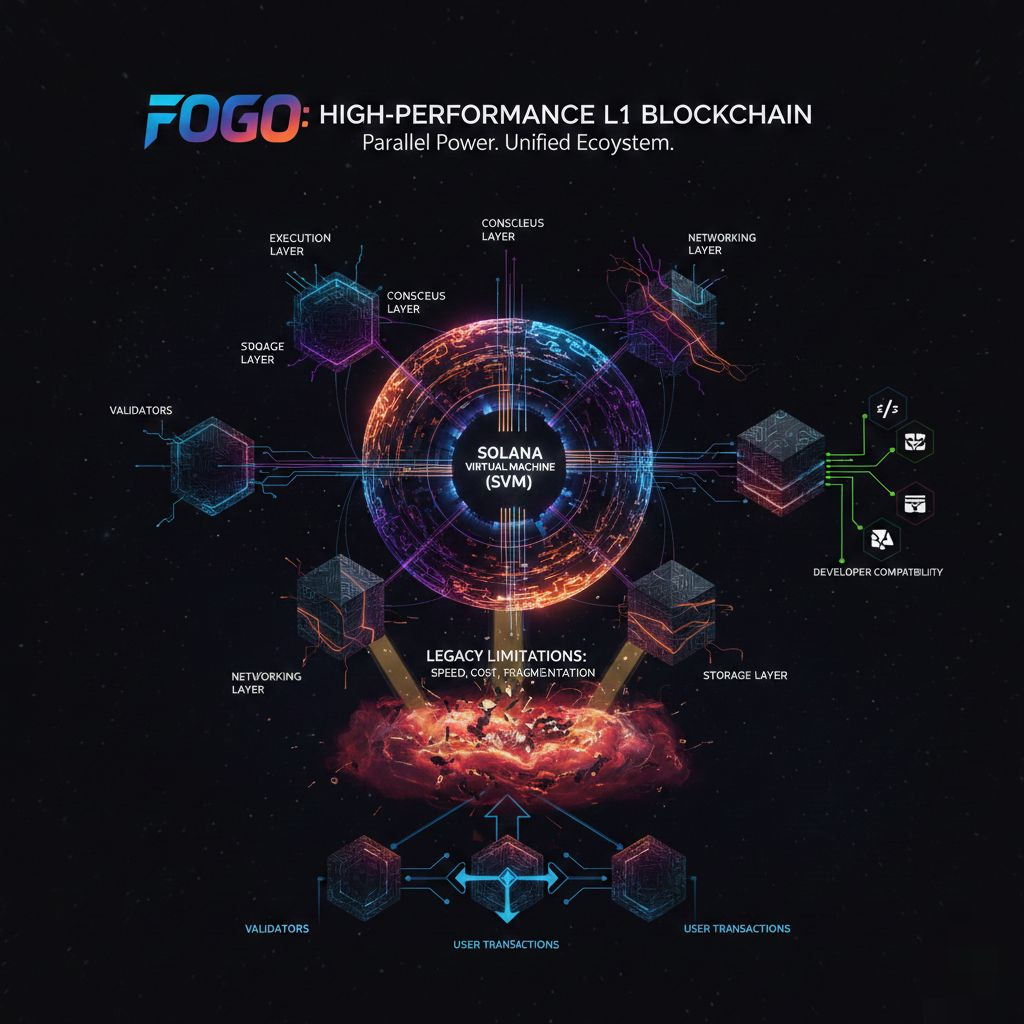
@Fogo Official Blockchain infrastructure has evolved through several generations, each attempting to solve limitations in speed, cost, scalability, and developer usability. Early networks demonstrated decentralization and security but struggled with performance and usability. Later systems improved scalability through alternative consensus models, modular design, and virtual machine improvements. Fogo represents a newer approach in this progression. It is a high performance Layer 1 blockchain designed around the Solana Virtual Machine, commonly known as the SVM. Its design focuses on improving execution efficiency, developer compatibility, and network scalability while maintaining decentralization and security properties expected from modern blockchain systems.
At its core, Fogo is trying to address a structural challenge in blockchain technology. Many networks face a tradeoff between decentralization, performance, and developer accessibility. Some chains achieve decentralization but suffer from slow transaction speeds and high costs. Others achieve high throughput but introduce complexity or fragmentation that makes development difficult. Additionally, developer ecosystems are often divided across incompatible virtual machines, forcing teams to rewrite applications when moving between networks. Fogo attempts to reduce these barriers by building directly on the Solana Virtual Machine architecture, which is known for parallel execution and efficient resource management. This allows Fogo to provide a performance-oriented environment while maintaining compatibility with a growing ecosystem of tools and applications built for the SVM.
Understanding how Fogo works requires a basic understanding of what a virtual machine does in a blockchain. A virtual machine is the execution environment where smart contracts run. It defines how transactions are processed, how data is stored, and how programs interact with the network. The Solana Virtual Machine differs from traditional blockchain virtual machines because it is designed for parallel execution rather than sequential execution. Instead of processing one transaction at a time, it allows multiple non-conflicting transactions to execute simultaneously. This significantly increases throughput and reduces network congestion. Fogo adopts this execution model as its foundation, allowing it to process many transactions efficiently without relying on complex secondary scaling solutions.
At a high level, Fogo functions as a standalone Layer 1 blockchain with its own validators, consensus system, and state management. Validators are responsible for verifying transactions, producing blocks, and maintaining the network’s integrity. These validators execute smart contracts using the SVM, which ensures consistent and deterministic results across the network. Transactions submitted by users are propagated to validators, which then execute the instructions and update the blockchain state. Because the SVM supports parallel execution, validators can process many independent transactions simultaneously, improving performance without sacrificing correctness.
The architecture of Fogo is designed around several core components. The execution layer is powered by the Solana Virtual Machine, which handles smart contract processing. The consensus layer coordinates validators and ensures agreement on the order and validity of transactions. The networking layer manages communication between nodes, ensuring fast propagation of transactions and blocks. The storage layer maintains the blockchain state, including account balances, contract data, and historical records. These components work together to create a cohesive system that can support high transaction throughput while maintaining reliability and security.
One of the key functional advantages of using the Solana Virtual Machine is its account-based parallel execution model. Each transaction specifies which accounts it will read and modify. The runtime uses this information to determine which transactions can be executed simultaneously without conflicts. This reduces unnecessary waiting and improves overall efficiency. Fogo benefits directly from this design, allowing applications to scale more effectively without requiring complex off-chain processing or batching techniques.
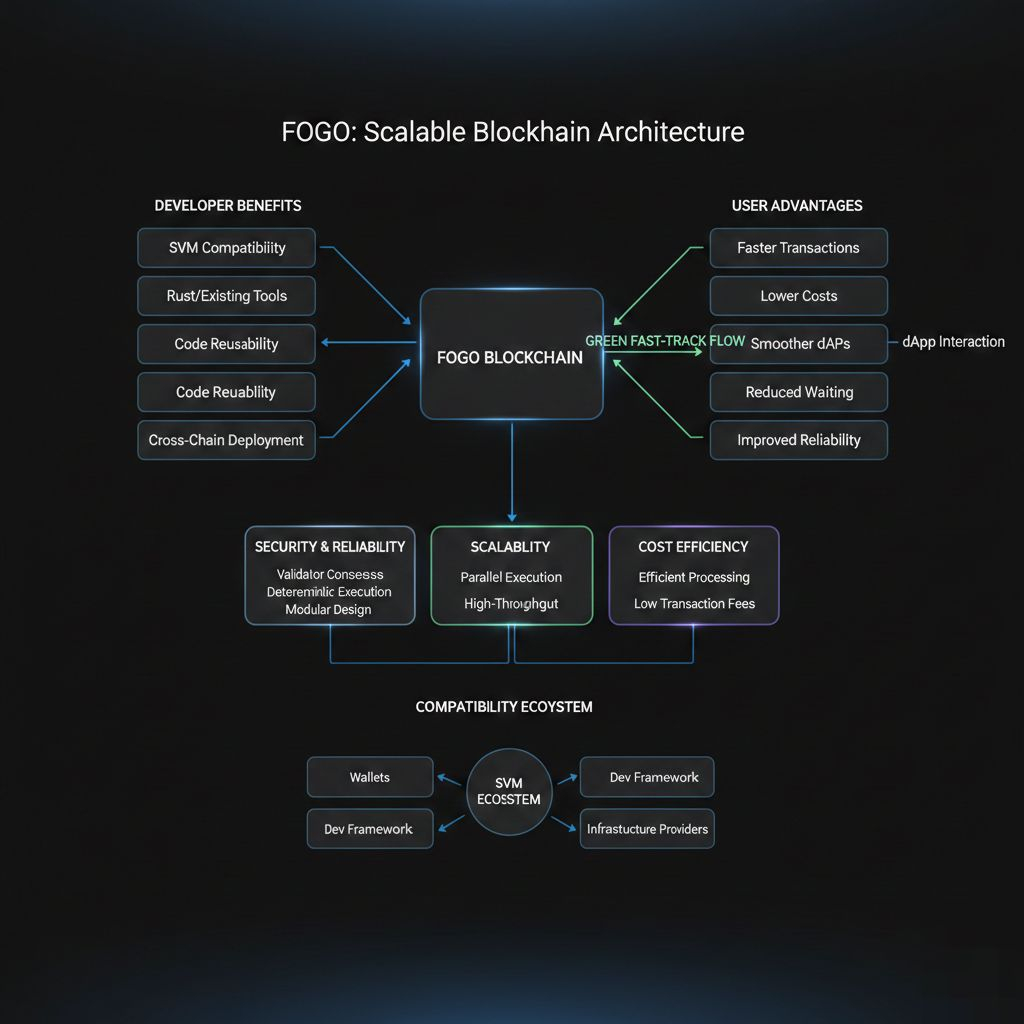
#fogo From a developer perspective, compatibility with the Solana Virtual Machine provides significant practical benefits. Developers can use familiar programming languages such as Rust and existing development tools designed for the SVM ecosystem. This reduces the learning curve and allows developers to reuse code, frameworks, and development workflows. It also makes it easier to deploy applications across multiple SVM-based networks. This type of compatibility contributes to a more flexible and interoperable development environment, which is important for long-term ecosystem growth.
For users, many of Fogo’s technical improvements operate in the background and may not be directly visible. However, they result in faster transaction confirmation, lower transaction costs, and smoother interaction with decentralized applications. Users benefit from reduced waiting times, lower fees, and improved reliability, especially during periods of high network activity. These improvements are important for applications that require frequent transactions, such as decentralized finance platforms, gaming systems, and payment networks.
Security and reliability are critical components of any blockchain system, and Fogo’s design reflects this requirement. Validator-based consensus ensures that multiple independent participants verify network activity. This reduces the risk of manipulation or centralized control. Deterministic execution within the Solana Virtual Machine ensures that every validator produces the same result when executing a transaction, preventing inconsistencies. Additionally, separating execution, consensus, and networking responsibilities allows the system to remain stable even if individual components experience temporary issues.
Scalability is one of the primary goals of Fogo’s architecture. Traditional blockchains often rely on sequential execution, which limits throughput. By using parallel execution at the virtual machine level, Fogo improves scalability without requiring external scaling layers. This simplifies system design and reduces complexity for developers and users. It also allows the network to support a wide range of applications, from financial systems to high-frequency trading platforms and real-time interactive applications.
Compatibility is another important aspect of Fogo’s design. By aligning with the Solana Virtual Machine ecosystem, Fogo positions itself within a growing network of tools, developer resources, and applications. This compatibility enables easier integration with wallets, development frameworks, and infrastructure providers that already support SVM-based systems. It also reduces fragmentation within the broader blockchain ecosystem, which has historically been divided across incompatible virtual machines.
Cost efficiency is closely related to execution efficiency. Parallel processing allows the network to handle more transactions without significantly increasing resource requirements. This helps keep transaction fees lower and makes the network more accessible to users. Efficient resource utilization also benefits validators, making network participation more sustainable and encouraging decentralization.
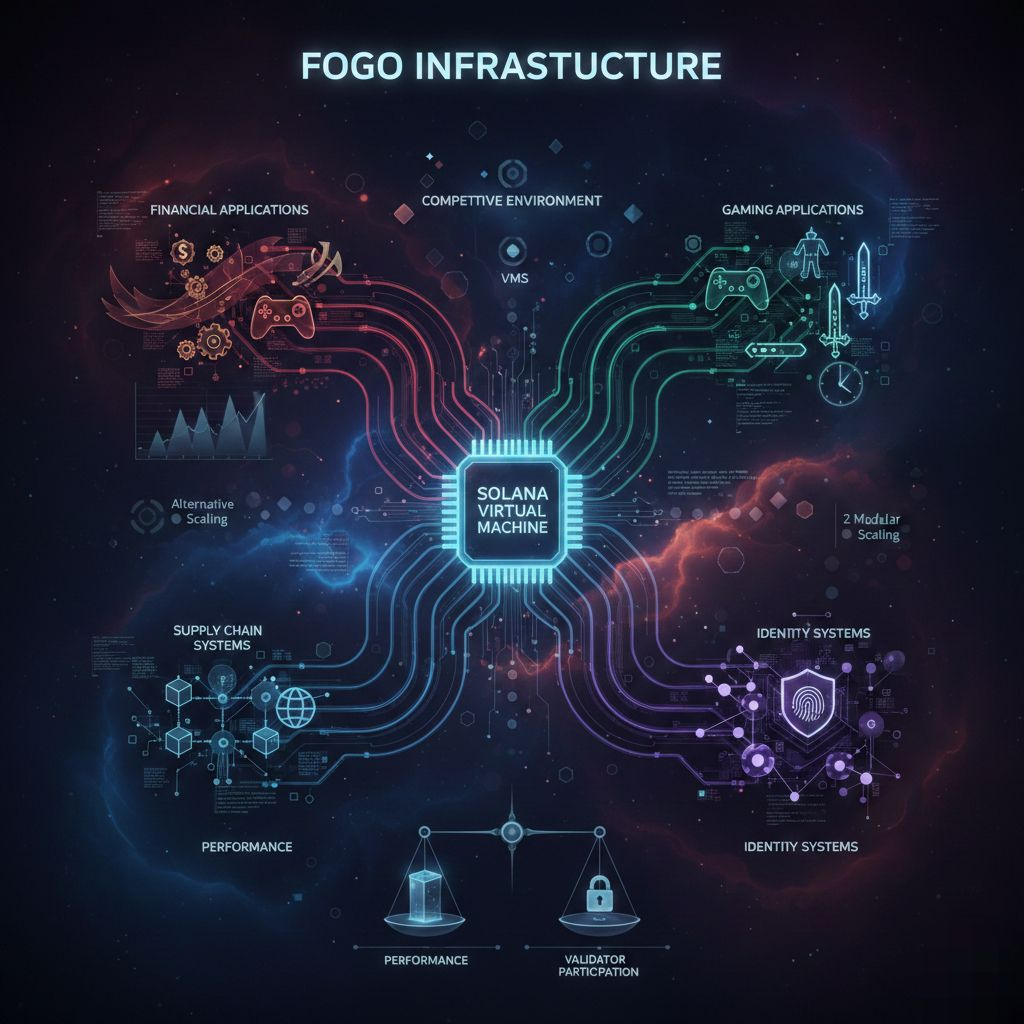
Fogo’s infrastructure can support a wide range of real-world applications. Financial applications can benefit from faster transaction processing and lower fees, making decentralized trading and payments more practical. Gaming applications can use the network for real-time asset ownership and in-game transactions without noticeable delays. Supply chain systems can record and verify data efficiently, improving transparency and traceability. Identity systems can use blockchain records to verify credentials securely. In each of these cases, performance and reliability are essential for practical adoption, and Fogo’s architecture is designed to support these requirements.
Despite these advantages, Fogo operates in a competitive environment. Many Layer 1 blockchains are working to improve performance and developer accessibility. Some use alternative virtual machines, while others rely on modular scaling approaches. Fogo’s reliance on the Solana Virtual Machine provides compatibility and performance benefits, but it also means the project must differentiate itself through reliability, developer support, and ecosystem growth. Network adoption, validator participation, and developer engagement will play important roles in determining its long-term relevance.
Another challenge involves maintaining decentralization while achieving high performance. High throughput systems often require more powerful hardware, which can limit validator participation. Fogo’s long-term sustainability will depend on balancing performance improvements with accessibility for independent validators. Maintaining strong security practices, regular software updates, and transparent governance will also be essential.
In the broader context of blockchain infrastructure evolution, Fogo represents a continuation of a shift toward more efficient execution environments. By building around the Solana Virtual Machine, it adopts a proven execution model that prioritizes parallel processing and efficiency. This allows the network to support modern decentralized applications without relying heavily on external scaling solutions.
Ultimately, Fogo’s value lies in its role as infrastructure. It is not focused on end-user features alone but on providing a reliable and efficient foundation for developers and applications. By improving execution efficiency, supporting developer compatibility, and enabling scalable transaction processing, it contributes to the ongoing development of blockchain technology as a practical computing platform. Its success will depend on its ability to maintain security, attract developers, and provide consistent performance in a rapidly evolving ecosystem.
