
Last week I ran into something frustrating.
I asked an AI assistant to help me debug a workflow I’d been refining for months — a trading-automation idea that depended on multiple iterations of testing. The assistant understood the code, but not the context. Every time the session restarted, it was like talking to someone new.
Same model. Same instructions.
But the continuity was gone.
And that’s when something became obvious to me:
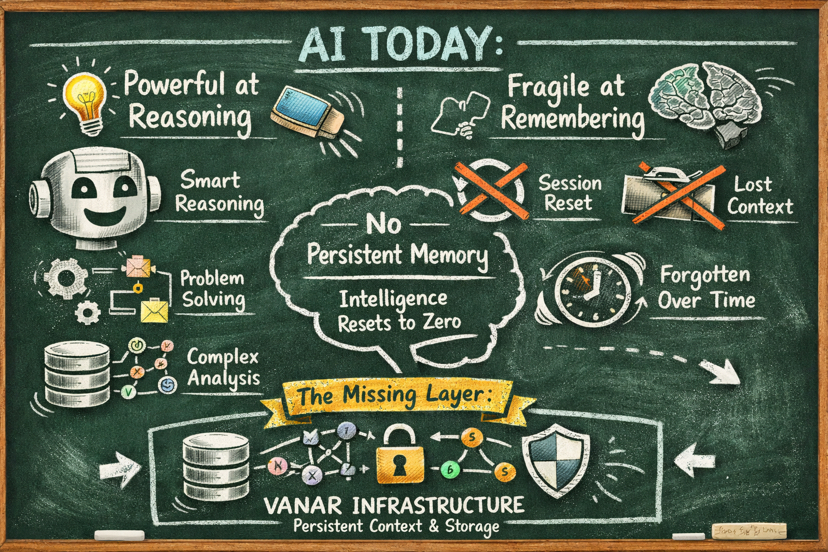
AI today is powerful at reasoning, but fragile at remembering.
Not memory in the human sense — not emotions or experiences — but operational memory: structured, persistent context that survives sessions, migrations, and time.
Without that, intelligence resets to zero more often than we realize.
This is exactly the infrastructure layer #vanar has been quietly building.
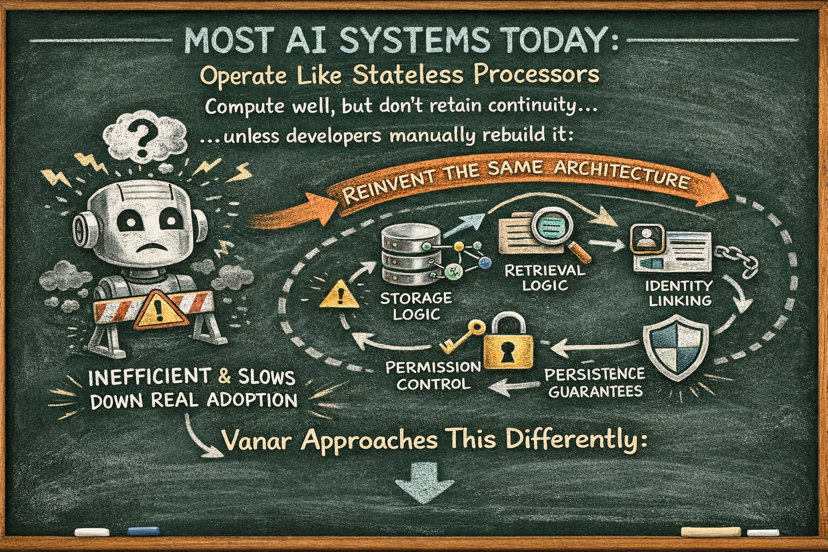
Most AI systems today operate like stateless processors.
They compute well, but they don’t retain continuity unless developers manually rebuild it through databases, APIs, or custom storage layers.
That creates friction.
Every AI agent that needs memory must reinvent the same architecture:
storage logic
retrieval logic
identity linking
permission control
persistence guarantees
It’s inefficient, and it slows down real adoption.
Vanar approaches this differently.
Instead of treating memory as an application-level feature, Vanar treats memory as infrastructure.
The Neutron API and OpenClaw integration move AI memory from “experimental concept” to callable system component. Developers can give agents persistent external memory without designing the entire backend from scratch.
That changes the development equation.
An AI agent is no longer just:
input → process → output
It becomes:
input → process → remember → evolve
And that subtle shift is where things start to feel less like software tools and more like digital systems.
There’s a deeper implication here.
Continuity is what makes intelligence useful over time.
A trading system without historical state is just a calculator.
A personal assistant without memory is just a chatbot.
A game AI without persistence is just scripted behavior.
Memory transforms tools into systems.
This is why infrastructure matters more than hype cycles.
Markets tend to chase visible layers — apps, tokens, narratives — but long-term adoption usually depends on invisible layers: storage, identity, memory, and execution environments.
Vanar sits in that invisible layer.
Not replacing AI models.
Not competing with them.
Supporting them.
And historically, infrastructure that quietly enables entire ecosystems tends to outlast the noise around it.
I don’t think the future of AI agents will be defined by how fast they respond.
It will be defined by whether they remember.
Because intelligence without continuity is just repetition.
And infrastructure that enables continuity becomes foundational.
That’s the layer Vanar is moving toward — not louder, but deeper.
