

How Fogo approaches latency at the infrastructure layer
Latency in crypto is often reduced to a marketing line: “X milliseconds per block.” But latency is not just block time. It is the cumulative result of hardware, networking topology, validator coordination, and execution design. If any of those layers is inconsistent, low latency becomes fragile — and fragility in execution environments translates into unfairness. Reducing latency is not a feature toggle. It is an architectural commitment.
Block time is the visible layer. When people hear that a network is targeting extremely short block cadence, the immediate assumption is that faster automatically means better. But block time alone does not determine user experience. True latency includes propagation time between validators, transaction arrival synchronization, hardware processing symmetry, and congestion handling behavior. If a network shortens block intervals without harmonizing these layers, it compresses competition into smaller windows and can amplify advantage instead of neutralizing it.
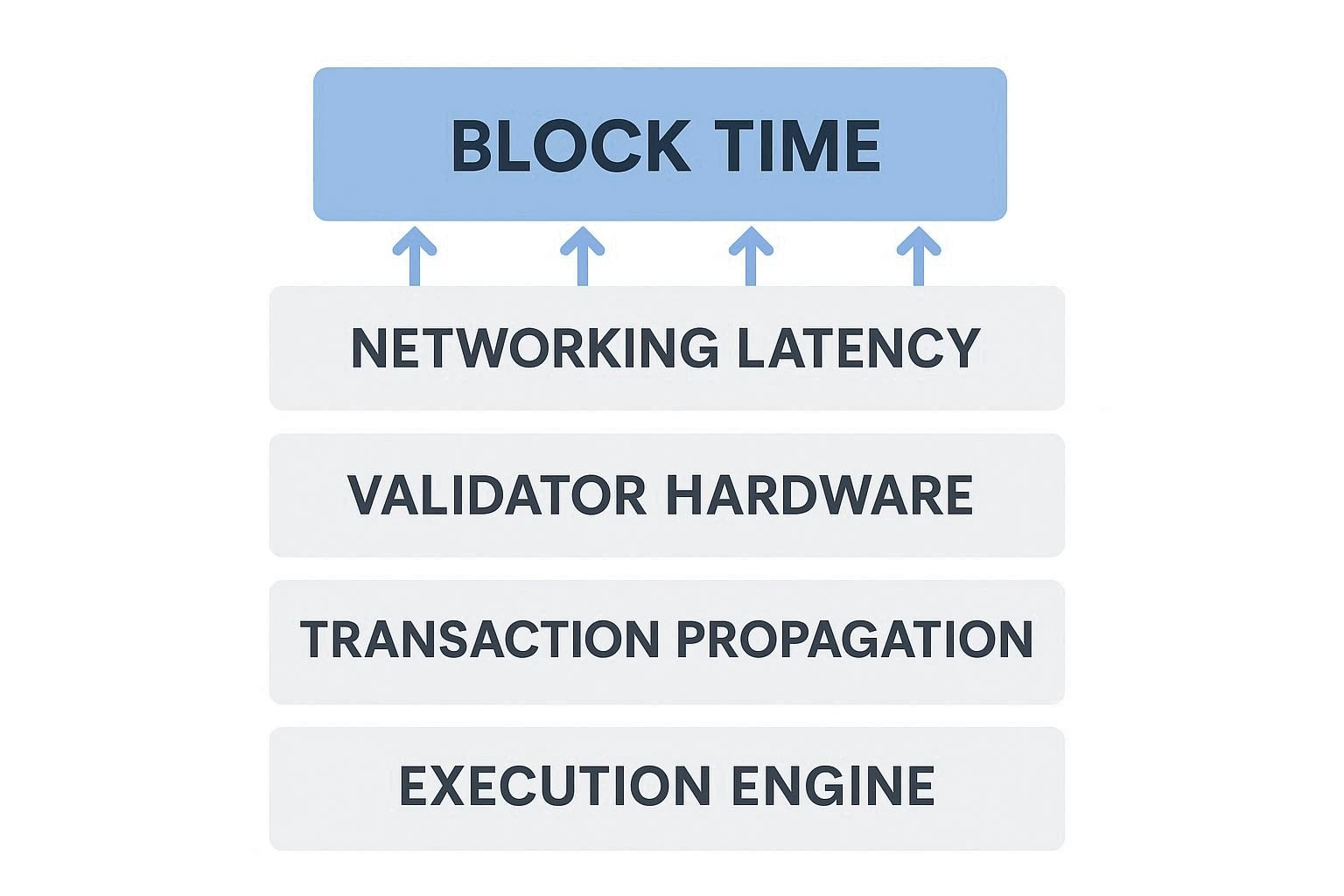
In ultra-low-latency systems, small differences matter. A few milliseconds in network routing, hardware processing, or geographic proximity can alter transaction ordering outcomes. This is where Fogo’s approach becomes structurally relevant. Rather than treating latency purely as a block production metric, the emphasis extends to validator performance consistency and execution coordination. In Fogo’s design, low-latency block cadence is not positioned as an isolated headline metric, but as part of a broader execution-structure framework that must operate coherently under real load. Short blocks only make sense if the infrastructure layer sustains them symmetrically. Otherwise, speed accelerates imbalance.
There is also a difference between latency compression and latency discipline. Latency compression means producing blocks faster. Latency discipline means ensuring transaction ordering and propagation remain coherent under shorter intervals. Fogo’s execution-focused architecture implies that low-latency cadence must be paired with structured handling of order flow rather than relying purely on throughput expansion. That distinction matters because predictability is more valuable than raw velocity in competitive on-chain environments.
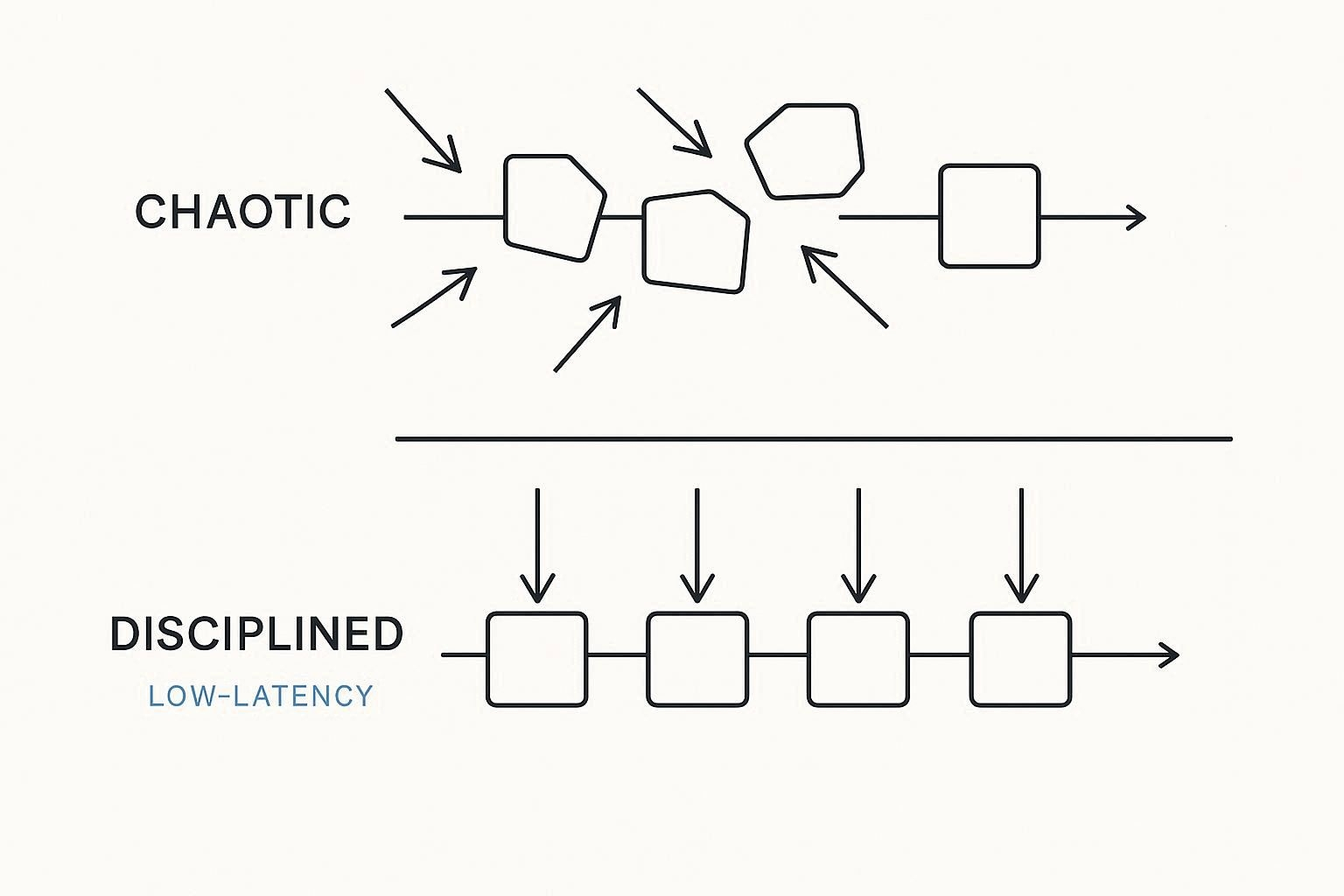
Under calm conditions, most networks appear fast. Under volatility, weaknesses surface. When block cadence shortens, the system must handle bursts of transactions, rapid price movements, competitive order flow, and congestion spikes. If infrastructure is not aligned, latency targets collapse under stress. If infrastructure is architected coherently, short block intervals can improve execution smoothness rather than destabilize it.
Instead of asking “How many milliseconds per block?” a more relevant question becomes: how consistent is propagation across validators? Does shorter cadence reduce or amplify ordering advantage? Is hardware expectation aligned with performance targets? Does execution remain predictable under load? These are infrastructure questions, and they determine whether low latency enhances fairness or simply accelerates competition.
Latency is easy to advertise. Sustainable low-latency execution requires disciplined infrastructure design, validator symmetry, and coherent order handling. Without those layers, speed is unstable. With them, speed becomes credible. Fogo’s positioning around execution and latency only becomes meaningful if the infrastructure layer consistently supports those ambitions, because latency is not a marketing number. It is an architectural stance.