
The first time I tried a sponsored session during a busy window, what hit me was not speed but friction. I could feel my attention getting cut into small pieces by repeated prompts and small failures, and I felt that quiet doubt that the next tap would work. That is why I keep thinking about Fogo Sessions and the Session Manager program as more than convenience tools. In congestion spikes, they act like a sponsorship control plane that decides whether fee sponsorship keeps a user flow moving or whether it freezes under congestion.
It is easy to believe that session UX is just fewer signatures. One approval, then the app runs smoothly for a while. That story is clean and it sounds like pure improvement. But under load, the problem shifts. Once actions are bundled under a session, the question becomes who pays and how long that payment stays reliable. When the network is busy and fees rise, the sponsor becomes the weak link. If the sponsor can be drained, rate limited, or pushed into failure, the smooth session turns into a stalled session.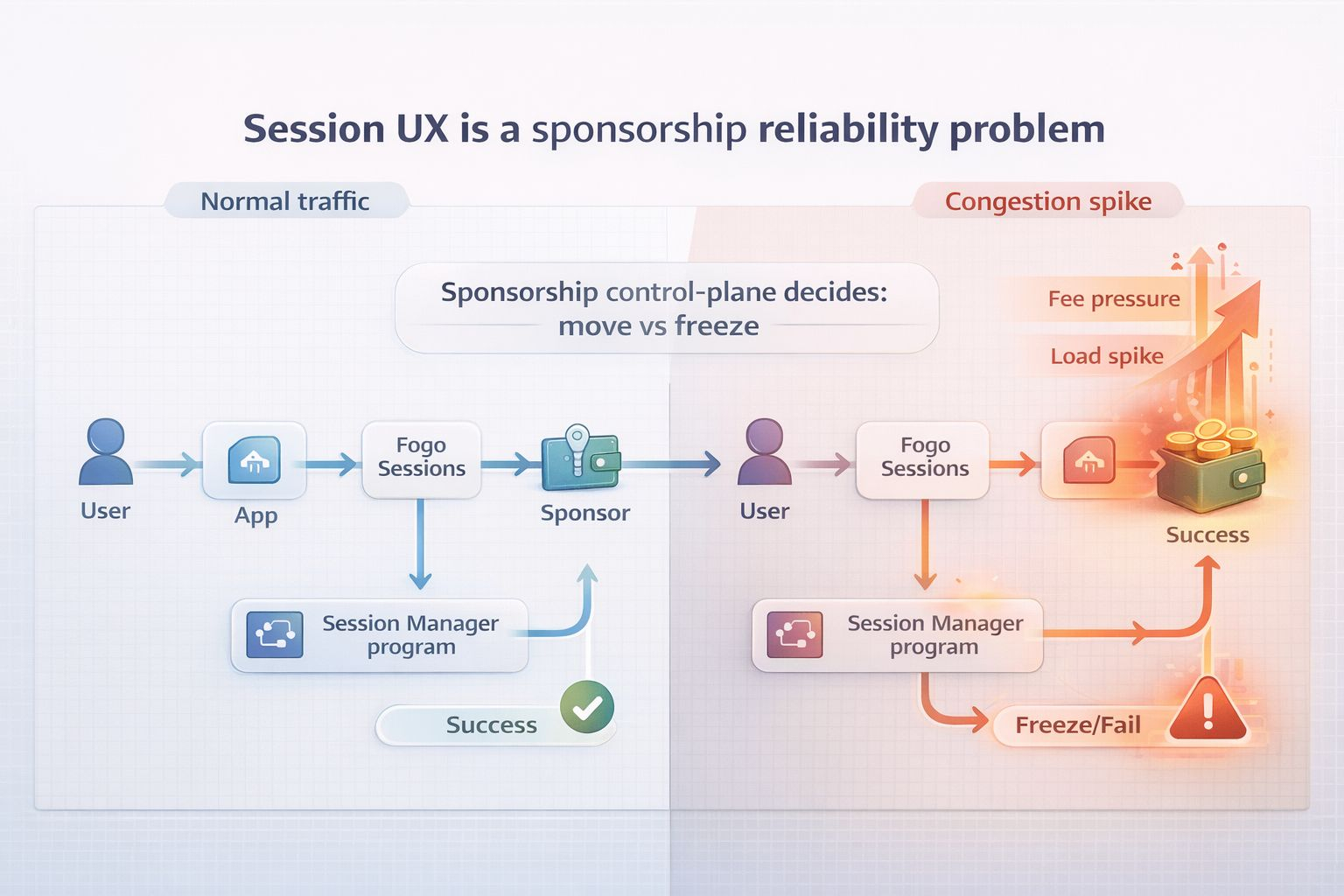
I have lived through this kind of failure before in systems that leaned on one shared payer, and the feeling is always the same. The UI still looks fine, but the flow starts to feel brittle. Users do not know why. They just see taps that do nothing, or actions that bounce. The same risk exists here. The moment you allow optional fee sponsorship inside sessions, you create a single point of pressure, and you can often see it as fee payer concentration in Session Manager program transactions. This is a design choice, and it comes with a cost.
The operational constraint is simple. Congestion spikes are the moments when many people try to do small actions quickly. Swaps, clicks, claims, game moves, and repeated retries all stack up. In those minutes, the network becomes less forgiving. If sessions are meant to help the user, they have to survive the worst minutes, not the calm ones. That means the sponsorship control plane must handle the case where high frequency actions meet high fees at the same time.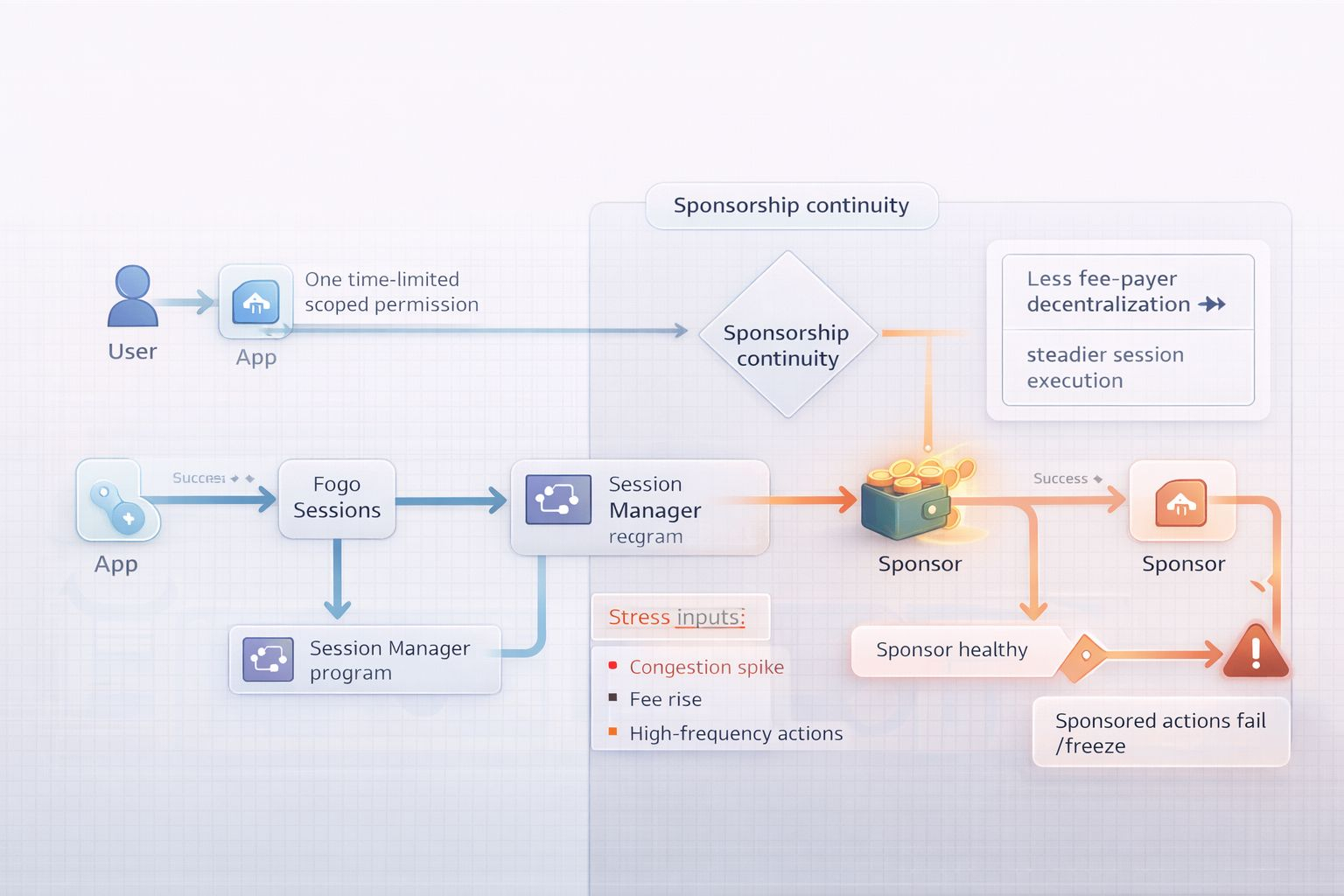
The trade off is this: if a few payers cover most session traffic, you lose fee payer decentralization. You might even accept that on purpose. You do it to keep the user flow steady. You sacrifice a wide spread of payers for fewer broken sessions. The risk is that this concentration is exactly what an attacker, or even normal competition, can push against. It is easier to harm a concentrated payer set than a wide one.
The failure mode I worry about is sponsor griefing. It does not need to be dramatic. It can be as simple as pushing extra load into the same sponsored path until the payer runs out of budget or hits limits. It can also be a more subtle freeze, where sponsored actions fail just often enough to break the user’s trust. Either way, the user experience turns from smooth to fragile right when the system is most stressed.
I do not treat sessions as a pure UX feature. I treat them as a reliability contract. Fogo Sessions are a promise that the app can keep acting on my behalf for a short time. The Session Manager program is the on chain place where that promise becomes real traffic. Under normal conditions, the promise is easy to keep. Under congestion, the promise has to be defended. That defense is not about nicer screens. It is about how sponsorship is controlled and how concentrated it becomes.
What makes this lens practical is that the chain does not hide the evidence. You can measure who is paying for Session Manager program transactions during stress and see whether a small set is carrying most of the load. If one address, or a tiny set, pays for a large share, you should assume the system is leaning into the trade off. That can be a valid choice, but it is not free, because it narrows the surface area that has to hold up under pressure.
When I read a chain’s reliability story, I look for signals like this because they tie intent to reality. A team can say sessions improve UX, but the chain can show whether those sessions are supported by a diverse payer set or by a single funnel. Under stress, the funnel is what breaks first. If the sponsorship control plane is working, the user flow should get steadier, not just cleaner. That means fewer failures inside Session Manager program transactions during busy windows, even if fees are high.
I also want the lesson to be simple for builders. If you build on a session model, you are building two things at once. You are building a permission model, and you are building a payment model. The permission part is what users see. The payment part is what stress tests you. If you ignore the payment part, you will ship a smooth demo and a fragile product.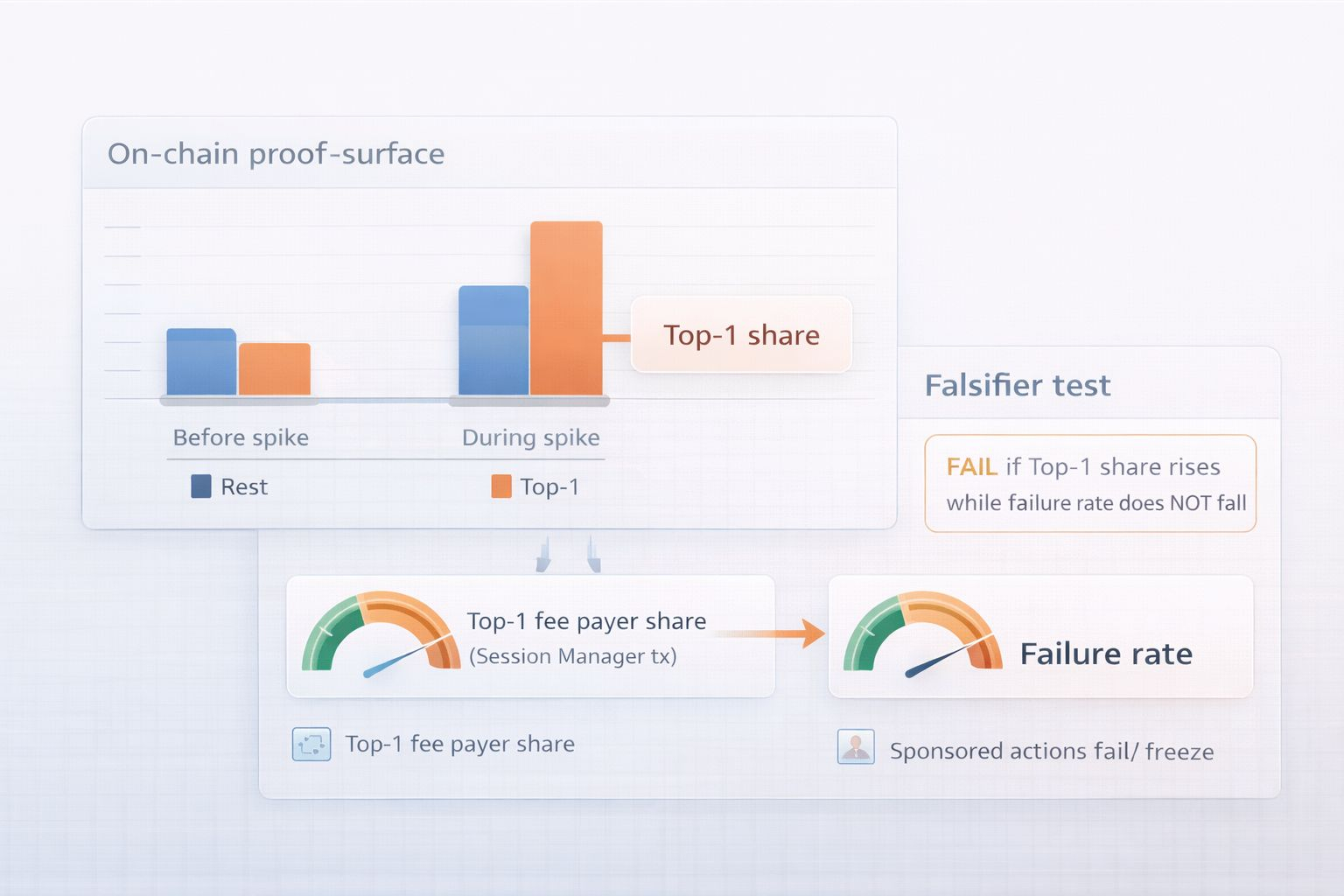
For me, the practical implication is to watch sponsorship health as closely as you watch UX, because the payer pattern decides whether sessions stay smooth when the chain is hot.
If, during congestion spikes, the top 1 fee payer share inside Session Manager program transactions rises while the Session Manager program transaction failure rate does not fall, then Fogo Sessions are not delivering steadier sponsored execution.
