
When I look at most blockchain projects, I often feel they are built for insiders, traders, or developers. They talk about speed, fees, and technology, but they rarely explain how normal people will ever use them. That is where Vanar begins to feel different. It is not only trying to build a fast network. It is trying to build something that actually makes sense in the real world. The idea behind Vanar is simple but powerful. If blockchain wants mass adoption, it must live inside the experiences people already understand, not force them to learn a new world from scratch.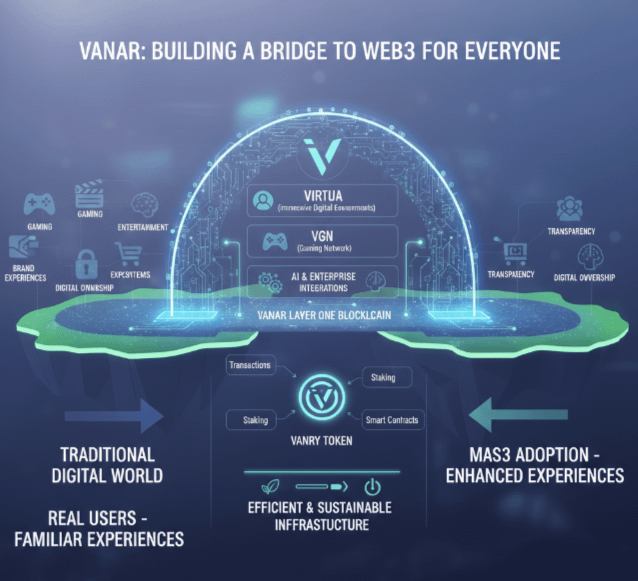
Vanar is a Layer One blockchain designed with the goal of bringing billions of users into Web3 through familiar digital environments. Instead of focusing only on finance, the ecosystem stretches across gaming, entertainment, artificial intelligence, digital ownership, and brand experiences. These are areas where users already spend time and money, so if blockchain becomes part of these spaces, adoption happens naturally. I am seeing this strategy as a shift away from the old model where chains tried to attract users first and build use cases later. Vanar is trying to build the use cases first so users arrive because the experience already exists.
The team behind Vanar has strong roots in gaming and digital technology, and that background shapes how the project is growing. Rather than chasing hype, they are building tools that developers and companies can actually plug into real products. If a brand wants to create a digital experience, if a game wants blockchain ownership, or if a platform wants token based interaction, Vanar wants to be the infrastructure behind it. This approach feels closer to how real technology spreads in the world. People do not adopt technology because it is complicated. They adopt it because it improves something they already use.
One of the most visible parts of the ecosystem is Virtua, an immersive digital environment where users can explore, collect, and interact with digital items in a more visual and engaging way. It shows how blockchain can move beyond charts and wallets and into experiences that feel alive. Alongside that, the VGN gaming network focuses on connecting developers and players into a shared blockchain powered gaming environment. Gaming is often considered one of the strongest paths to mass adoption because players already understand digital ownership and in game economies. If blockchain enhances those experiences without making them harder to use, it becomes a natural fit rather than a forced one.
Vanar is also structured to support artificial intelligence driven tools and enterprise style integrations. We are seeing more applications where AI systems interact with blockchain data, manage assets, or power automated experiences. If this trend continues, infrastructure chains that can support both AI and user facing applications could become extremely important. Vanar appears to be positioning itself for that future by creating a network that is flexible enough to support different types of digital activity rather than locking itself into one narrative.
At the center of the ecosystem is the VANRY token. It acts as the energy layer for the network. Transactions, smart contract execution, staking, and participation inside applications all rely on this token. If the ecosystem grows and more products run on Vanar, the token becomes tied to actual usage rather than just market speculation. This is the stage every blockchain hopes to reach because it means the network is being used for something real. It becomes less about price swings and more about whether people are actually building and interacting on the chain.
Another thing that stands out is the focus on efficiency and sustainability. Many institutions and global brands hesitate to enter blockchain because of concerns about energy use and long term reliability. Vanar promotes a more efficient infrastructure model that aims to reduce these barriers. If blockchain is going to support global scale applications, it cannot just be powerful. It must also be responsible and practical for companies planning long term digital strategies.
What I find most interesting is that Vanar is not presenting itself as a loud revolution. It feels more like a quiet infrastructure play. Instead of promising to replace everything, it is trying to slip into existing industries and make them work better. If this approach succeeds, adoption may not look dramatic at first. It may look like small integrations, steady partnerships, and gradual growth. But over time, those small steps can build something much bigger.
Right now, Vanar feels like a bridge between two worlds. On one side there is blockchain technology with its speed, transparency, and digital ownership. On the other side there are real users who simply want better digital experiences.
