
@Fogo Official The first time I encountered Fogo, it did not feel like a project trying to introduce itself to the world. It felt more like something that had already made a decision internally and was simply continuing forward, whether anyone noticed or not. There was no dramatic attempt to redefine what a blockchain should be. Instead, the impression it gave was quieter, almost procedural. It seemed less concerned with announcing its presence and more focused on correcting something that had started to feel slightly off in the broader environment. That subtle difference matters. After enough cycles in this space, you learn to recognize the projects that are trying to prove something, and the ones that are trying to fix something.
What makes its timing interesting is the stage at which the industry currently exists. Blockchains are no longer experimental ideas trying to justify their existence. They are operational systems carrying real financial activity, real expectations, and real consequences when they fail. And failure does not always look dramatic. Sometimes it appears in smaller ways a delay that disrupts timing, a transaction that lands too late, a system that slows down just enough to introduce doubt. These moments accumulate quietly. Over time, they reshape how people behave. They introduce hesitation into environments that depend on precision.
Fogo appears to have been shaped by observing these moments closely. It does not attempt to invent a new programming environment or force developers into unfamiliar territory. Instead, it chooses compatibility, allowing existing tools and applications designed for Solana’s environment to function without modification. This decision reflects a certain humility in design. It accepts that the problem may not be creativity, but continuity. Rather than encouraging reinvention, it allows extension. That choice reduces friction, not by simplifying the system itself, but by respecting the habits and workflows that already exist.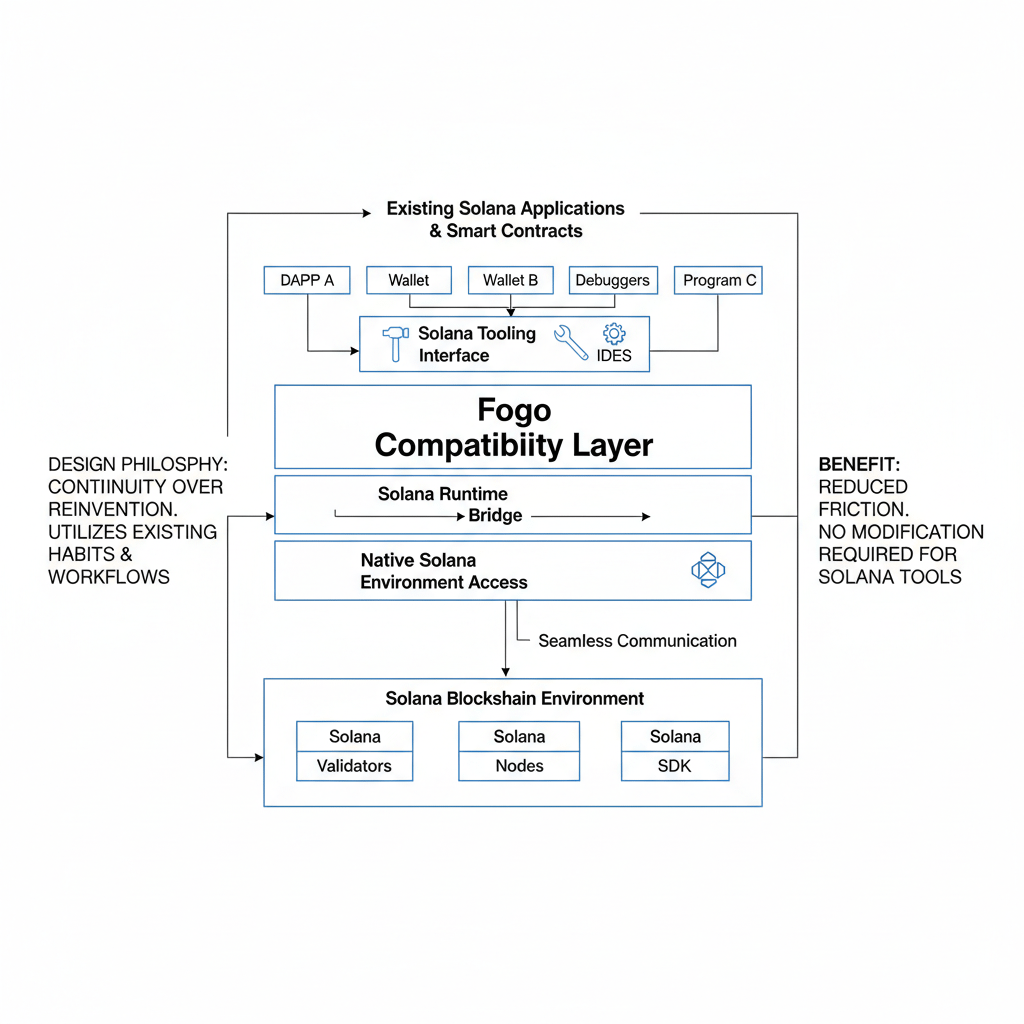
There is also a noticeable focus on physical reality, something that is often ignored in discussions about digital systems. Fogo places its validation infrastructure geographically close to major trading centers, keeping parts of the network near the environments where timing matters most. This may seem like a minor operational detail, but it reflects a deeper understanding. Digital systems do not exist in isolation. They are affected by distance, by hardware, by coordination. The idea that performance is influenced not only by code, but by placement, suggests that Fogo’s creators are thinking beyond abstract architecture and considering the system as something that lives within the real world.
This approach reveals a project that is not chasing theoretical maximums, but practical reliability. It is designed to support applications where timing is sensitive and outcomes depend on consistent execution. This is not about achieving impressive numbers in isolation. It is about reducing uncertainty. And uncertainty, more than speed itself, is often the hidden cost users pay. A system that behaves predictably, even if imperfect, can sometimes be more valuable than one that promises extremes but delivers inconsistently.
There is also an intentional narrowing of focus. Many blockchains attempt to position themselves as universal foundations capable of supporting every possible use case. Fogo does not appear to pursue that breadth. It leans into a specific category of activity financial applications that depend on responsiveness and coordination. This narrowing introduces trade-offs. Specialization can create strength, but it can also limit flexibility. A system optimized for one environment may not adapt easily to another. It accepts this constraint in exchange for stability within its chosen domain.
This is where its philosophy becomes clearer. It does not attempt to compete through novelty alone. Instead, it competes through refinement. It builds on an existing foundation rather than replacing it. Its core client is based on Firedancer, adapted for its own goals. This suggests a project more interested in evolution than disruption. It does not reject the past. It continues it, with adjustments.
Adoption, in situations like this, rarely happens suddenly. Systems designed around reliability tend to grow through gradual trust rather than immediate attention. Early users are often those who already understand the limitations of existing systems. They are not drawn by promises, but by small improvements that reduce friction in daily activity. These improvements are rarely visible to outsiders. They are felt, rather than announced.
At the same time, there are questions that remain unanswered. Specialization can create efficiency, but it can also create dependence. If the system’s relevance is tied closely to a particular type of activity, its future becomes linked to the health of that activity. There is also the broader question of whether incremental improvements are enough to sustain long-term attention in an industry that constantly seeks novelty. Quiet competence is valuable, but it is not always visible.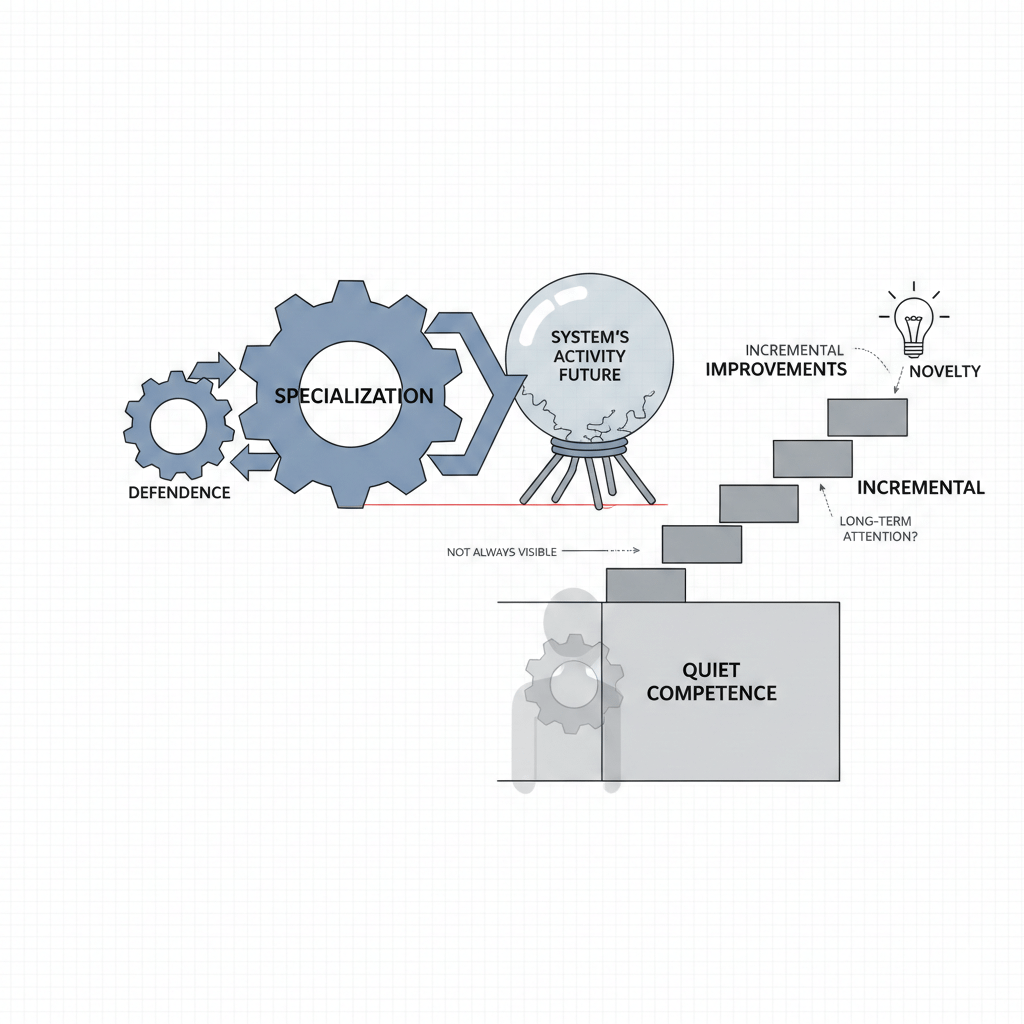
There is also the human factor. Systems do not exist independently of the people who maintain them. Reliability is not only a property of architecture, but of discipline. It requires consistency over time. It requires restraint the willingness to avoid unnecessary changes. This is often more difficult than innovation itself.
What makes Fogo interesting is not that it claims to solve everything. It is that it seems to accept the limits of what it can solve. It does not try to escape the realities of existing infrastructure. It works within them. It treats blockchain not as an abstract experiment, but as a system that must function under real conditions, with real constraints.
After watching multiple cycles come and go, you begin to notice that the projects which endure are not always the loudest ones. They are often the ones that integrate themselves quietly, becoming part of the background. They stop needing attention. They simply continue.
Fogo feels like it is attempting to become that kind of system. Not something that demands belief, but something that earns familiarity over time. Not something that promises transformation, but something that reduces friction just enough to be noticed by those who depend on it.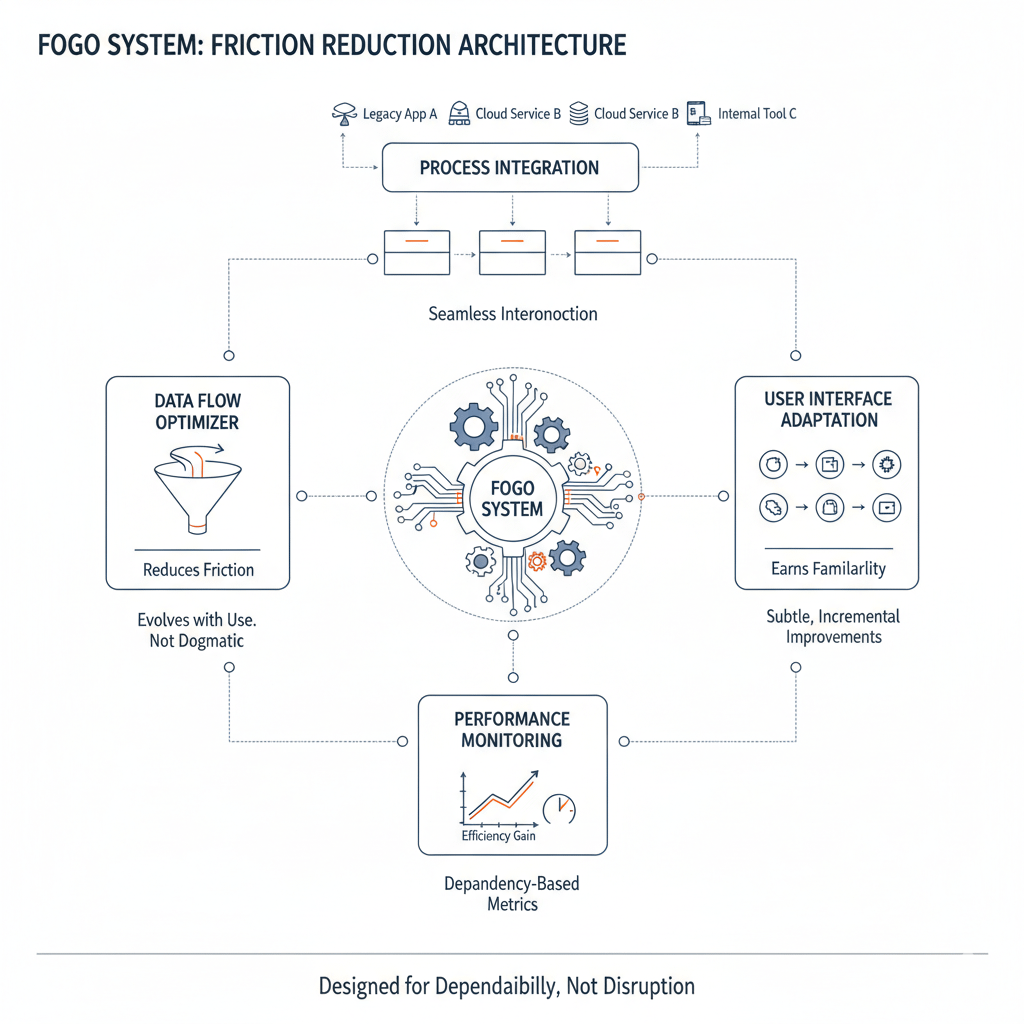
It does not feel finished. It does not feel complete. It feels like a system that has identified its direction and is now moving steadily within it, without urgency, without spectacle. And sometimes, in an environment driven by constant acceleration, that kind of steady movement is its own form of progress.
