
“Fogo is a high-performance L1 that utilizes Solana Virtual Machine.”
Most people read that and see speed.
I read it and see restraint.
They didn’t design a new VM. They didn’t introduce a new execution language. They chose the Solana Virtual Machine — an environment that has already broken in public, scaled in public, and exposed its edge cases in public. That decision doesn’t expand the surface area of innovation. It compresses it.
And when you compress the innovation surface, you concentrate pressure somewhere else.
If the execution environment is known, then performance is no longer a research problem. It becomes an operational problem. Deterministic ordering enforcement isn’t theoretical. Parallel execution isn’t experimental. Account isolation rules are already understood. Developers can’t blame tooling immaturity. Validators can’t hide behind novelty instability.
If something fails, it’s discipline.
That’s a different kind of chain.
High-performance in this context doesn’t mean “fast.” It means consistent under load. It means sub-40ms cadence that doesn’t widen when volatility spikes. It means compressed propagation inside a physically tight validator cluster where geography stops being an excuse for uneven arrival times.
Forty milliseconds isn’t a marketing number. It’s a behavioral constraint.
At that cadence, hesitation becomes inventory.
You widen size. Two rotations pass. Eighty milliseconds. The book rebalances. Your intent message lands into a different ordering context than the one you observed. Not malicious. Not unfair. Just mechanically ahead.
Deterministic.
And because it’s SVM, execution rules are predictable. SPL-only execution keeps the surface narrow. No exotic extension paths. No undefined behavior hiding in custom precompiles. If contention occurs, it’s because accounts collide. If you lose priority, it’s because someone cleaner arrived earlier.
Clean systems remove narrative comfort.
Fogo Sessions amplify that pressure.
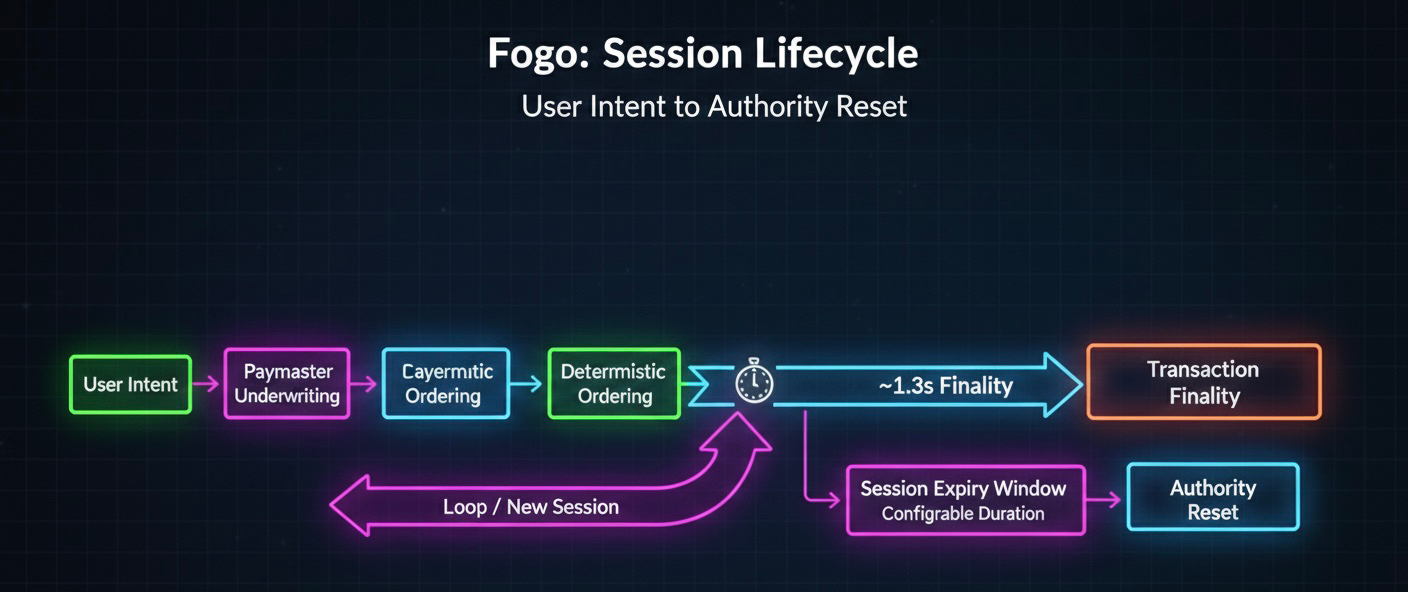
Bounded wallet authority. Time-limited delegation. Native $FOGO isolated from application-level flows. You open a session and you operate inside a constrained window. It feels smooth. Fewer signature prompts. Less friction. But authority is now time-bound, and when session expiry approaches — say within a few hundred milliseconds — hesitation isn’t philosophical anymore. It’s procedural.
Expiry doesn’t wait for conviction.
You recalibrate size mid-volatility. Paymaster quota recalculates simultaneously. Underwriting endpoints don’t disappear, but they don’t overextend either. If demand spikes, quota throttles. If spreads widen, it’s because someone is pricing execution risk in real time. The user experiences this as “the app slowed” or “fees changed.”
It didn’t slow.
The underwriting layer adjusted.
This is the part most people skip. Moving fee payments into SPL tokens doesn’t remove cost. It professionalizes it. A smaller class of operators now holds native inventory, provisions working capital, hedges exposure, and decides acceptance parameters. In calm markets, this abstraction feels invisible. In chaotic markets, it becomes the difference between seamless execution and silent restriction.
Responsibility moves up the stack.
And because Fogo chose SVM instead of inventing a new VM, that responsibility has nowhere to hide. There’s no experimental compiler to blame. No academic VM nuance to defer to. If propagation drifts, it’s infrastructure. If votes hover at 66.7% instead of clearing supermajority immediately, it’s coordination discipline. If hardware threads spike and flirt with ceiling during peak load, that’s physical reality meeting economic demand.
Mechanical systems are honest like that.
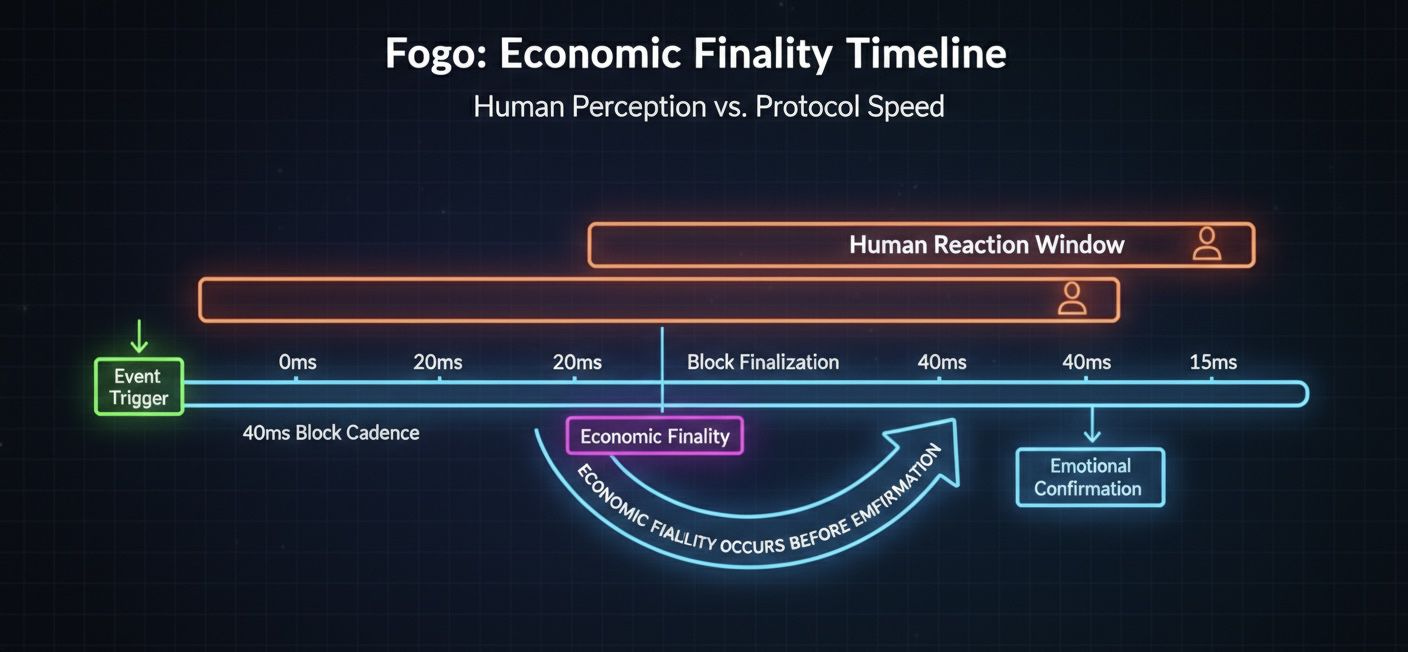
Finality at ~1.3 seconds sounds comfortable until you realize economic finality happens earlier. By the time confirmation locks, ordering advantage has already been decided several rotations back. Your nervous system reacts slower than the cluster rotates. You feel stable because the UI feels stable. The system is already done.
That’s the gap.
Human reaction time averages around 200–250 milliseconds. Fogo rotates five or six times inside that window. When cadence compresses below biological response thresholds, fairness stops feeling interactive. It becomes architectural. Whoever aligns with the tempo wins. Whoever hesitates donates edge.
Not unfair.
Unforgiving.
Colocation reinforces this. Validators operating within tight physical proximity reduce propagation variance. That shrinks latency arbitrage between distant nodes. It doesn’t eliminate competition. It just moves it. Instead of racing geography, participants race precision. Infrastructure quality becomes differentiator. Hardware selection matters. Network stack tuning matters. Miss a vote window by a handful of milliseconds and you hover below supermajority until the next rotation.
Hovering matters.
Because under sustained load, hovering changes perception. It introduces psychological doubt even if mathematically nothing is wrong. A vote at 66.8% clearing to 67% a rotation later isn’t failure. It’s mechanical cadence doing its job. But humans interpret delay as instability. And in markets, perception feeds behavior.
Fogo’s architecture feels indifferent because it is. It doesn’t stretch cadence to comfort participants. It doesn’t slow block production to accommodate congestion narratives. If hardware barely keeps up during peak demand, that’s visible. If paymasters recalibrate exposure during volatility, that’s visible. If your session expires mid-adjustment, that’s visible.
Transparency through tempo.
By choosing SVM, Fogo avoided the theater of reinvention. No new language to market. No research paper to brand. Just an execution engine already understood — placed inside a tighter physical and economic loop.
That’s a sharper bet than building something novel.
Because novelty buys forgiveness.
Restraint buys scrutiny.
If you fail with a new VM, people say, “It’s early.” If you fail with SVM, people say, “Why didn’t it perform?” The margin for error shrinks. Expectations harden. The system must be disciplined, not interesting.
Which leads to the real thesis.
Fogo isn’t competing on imagination. It’s competing on mechanical reliability under stress. Sub-40ms cadence. ~1.3s finality. Compressed propagation. Session-bounded authority. Fee underwriting handled by operators who must survive volatility, not marketing cycles.
In calm markets, this feels smooth.
In chaotic markets, this feels strict.
And strict systems reveal something uncomfortable: performance isn’t about how fast blocks are when nothing is happening. It’s about how little they care when everything is.
Fogo removed novelty from the stack.
Now the only variable left is execution.
And execution doesn’t negotiate