
I’ve seen enough “next-gen L1” pitches to know the pattern: speed claims, low fees, a glossy trailer, and then… silence when you ask what actually changes for users. That’s why Vanar feels different to me right now. Not because it’s the loudest chain, but because it’s leaning into something most blockchains still don’t even try to solve properly:
State. Context. Memory.
And if you’re serious about AI agents, AI gaming, and real-world digital ownership, that’s not a “nice to have.” That’s the whole game.
The Problem Nobody Likes Admitting: Most Chains Are Stateless
Blockchains are amazing at being ledgers. They confirm transactions, store balances, and execute contracts. But they’re also… forgetful. Like, painfully forgetful.
You can run a smart contract in milliseconds, sure. But try asking the chain:
• “What did the user do last session?”
• “What are their preferences?”
• “What’s the context behind this transaction?”
• “What happened before this action?”
Most chains shrug. They aren’t built to remember.
That’s fine for simple transfers, but it becomes a wall the moment you want AI-native experiences. AI agents can’t operate like goldfish. They need continuity. They need context that survives restarts, time gaps, and multi-step workflows.
And that’s where Vanar’s narrative stops sounding like marketing and starts sounding like infrastructure.
Vanar’s Core Bet: A Memory Layer Changes Everything
Vanar is basically saying: “Okay… what if the chain could actually remember?”
Not in the vague “data is on-chain somewhere” way. In the practical, usable way:
• session continuity
• preferences retained
• transaction context preserved
• low friction for developers to plug into
That’s a massive shift, because memory turns a chain from a filing cabinet into something closer to a stateful platform — where apps can feel personal, adaptive, and “alive” instead of reset-every-time.
And if you think about the next phase of Web3 (especially AI gaming + autonomous agents), the chain that can hold persistent context becomes way more valuable than the chain that can only move tokens quickly.
“They Forget. We Don’t.” — Why This Message Hits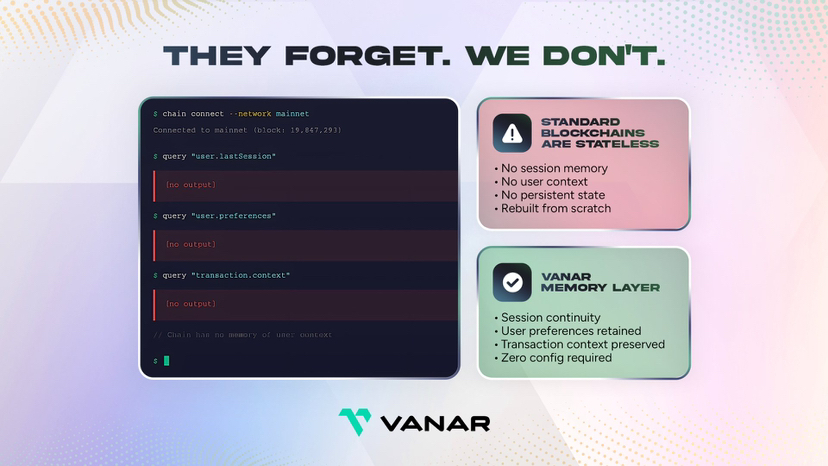
This first image is honestly the simplest explanation I’ve seen of the whole thesis.
On the left, you’ve got a terminal-style view where queries like:
• user.lastSession
• user.preferences
• transaction.context
return basically nothing.
On the right, it flips the script: Vanar Memory Layer promises the opposite — continuity, retained preferences, preserved context, and “zero config required.”
This matters because it’s not just a branding line. It’s the exact problem AI agents struggle with today.
If your chain forgets everything, your AI becomes a demo.
If your chain remembers, your AI becomes a product.
The Real Angle: “Fast Execution” Is Not the Same as “Smart Infrastructure”
I’m not saying speed doesn’t matter. It does. Vanar still talks about high performance, low fees, and smoother UX. But I don’t think the long-term story is “we’re faster.”
The long-term story is:
“We’re building rails where intelligent apps can keep state, keep context, and scale.”
That’s the difference between a chain that hosts apps and a chain that becomes part of the app’s brain.
Because once AI agents start moving between platforms — gaming economies, marketplaces, identity systems, digital ownership layers — memory isn’t just helpful. It becomes a competitive moat.
Vanar + Neutron + OpenClaw — The “Persistent Context” Signal
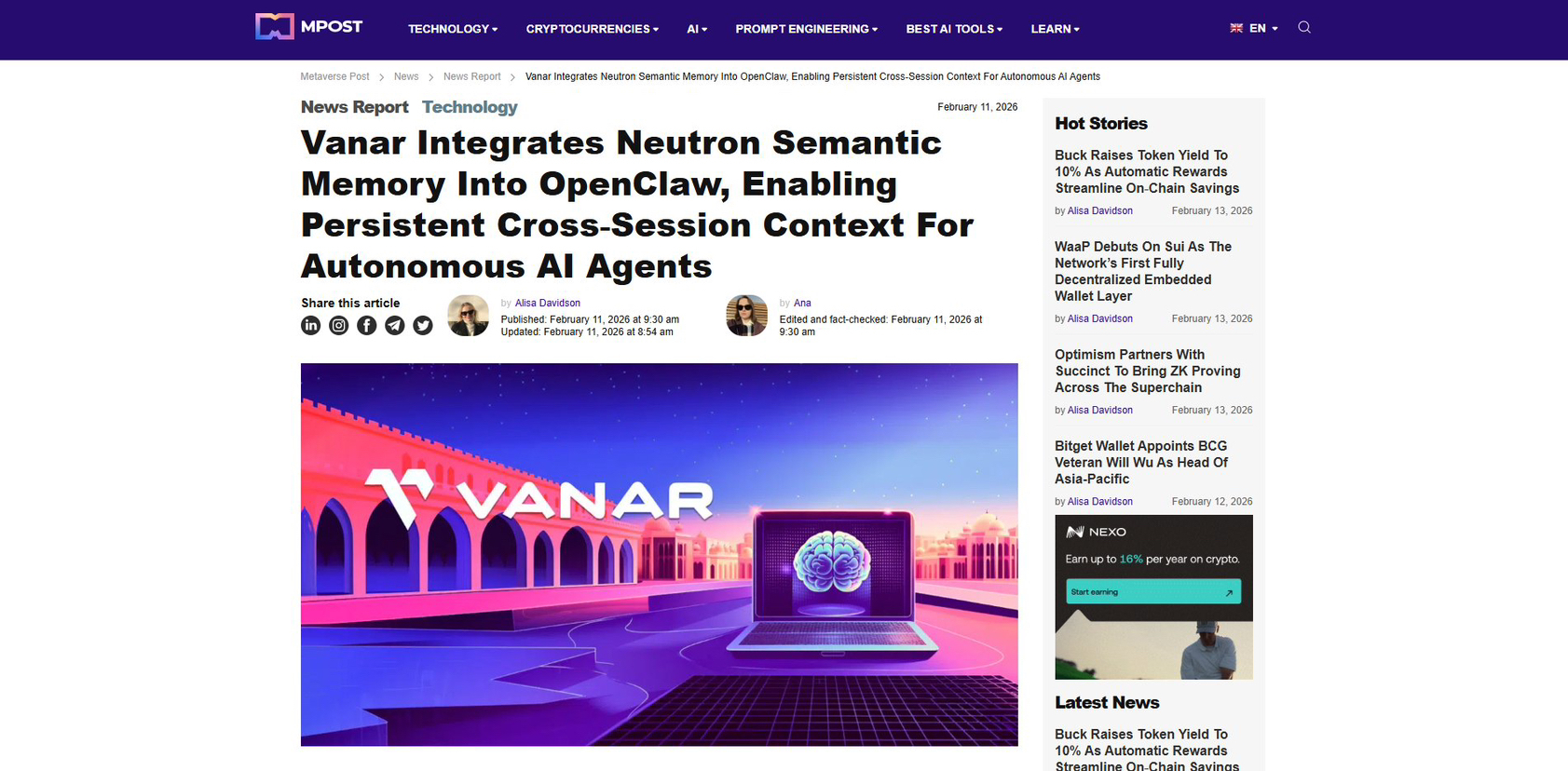
The second screenshot (the article page) is important because it pushes the idea beyond a slogan.
The headline says Vanar integrates Neutron semantic memory into OpenClaw, enabling persistent cross-session context for autonomous AI agents.
That’s exactly the kind of signal I watch for: not “we’re partnering,” but “we’re integrating a feature that changes how agents behave.”
Because if Neutron is actually being used as a semantic memory layer, then $VANRY isn’t just talking about AI. It’s building something AI can rely on:
• persistent identity across sessions
• context that survives restarts
• continuity for long-running agent workflows
That’s how you move from “AI-ready chain” to “AI-native system.”
Why This Matters for AI Gaming (Not Just AI Twitter)
AI gaming is where I think this gets spicy.
Gaming needs:
• fast interactions
• tiny transactions
• cheap execution
• smooth onboarding
• continuity (progress, identity, history)
Now imagine AI-driven NPCs, evolving player companions, adaptive economies, and intelligent assets that “learn” from how you play.
Without persistent memory, those features feel fake. Like an illusion that resets.
With persistent memory, you can build:
• characters that remember your past choices
• in-game economies that react to long-term behavior
• AI companions that feel consistent, not random
• reputations that are verifiable (not just claimed)
That’s why I keep saying: a memory layer isn’t a side feature. It’s a foundation for a new category of apps.
Where $VANRY Fits (And Why I Don’t Treat It Like “Just Another Token”)
I look at $VANRY the same way I look at any infrastructure token: it matters if the network becomes genuinely used.
If Vanar succeeds at becoming a stateful layer for AI + gaming + digital ownership, then VANRY isn’t just “gas.” It becomes the value rail for:
• memory writes / reads
• agent interactions
• game economies
• app activity
• ecosystem incentives
And that’s the point: the token’s relevance improves when the chain becomes the place where real activity happens, not just the place where people speculate.
The Way I’m Personally Watching Vanar From Here
I’m not just watching price. I’m watching whether this “memory layer” idea turns into real developer behavior:
• Are builders shipping apps that actually use persistent context?
• Do we see agents operating across sessions like it’s normal?
• Does the ecosystem attract products that need statefulness, not just want it?
• Do users feel the difference in UX (less friction, more continuity)?
If those answers trend “yes,” Vanar starts to look less like another L1 and more like a new kind of infrastructure layer.
And in 2026, I honestly think that’s the direction the market eventually rewards.
Final Thought: Chains That Can’t Reason Will Always Feel Empty
You can have the fastest chain on earth…
…but if it forgets everything, it’s still a machine with no continuity.
@Vanarchain messaging is basically calling that out: “Chains that can’t reason are just fast filing cabinets.”
And whether you love that line or hate it, the idea behind it is real.
Because the next wave of adoption won’t just be about speed.
It’ll be about systems that feel intelligent, personal, and consistent.
And memory is how you get there.