
For most of blockchain’s history, the industry has been focused on solving consensus. Consensus determines how validators agree on the state of the network, and innovations like Proof-of-Stake dramatically improved efficiency compared to early Proof-of-Work systems. However, as blockchain adoption has expanded into real-time finance, AI automation, and interactive applications, a new and more critical bottleneck has emerged: execution. Execution is the phase where transactions are actually processed, computed, and applied to the network state. It is where smart contracts run, trades complete, and applications deliver results. While consensus ensures agreement, execution determines performance. This shift has transformed execution into the most important competitive battleground in modern blockchain infrastructure, and Fogo is positioning itself at the center of this transformation.
In traditional blockchain architectures, execution is inefficient by design. Validators independently receive transactions, execute them locally, and then compare results through consensus. This model creates massive redundancy because the same computations are repeated across many validators. While this redundancy improves security, it also introduces latency, wastes computational resources, and limits scalability. As network activity increases, these inefficiencies become more pronounced, slowing execution and reducing the responsiveness of applications. Even networks with fast block times can suffer from execution delays because coordination between validators is not optimized. This structural limitation is one of the main reasons why blockchain applications often feel slower than centralized systems.
Fogo addresses this problem by rethinking how execution coordination works at the architectural level. Instead of allowing validators to operate in isolation, Fogo introduces a coordinated execution pipeline where validators operate with shared awareness of execution order and responsibility. This reduces redundant computation and allows the network to process transactions more efficiently. By improving coordination before execution occurs, Fogo ensures that computational effort is used efficiently rather than duplicated unnecessarily. This architectural shift improves throughput, reduces latency, and creates a more predictable execution environment.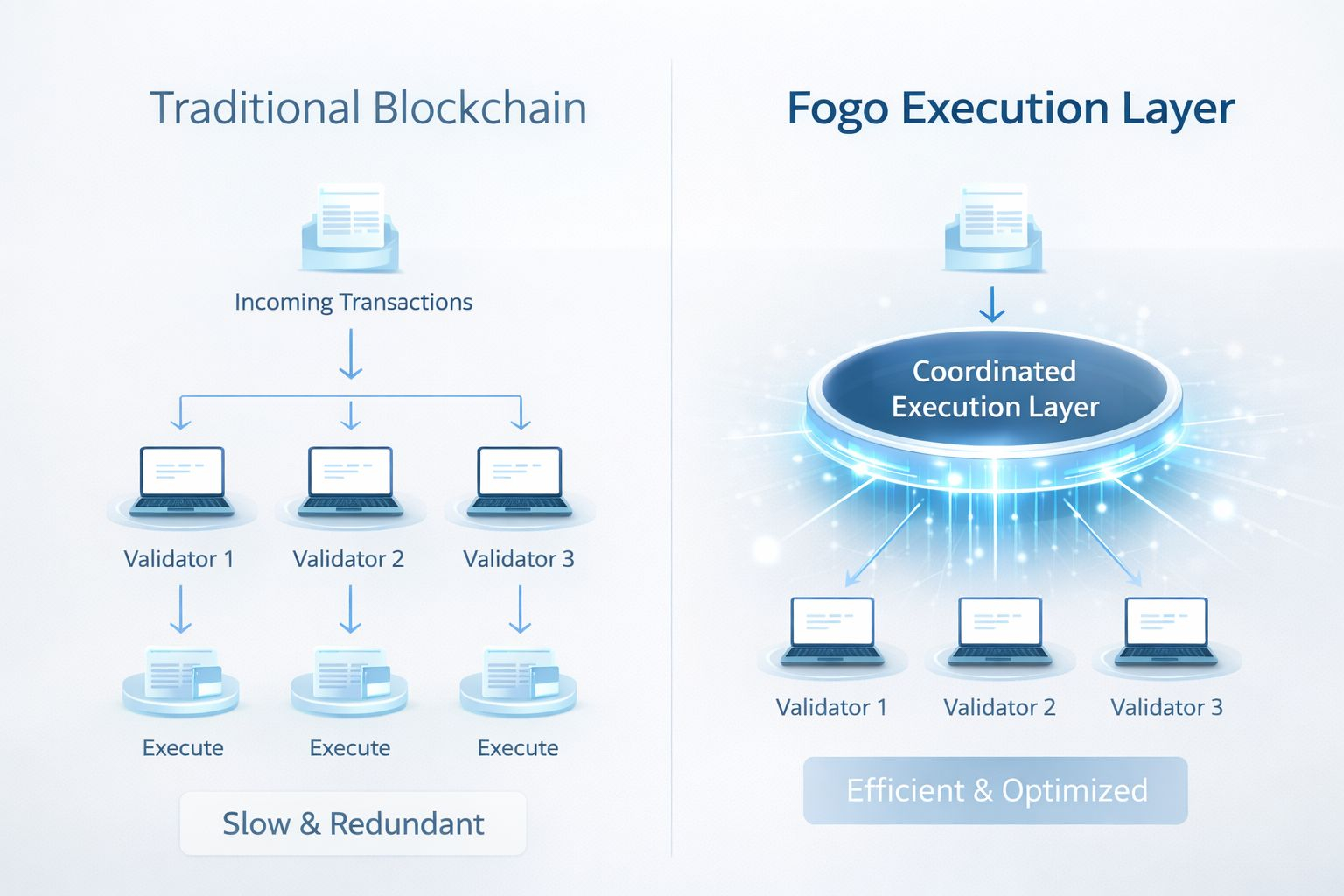
One of the most important advantages of Fogo’s execution-focused design is consistency. In traditional systems, execution timing can vary depending on validator synchronization and network conditions. This creates unpredictability, which limits the types of applications that can reliably run on blockchain infrastructure. Fogo’s coordinated model reduces this variability, creating a more stable and predictable execution layer. Predictability is critical for advanced applications such as algorithmic trading, AI agents, and real-time financial systems, where delays or inconsistencies can lead to inefficiencies or failures.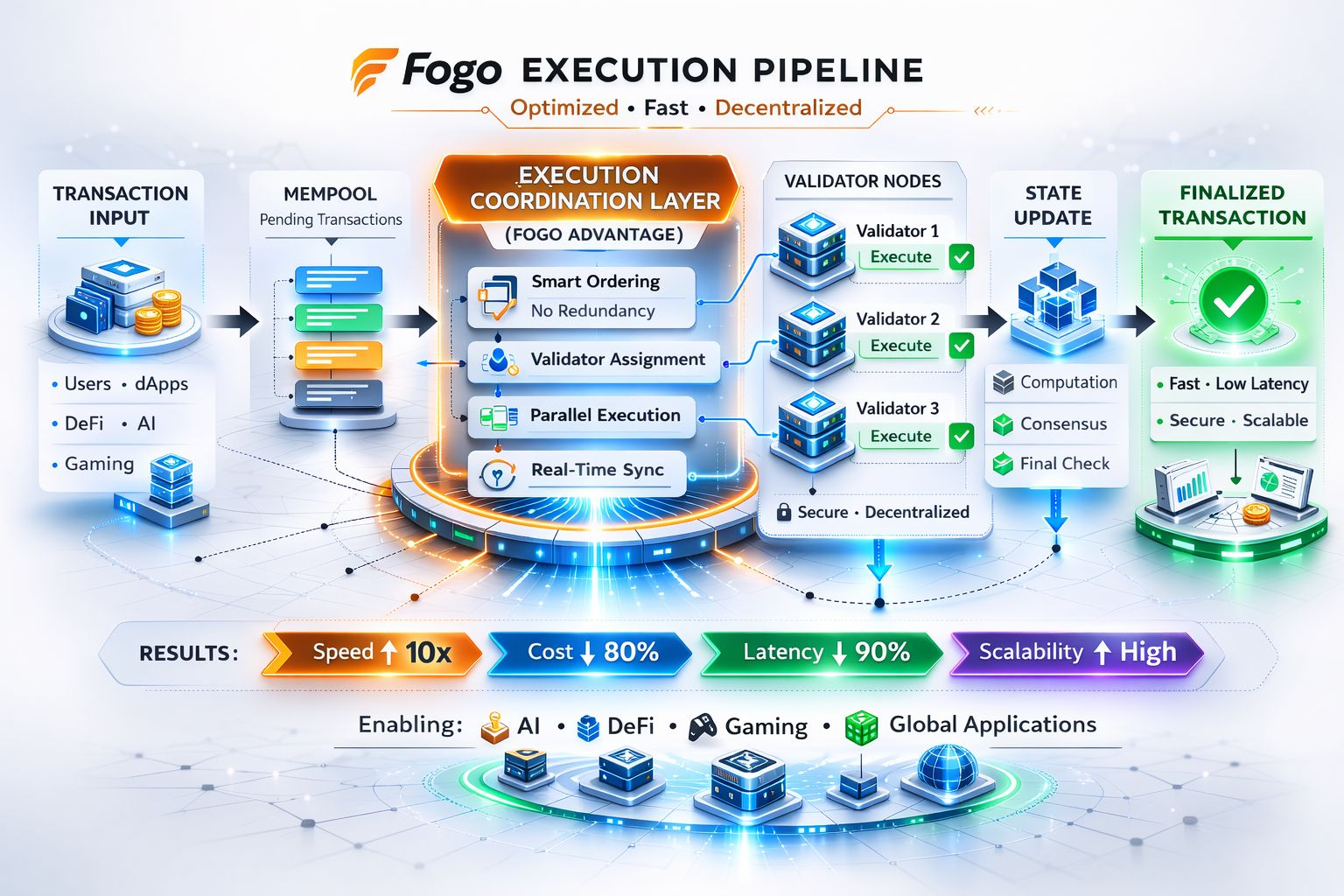
Execution efficiency also directly affects scalability. Many blockchain scaling solutions focus on increasing throughput by increasing block size or adding parallel chains. However, these approaches often shift the bottleneck rather than eliminating it. Fogo addresses scalability at its root by improving execution efficiency itself. When execution becomes more efficient, the network can process more transactions without increasing hardware requirements or compromising decentralization. This allows the network to scale more naturally while maintaining performance.
Another critical implication of execution optimization is improved user experience. Most users do not think about consensus or validator coordination. They only care about whether transactions complete quickly and reliably. Slow execution creates friction, reduces confidence, and limits adoption. By improving execution speed and predictability, Fogo creates an infrastructure layer that feels faster and more responsive. This improves usability and makes blockchain technology more practical for mainstream applications.
The importance of execution becomes even more apparent when considering the future of decentralized systems. AI agents are expected to perform autonomous transactions, financial protocols are becoming increasingly automated, and digital economies are expanding rapidly. These systems require infrastructure that can handle high volumes of transactions with minimal delay. Execution efficiency will determine whether blockchain can support these next-generation workloads. Networks that fail to optimize execution will struggle to support advanced applications, while execution-optimized networks will become foundational infrastructure for the digital economy.
Fogo’s approach represents a shift in how blockchain performance is improved. Instead of focusing only on consensus or superficial scaling techniques, it addresses execution coordination directly. This allows the network to operate more efficiently without compromising decentralization or security. By optimizing how validators coordinate and execute transactions, Fogo improves performance at the structural level rather than applying temporary fixes.
This evolution reflects a broader shift occurring across the blockchain industry. Early blockchain development focused on security and decentralization. The next phase focused on scalability. Now, the focus is shifting toward execution efficiency. Execution is where real performance is determined, and execution-optimized networks will define the next generation of blockchain infrastructure. As decentralized systems continue to evolve, execution efficiency will become the primary factor that determines which networks can support the future digital economy.
Fogo is emerging at the center of this transition by focusing on execution as the core performance layer. By improving validator coordination, reducing redundant computation, and creating a more predictable execution environment, it addresses one of the most fundamental limitations of traditional blockchain architecture. This positions Fogo not just as another blockchain, but as part of a new generation of infrastructure designed specifically for high-performance decentralized systems.
As blockchain adoption continues to expand into finance, AI, and global digital infrastructure, execution will determine which networks succeed and which fall behind. In this new competitive landscape, execution is no longer just a technical detail. It is the foundation of performance, scalability, and usability. And this is exactly where Fogo is building its advantage.