

Every cycle, a new chain makes that promise. Benchmarks look impressive. Throughput charts climb higher. And yet when you deploy real applications, the experience rarely changes enough to matter.
What changed my view wasn’t a benchmark. It was structure.
Headline TPS numbers don’t capture how systems behave under stress. During peak NFT waves, Ethereum gas fees have exceeded $50 per transaction. That isn’t a marketing failure. It’s structural congestion. Sequential execution forces transactions through a single ordered pipeline. When demand rises, the queue grows. Fees spike to ration access. Latency becomes unpredictable.
Congestion is not random. It’s architectural.
EVM based systems execute transactions largely one after another. That design favors simplicity and deterministic state transitions, but it creates a single-lane highway. When traffic increases, everything slows down together. Even unrelated actions wait in line.
SVM changes the lane structure entirely.
Instead of assuming transactions must execute sequentially, SVM allows parallel execution when transactions don’t touch the same state. Independent workloads don’t block each other. If two users interact with different programs, those operations can proceed simultaneously. The system scales across lanes instead of stacking cars in one.
This is where the difference becomes behavioral.
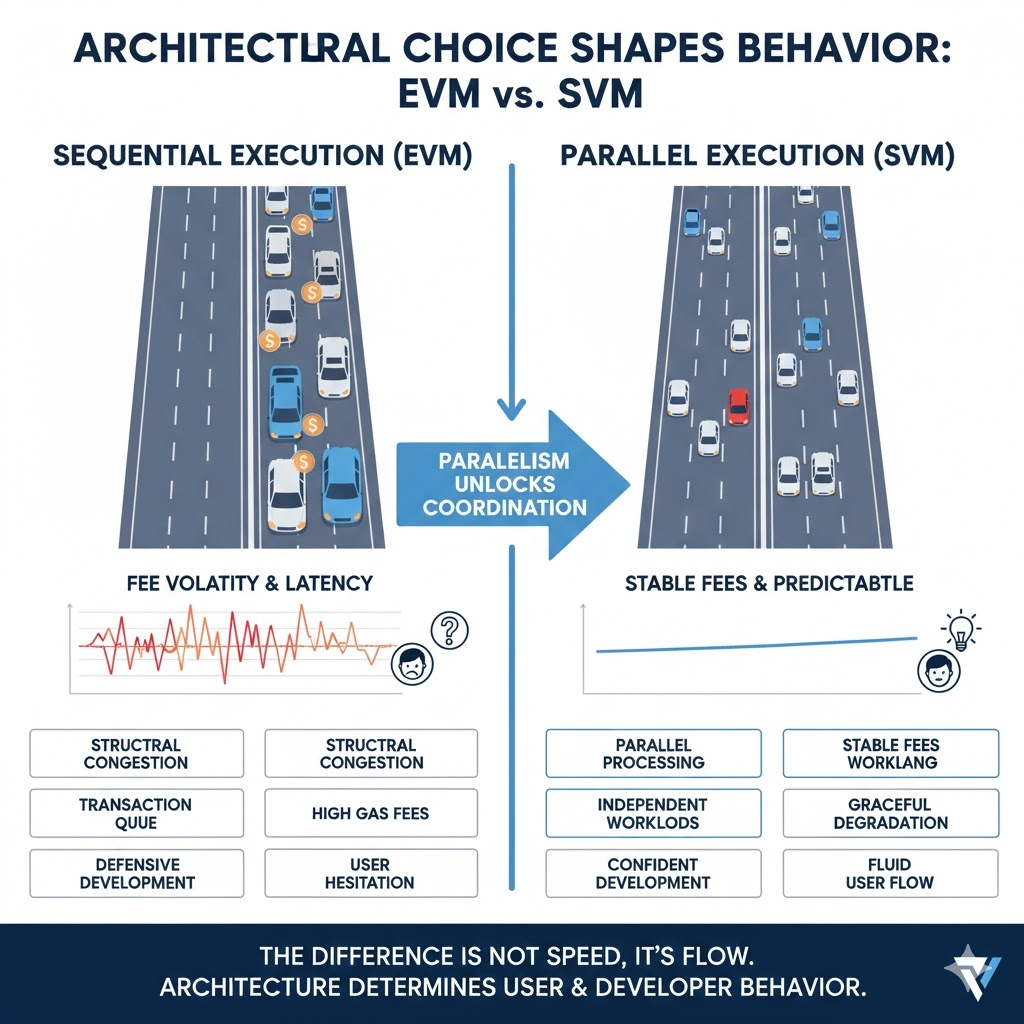
Sequential systems create fee volatility under load. Fee volatility changes user behavior. Users batch actions. They hesitate. They delay small interactions. Developers respond by compressing flows, adding buffers, overestimating gas, and designing defensively. The chain begins to shape the product.
Parallel execution reduces that pressure. When unrelated transactions don’t compete artificially, performance degrades more gracefully. Fees remain more stable. Responsiveness holds up longer. The network doesn’t need to aggressively price people out to stay functional.
Queues are policy. Parallelism is architecture.
Predictability becomes the multiplier.
When users don’t have to wonder whether a click will cost cents or dollars, they act more freely. Small transactions become normal. Real-time interaction feels viable. Flow improves.
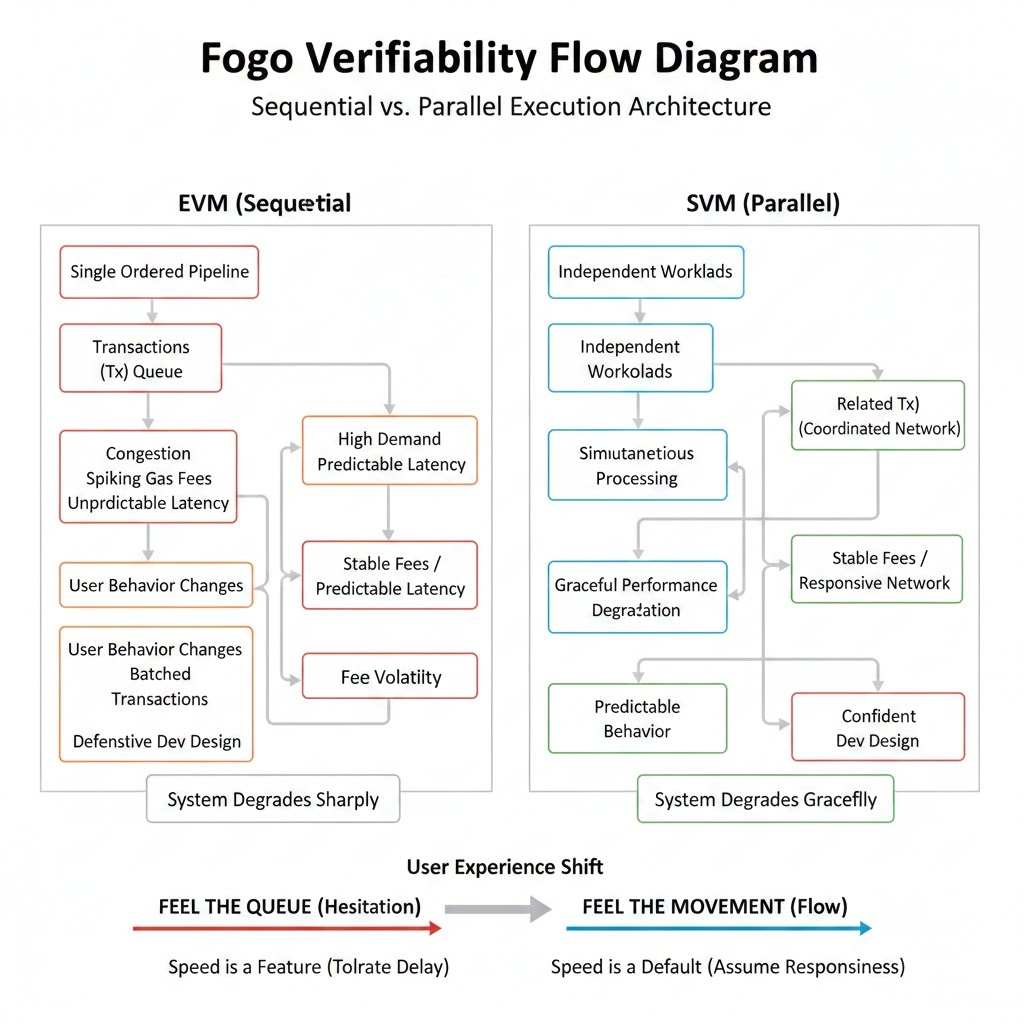
Developers feel it too. On EVM, significant engineering effort goes toward surviving congestion. Gas optimization drives architecture. State design becomes defensive. Execution order is a constant concern. A surprising amount of creativity is spent navigating structural limits.
With SVM, the constraints move. Concurrency is assumed. Independent workloads scale naturally. Instead of building around scarcity, you build around coordination. That doesn’t eliminate complexity, but it changes its direction.
This is why describing SVM as faster is incomplete. The advantage isn’t magical transaction efficiency. It’s coordination. It’s eliminating artificial serialization.
Performance is not just speed. It’s flow.
Of course, tradeoffs exist. EVM has unmatched ecosystem depth, tooling maturity, and familiarity. Its simplicity has advantages. Parallel systems require careful account management and thoughtful state design. Developer ergonomics evolve differently. Ecosystem gravity matters.
Choosing SVM over EVM isn’t about declaring one obsolete. It’s about prioritizing how systems are used today. High frequency interaction. Consumer-scale flows. Applications that assume responsiveness, not tolerate delay.
After working across both models, the difference is not visible in a dashboard first. It’s visible in hesitation. On sequential systems, you feel the queue. On parallel systems, you feel movement.
That feeling compounds.
Architectural decisions are rarely visible to end users, but they determine whether systems degrade sharply or gracefully. They influence whether developers design cautiously or confidently. They shape whether users pause or proceed.
Once you experience a system where unrelated actions don’t wait in line behind each other, it becomes difficult to ignore the structural shift.
Speed stops being a feature.
It becomes the default.
