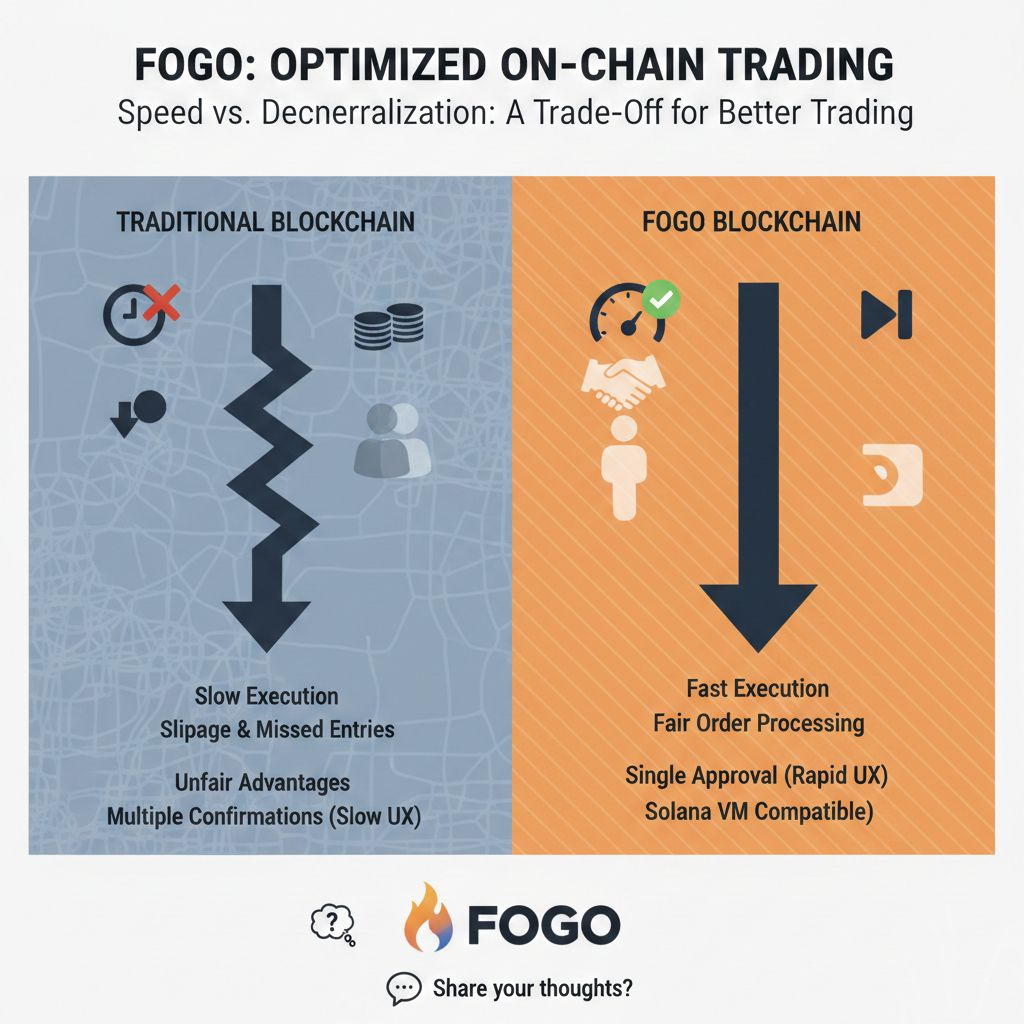
Do your on-chain trades also get filled late?
You place an order, wait… and by the time it confirms, the price has already moved. Slippage eats your profit or your entry gets missed. I’ve been through this more times than I can count, and honestly, that’s where most on-chain systems fail. Not in theory, but in real trading.
I’ve spent a lot of time studying crypto projects that claim to fix trading. Most of them promise big ideas but don’t solve the real pain. Fogo felt different. It’s not trying to do everything. It focuses on one thing: making trading actually work on-chain.
If you’ve ever used a DEX, you know the frustration. Orders take longer than expected. Execution can be random. Sometimes it even feels like someone else got ahead of you, even though you clicked first. That uncertainty kills confidence, and it’s exactly what Fogo is trying to fix.
Fogo is a Layer 1 blockchain built on the Solana Virtual Machine. Developers can bring over existing apps without rebuilding everything from scratch. But for me, the important part is whether it actually improves trading. If it doesn’t fix execution, nothing else really matters.
Most blockchains were never designed for fast markets. They’re fine for sending tokens or slow interactions, but active trading breaks them. Execution is slow, order outcomes are unpredictable, and sometimes hidden advantages exist for others. I’ve seen trades where my order got filled at a different price, and it makes you wonder — was I just slow, or is the system unfair?
Fogo feels different because it focuses on speed and clean execution. Faster blocks, quicker confirmations, less waiting. In trading, timing is everything. Even a small delay can turn a good trade into a bad one.
Fogo co-locates validators closer together to reduce delay. Some people might say it’s not fully decentralized. But let me be honest — if my trades execute fast and fair, I’m okay with that trade-off. Execution matters more than ideology, at least for active trading.
Another thing I like is fairness. On many chains, transaction order isn’t always clear. Some participants have an advantage, and you feel it. Fogo tries to make it straightforward. You place an order, it gets processed without hidden tricks. At least, that’s the goal. If they can deliver that, it would solve one of the biggest problems in on-chain trading.
User experience is also considered. In DeFi, you constantly approve, sign, confirm, and wait. It slows you down, especially when you need to react quickly. Fogo introduces a session-style system: approve once, then interact freely. It sounds small, but it changes how the system feels. Trading isn’t just about network speed; it’s about how fast you can act.
From what I’ve seen, Fogo is moving beyond ideas. The network has been tested under conditions that matter. Transaction speed, confirmations, and stability are being observed in real use cases. There’s a clear focus on trading applications, not random experiments. That kind of focus is rare.
Fogo isn’t trying to please everyone. Its focus is trading, and that means making trade-offs. Some people won’t agree with this approach. But at least it’s honest. Too many projects try to do everything and end up doing nothing well. Fogo doesn’t feel like that.
After looking at it closely, I don’t see Fogo as a “next big everything chain.” I see it as something more specific: a system trying to make on-chain trading feel fast, fair, and usable. And honestly, after dealing with slow and unpredictable execution for so long, that alone feels like a step in the right direction.
What do you think? Is speed more important or decentralization? Share your thoughts in the comments!