
Fogo is the novel type of blockchain. Contrary to most sites that attempt to report on games, NFTs, and applications simultaneously, Fogo is all about on-chain finance in real-time that is high-speed, or fast - transactions are done quickly, reliably, and with virtually no latency.
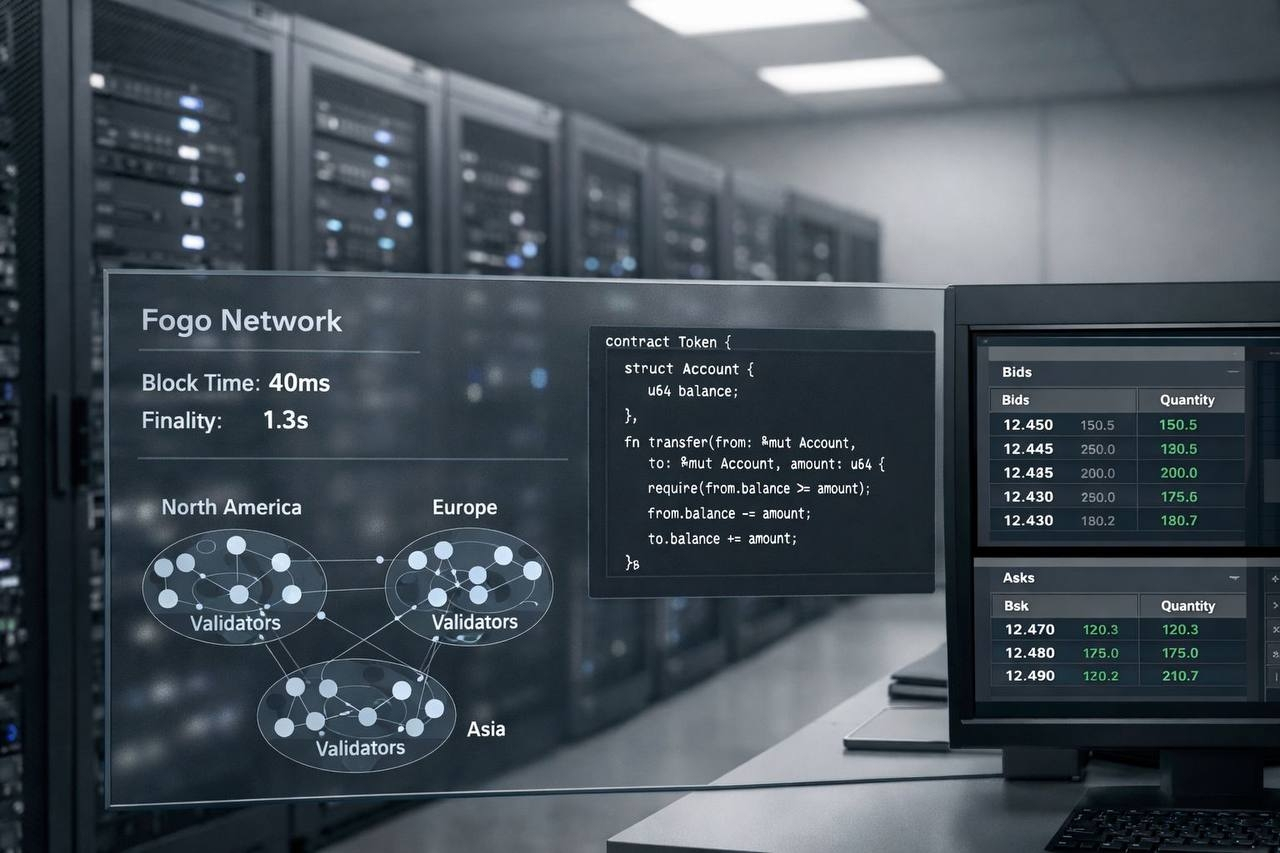
To understand why this is important, consider the way the majority of blockchains work nowadays and the fact that a transaction can spend over a minute to confirm, which in fact can be a major irritant to certain individuals.
The importance of Speed and Reliability in Finance.
In real world blockchain applications, such as sending coins or issuing a nonfungible token, the fact that it may take several seconds to do so is generally not a big deal. However with real finance, particularly trading style applications, a fraction of a second can turn a victory into a defeat.
For example:
Speed of execution of a trade.
The speed at which order book is updated.
The exact way a liquidation is done.
Each of them requires milliseconds rather than seconds. Contemporary trades nail in that, yet the vast majority of blockchains were not designed to do so.
Fogo was developed to overcome the remnants of traditional finance speed and blockchain transparency.
The way Fogo Provides Live Performance.
Fogo has a number of technical tricks. I will make them down to plain English:
Construction on the Solana Virtual Machine (SVM).
Fogo is based on the same virtual machine Solana operates on. That's a win because:
The developers already from Solana can easily transfer their apps to Fogo without writing new code.
Current means and developer skills are easily transferred.
That reduces the hassle on the part of the builders and contributes to the natural expansion of the network.
Custom Validator Customer with Firedancer.
A collection of computers, called validators, is used to agree on the order of the transactions and create new blocks in blockchains. Most chains will allow you to be able to run various versions of clients, though slower client versions can bring the entire network to a crawl.
Fogo uses a single super-optimized Solana eco validation client that is supported by Firedancer, a high-performance implementation.
That will allow the entire network to think in terms of speed and reliability rather than be slowed down by sluggish clients.
Ultra-Latency and Rapid Finality.
Latency is the duration of time between giving a transaction and the network verifying it.
Fogo sets targets like:
Block time= 40ms on average, that is, a new block every 40 thousandths.
~1.3 finality How long your tx has been nailed after submission.
The speeds of these are nearer to those experienced by trading systems compared to normal blockchains.
Multi Local Consensus and Validator Zones.
Fogo does not locate validators spread all over the globe, but concentrates them in geographic areas to maintain fast communication amongst their local counterparts.
Consider it as the presence of validator squads that are located regionally therefore messages move quicker and block-agreement smoothers, therefore reducing delays.
Fogo Sessions-It is a better user experience.
Another popular grind among crypto apps nowadays is that multiple approvals need to be signed or small fees charged on each move. Fogo mends this with Fogo Sessions which is a scheme that allows users to tap into apps with fewer hiccups and at times even gas-free maneuvers.
This is aimed at ensuring on-chain finance becomes smoother, predictable and a bit more like the web that we are accustomed to without compromising security.
Token and Ecosystem- The reason why FOGO exists.
FOGO, the original token, accomplishes the following few things:
It pays transaction charges and compensates authenticators.
It uses it to stake rewards enabling holders to contribute to network security.
It drives governance and involvement in community in the long run.
Instead of concentrating the bulk of the supply behind a closed list, the team has airdropped tokens to the community via various programs, such as early incentives, partnerships, etc. The concept is to harmonize the interests of the users, builders and the community in the long term.
Existing Uses on Fogue.
Fogo has hosted live apps including:
Decentralized exchanges
Borrowing and lending procedures.
Liquid staking platforms
Token launchpads
These are all signs that Fogo is already being used in practice outside of testnets, and developers are working on high-latency-sensitive finance with its speed.
[?]
This is a bridge to Other Blockchains.
Another cross-chain bridge, Wormhole, was also connected to Fogo. That enables users and devs to move assets such as USDC, ETH and SOL to Fogo without any trouble.
The interoperability is important as it is a unifying factor in the fast environment that Fogo is in; it will stretch its usability because it draws on the liquidity and assets of the large chains.
Balanced Perspective: Problems and Reality.
It is a cool technology by Fogo, but you have to keep in mind:
Speed is not the matter, liquidity, dev support, and ecosystem growth are required to make the adoption.
Validator design compromises speed in decentralization, something that is important to some people.
The conditions of the market are important - institutional activity, clarity of regulation, and actual use will determine the way of Fogo.
Concisely, Fogo presents a clever technical solution, however, its actual effect is going to be felt once the constructors and consumers begin to ride the network in their daily lives.
In Simple Words
Fogo essentially a contemporary blockchain created on objective to real time finance. It steals sound concepts such as the Solana VM and lighting-speedy validator software and packages them in such a way that the game is fast, predictable, and smooth to users.
That suits it well to order books, liquidations and auctions as well as to high-frequency trading, where milliseconds matter. However, it will only win when it is truly adopted, a garden economy is created and it is worked upon, not merely by flashy figures.