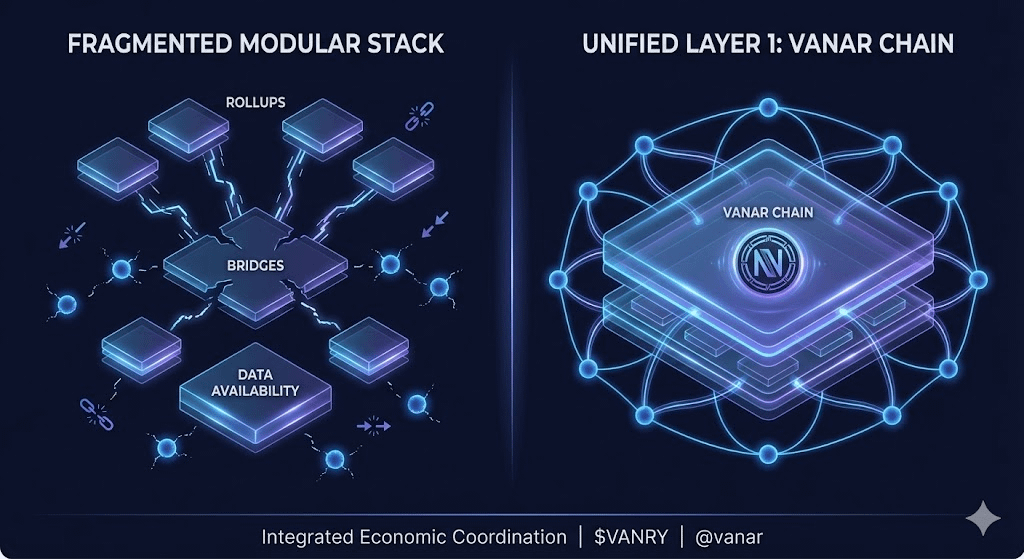
When discussing blockchain scalability, people typically refer to modularity. They disaggregate execution, rollups off of computation, and specialized layers take care of data availability. Although this design has the capability of increasing the theoretical throughput, it introduces a new limitation; coordination overhead. Liquidity is fragmented across markets, bridges are choke points, and users have inconsistent paths of transactions. There is improved performance and a decline in the general coherence.
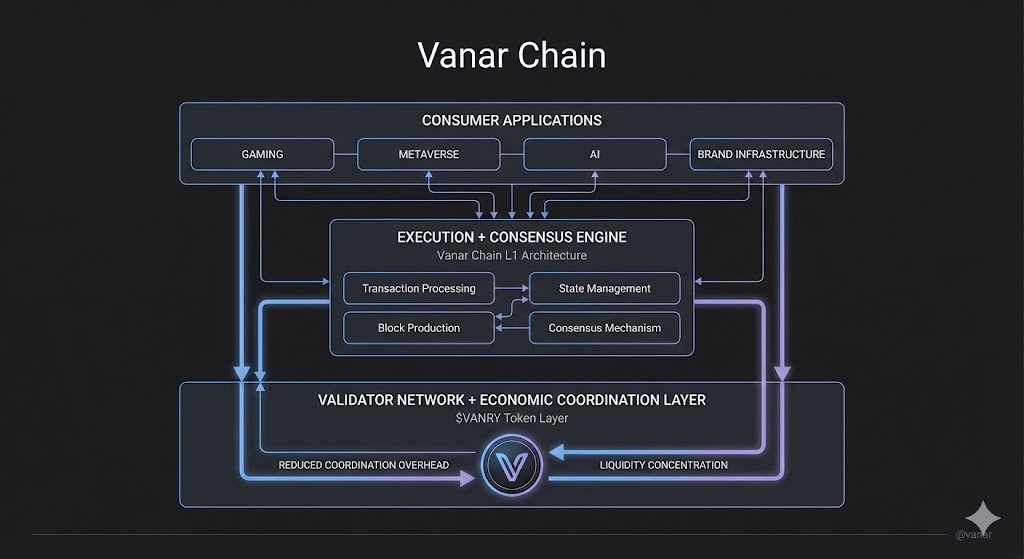
@Vanarchain is addressing this shortcoming in another way. It does not maximize component separation instead, it has the majority of functions within a single Layer-1 blockchain. The concept is workable individuals embrace a network not as much because of raw speed but as a result of a coherent and integrated system.
On the feature level, Vanar will be a single base network combining gaming tools, metaverse worlds, AI, and brand integration. At the system level this slices cross domain dependencies. Apps in modular ecosystems are dependent on external rollups, bridges, and liquidity routes. Each connection introduces government labor and an opportunity of making mistakes. Vanar reduces these points of coordination by maintaining these two functions in close contact, execution and consensus. A concentration on system stability and not component scaling is the industry effect.
This logic is evidenced in such platforms as Virtua Metaverse and VGN games network. Leaving them on the same Layer-1 minimizes friction on transfers of assets, latency swings, and maintaining the same execution rules. The advantage is not limited to technology, but it is also economical. As long as user assets, identities, and flow of transactions remain within a single state, liquidity gets concentrated and bridge risk decreases.
Characteristics On the technical component, a unified design transforms coordination among validators. In modular stacks, all validators, sequencers and data-availability nodes are in different layers, and upgrading and inter-tier governance is more difficult. These boundaries are clipped by Vanar. The downside? The gains of scalability have to occur in one framework as opposed to off loading. This concentrates engineering and reduces endemic interdependence.
The economic glue within this integrated ecosystem is the token $VANRY . Split ecosystems tend to drag liquidity across sub-layers, which makes depth weak. One environment fixes token demand on daily operations - gameplay, asset usage, brand collaborations. This minimizes cross-layer and cross-tie speculative swaps and rewards validator to continued ecosystem usage.
Fragmentation has the potential of amplifying chaos during stress. Liquidity escapes in bridges, execution stalls wave between stages and governance requires harmonization between domains. The feedback loop is contained in a single coordination system through a cohesive architecture. It will not eliminate volatility but will restrict channels of contagion.
To developers, the unified model reduces integration threats. The apps operate under a single set of execution rules and not multi-layers operations. In the case of brands and institutional users who interact with vanar through the use of the @Vanarchain , the access points are coordinated with the existing digital infrastructure, which facilitates its use. In the long-term, this harmony may increase the liquidity concentration and governance change.
The trade‑off is real. Close coupling constrains the experimental liberty that rollup based ecosystems provide. Modular arrangements may still be preferred by teams that require special execution environment. Additionally, maintaining consumer-grade reliability on Layer-1 involves consistent performance optimization and stable upgrading.
Vanar presents a clear structural argument: scaled without being coherent throws complexity to users and capital. VANRY is a stabilizer in a consumer-based blockchain because Vanar Chain coordinates everything instead of dividing, in order to stabilize the system instead of spread it out. The enduring networks might be the ones which reduce the cost of connecting layers rather than those which cut the most.