
It’s tempting to slot Fogo next to Solana on the same leaderboard. They share the same execution lineage, similar developer interfaces, and a familiar feel for anyone who’s looked at high-performance blockchains. Glance at it quickly, and your brain does what it always does: “Oh, another chain trying to beat the fastest one.”
But that’s a misleading frame. Once you dig into Fogo’s approach, you notice something subtle but important: this project isn’t fixated on being the fastest. It’s fixated on being predictable.
The obsession with raw speed is common in crypto discussions, but it often ignores a fundamental truth: distance matters. Packets travel through the world at finite speeds, jitter happens, congestion happens, and the worst-case scenario—the “tail latency”—is what really matters when systems are under pressure. For traders, liquidators, and anyone making decisions in real time, those tail events aren’t a minor inconvenience—they define who wins and who loses.
Fogo’s design philosophy reflects that. It doesn’t shout benchmarks. Instead, it acknowledges the hard reality of distributed systems: global scale introduces variance, and variance is dangerous if you rely on precise timing. Once you accept that, everything else changes. Consensus isn’t just about who votes fastest—it’s about where those votes happen, how the network topology shapes outcomes, and which variables you can actually control.
This is where Fogo and Solana diverge. Solana aims to push the limits: a broad, permissionless network, growing its validator ecosystem, increasing throughput, and optimizing tooling. Fogo’s goal is narrower but more surgical: reduce unpredictability in execution, stabilize timing-sensitive operations, and give certain applications a consistent playground.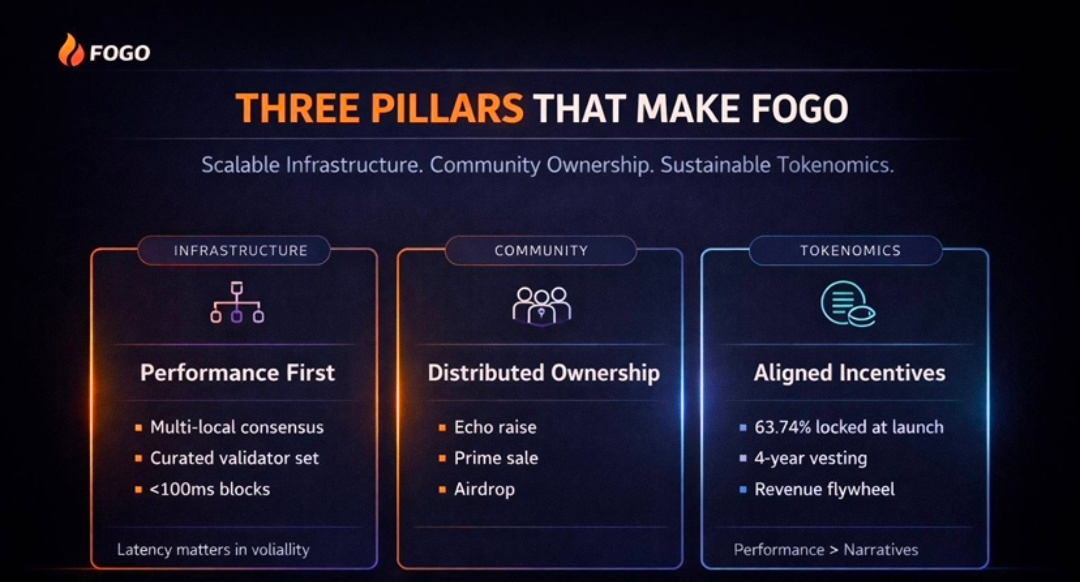
What does that look like in practice? Think of markets that are unforgiving of small delays: real-time auctions, order books, liquidations, or anything that relies on immediate transaction replacement. A millisecond can change profit and loss. Fogo wants to flatten that variability.
And flattening variance is a trade-off. You can’t maximize openness, geographic neutrality, and ultra-low latency all at once. Choices must be made. Fogo appears to favor a controlled validator set and careful network topology—not as an accident, but as a strategic decision. That opens a delicate line: the system can’t become opaque or favor insiders without undermining trust. Markets notice. Sophisticated users can feel even subtle inequities.
Performance isn’t just about consensus or block speed. It’s about the whole user loop: wallets, signing flows, and interactions that can introduce hidden delays. For latency-sensitive applications, those small frictions are amplified. Fogo’s approach seems to prioritize smoother user flows—less click fatigue, more predictable execution—so that the network doesn’t inadvertently give an edge to those running private infrastructure.
But the path isn’t guaranteed. Real-world load can expose vulnerabilities: congestion, adversarial behavior, and creative attempts to game the system can turn a theoretically stable network into one as chaotic as any other. Worse, speed may remain, but fairness could become invisible, felt only in outcomes, not reported metrics. Once suspicion sets in, trust is hard to rebuild.
If Fogo succeeds, it won’t look like a flashy victory. It will be a subtle shift in behavior: developers choosing it because mechanisms are easier to run, traders relying on it because execution feels consistent, and the network earning credibility because it behaves predictably under stress. Raw speed will matter less than reliability and fairness.
The real story isn’t “Fogo vs Solana.” It’s whether a blockchain can offer a credible, measurable, and inspectable environment for timing-sensitive markets without sliding into opaque control. If it can, it doesn’t need to “beat” anyone—it just becomes the natural home for a class of applications that demand consistency. And even if it fails, it exposes an uncomfortable truth: much of crypto’s obsession with performance is really a debate about distance, variance, and the hidden constraints that determine real-world outcomes.