
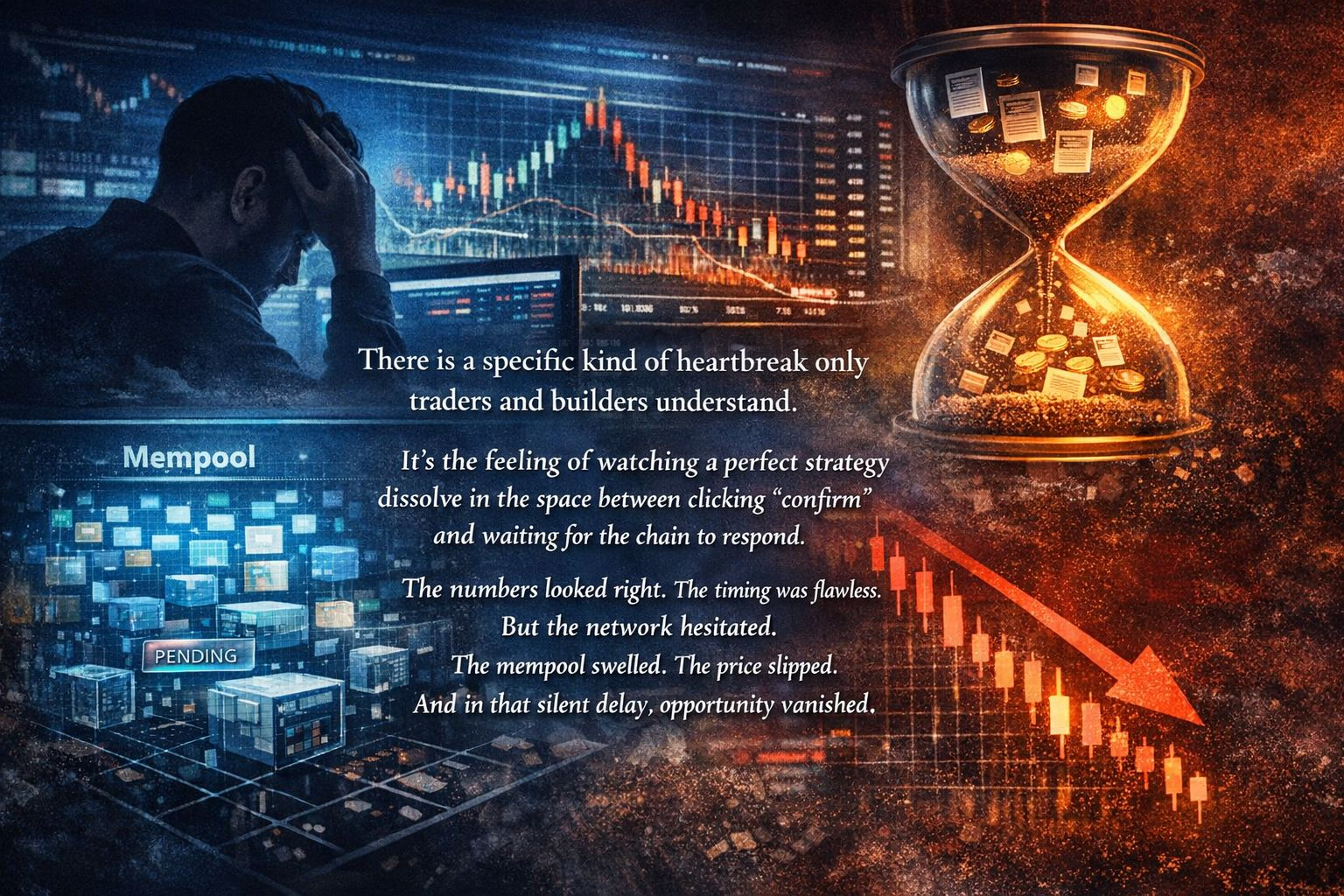
There is a specific kind of heartbreak only traders and builders understand. It’s the feeling of watching a perfect strategy dissolve in the space between clicking “confirm” and waiting for the chain to respond. The numbers looked right. The timing was flawless. But the network hesitated. The mempool swelled. The price slipped. And in that silent delay, opportunity vanished.
Fogo was born in that silence.
Not as a marketing slogan. Not as another Layer-1 promising the moon. But as a response to a very human frustration: why does decentralization still feel like waiting in line?
Fogo is a high-performance Layer-1 blockchain built around the Solana Virtual Machine. That technical detail might sound abstract at first, but it matters in a deeply practical way. By embracing the same execution environment that powers Solana’s parallel transaction model, Fogo doesn’t ask developers to abandon what they already know. It doesn’t force them to relearn the language of performance. It says, quietly: bring your tools, bring your ideas, bring your ambition — and let’s go faster.
There’s something emotionally reassuring about that choice. It isn’t revolutionary for the sake of ego. It’s evolutionary with intention. The Solana Virtual Machine allows transactions to be processed in parallel rather than one by one, dramatically increasing throughput. For developers who have struggled with bottlenecks and unpredictable execution delays, this isn’t just a feature. It’s relief.
But Fogo doesn’t stop at compatibility. It sharpens its purpose around something most chains treat as just another use case: trading.
For years, decentralized finance has tried to mimic the fluidity of centralized exchanges. Yet there has always been a gap. Centralized exchanges feel instantaneous. Orders snap into place. Markets breathe in real time. On-chain systems, by contrast, often feel like shouting across a canyon and waiting for the echo. Even when block times shrink, unpredictability lingers.
Fogo aims to close that emotional gap.
With block times targeted in the tens of milliseconds and ambitions of sub-second finality, the chain is engineered to make transactions feel immediate rather than anxious. The difference between 400 milliseconds and 40 milliseconds might seem small on paper. But in trading, milliseconds can mean the difference between profit and regret. More importantly, predictable latency restores confidence. When confirmation times are consistent, strategies become trustworthy again.
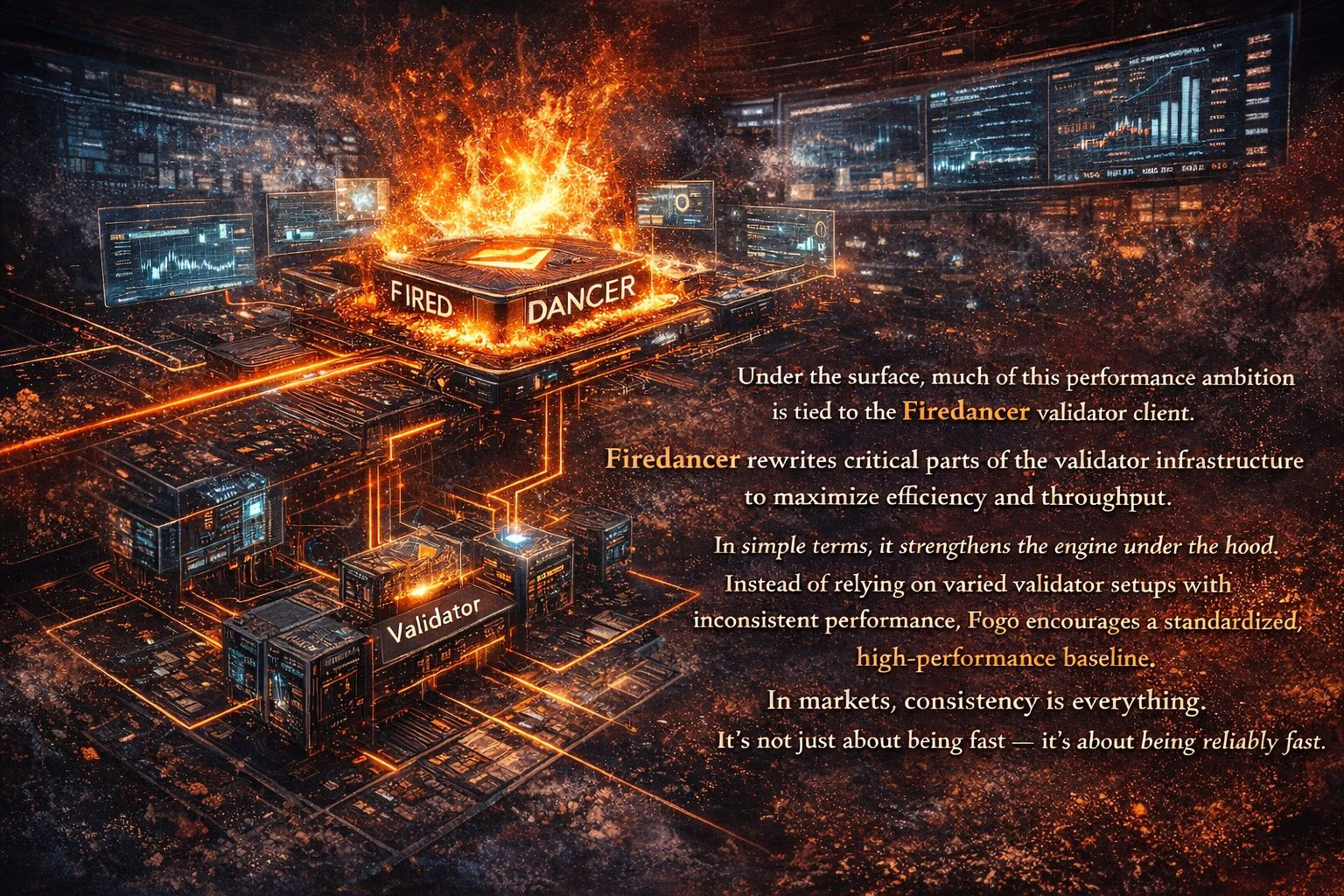
Under the surface, much of this performance ambition is tied to the Firedancer validator client. Firedancer rewrites critical parts of the validator infrastructure to maximize efficiency and throughput. In simple terms, it strengthens the engine under the hood. Instead of relying on varied validator setups with inconsistent performance, Fogo encourages a standardized, high-performance baseline. In markets, consistency is everything. It’s not just about being fast — it’s about being reliably fast.
Another subtle but powerful idea inside Fogo is zoned consensus. Rather than treating all transactions as identical streams of data, zoning allows the network to manage different types of activity with intention. Think of it like building express lanes on a highway. High-frequency trading traffic can move without being slowed by unrelated congestion. The network becomes organized, almost purposeful. It stops feeling chaotic.
All of these design decisions orbit around one emotional truth: waiting is exhausting.
Developers are tired of building around constraints instead of potential. Market makers are tired of widening spreads because they cannot trust settlement speed. Retail traders are tired of wondering whether their transaction will land in time or get swallowed by volatility. The promise of decentralization was empowerment, but too often it came wrapped in delay.
Fogo’s appeal lies in the possibility that decentralization can finally feel responsive.
Imagine a young developer sitting at her desk at 2 a.m., testing a new on-chain order book protocol. In the past, she ran simulations only to see performance crumble under load. Now she deploys to a network tuned specifically for high-frequency financial logic. Transactions process in parallel. Confirmation is swift. The system behaves. For the first time, her design feels realistic instead of theoretical.
Or imagine a small trading firm that once relied solely on centralized exchanges because on-chain execution felt too risky. With predictable sub-second finality, hedging strategies become viable. Liquidity provision feels less like gambling and more like calculated participation. Decentralized infrastructure stops being an experiment and starts being an option.
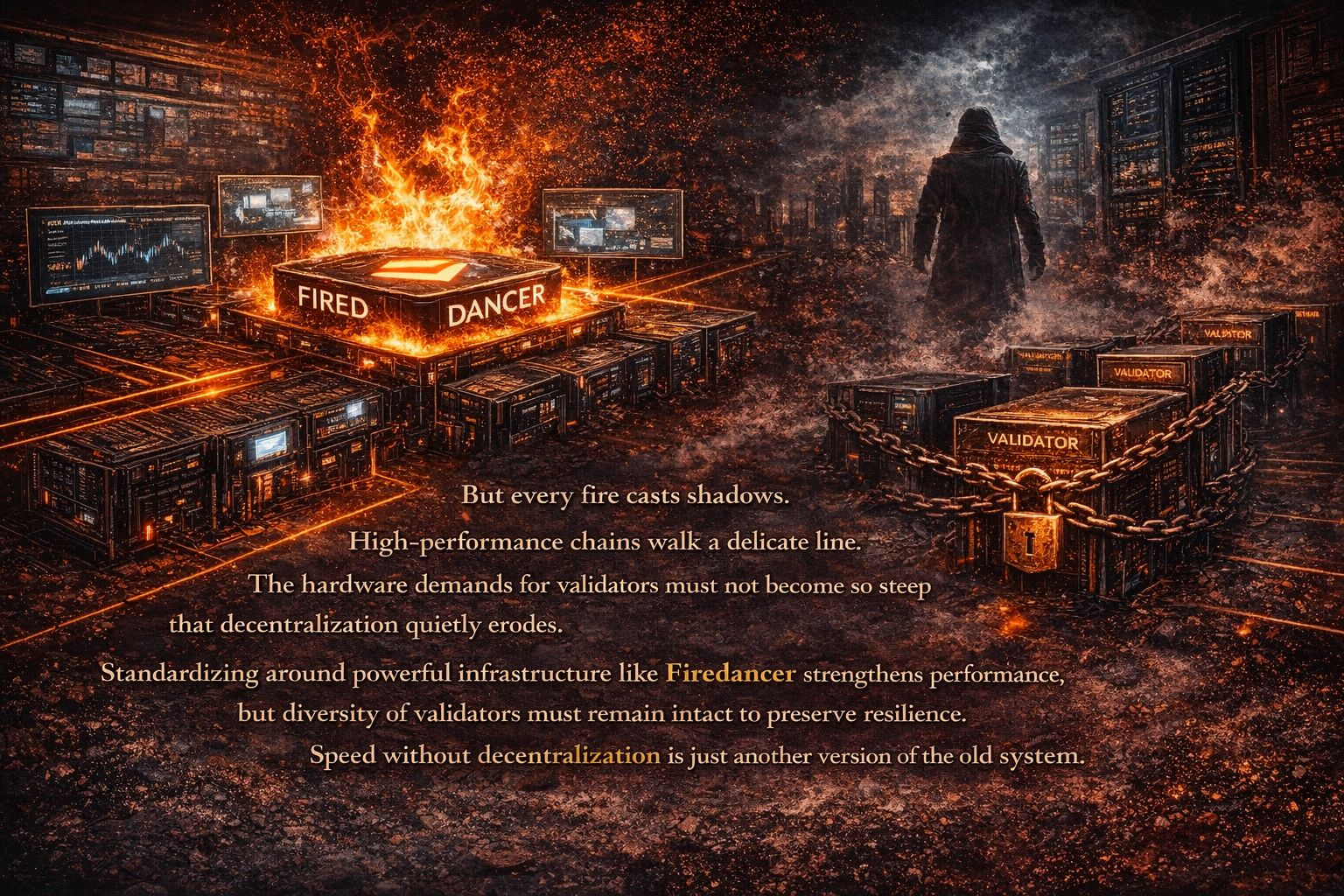
But every fire casts shadows.
High-performance chains walk a delicate line. The hardware demands for validators must not become so steep that decentralization quietly erodes. Standardizing around powerful infrastructure like Firedancer strengthens performance, but diversity of validators must remain intact to preserve resilience. Speed without decentralization is just another version of the old system.
Fogo’s future will depend not only on its technical benchmarks, but on how it behaves when markets turn violent. When volatility surges and transaction volumes spike, will it remain stable? When opportunistic actors search for MEV extraction, will its architecture reduce exploitation or accelerate it? These questions matter because trust is fragile. Once lost, it does not return easily.
And yet, hope remains a powerful force in crypto.
What makes Fogo compelling is not only its throughput numbers or validator optimizations. It is the emotional shift it represents. It suggests that decentralization does not have to apologize for being slow. It proposes that open systems can compete with the polished speed of centralized venues. It whispers that transparency and performance can coexist.
In the end, blockchains are not just networks of nodes. They are networks of people — engineers tuning clients, validators maintaining uptime, traders risking capital, developers chasing vision. Performance metrics matter because human lives orbit them. A delayed confirmation can mean a missed opportunity. A reliable settlement can mean stability.
Fogo feels less like a product and more like a response to a collective impatience — an impatience born from believing that decentralized markets deserve better infrastructure.
Whether it becomes a lasting foundation or a brief spark will depend on execution, governance, and community. But the emotional truth remains: there is something powerful about a chain designed not merely to exist, but to move.
And perhaps that is what makes Fogo resonate. Not just speed for its own sake, but speed that restores belief.
