The Layer-1 discourse has dominated the idea of throughput, but the effects of market dislocations in congestion still exist. Its failure period is not caused by lack of transactions per second. It is execution variance. In the case of the expansion of confirmation timing unpredictably, structural inefficiencies of decentralized markets include extended spreads, greater MEV capture, delayed settlement, and fragmentation of capital. Execution determinism does not qualify as a performance metric. It is financial infrastructure.
Fogo is a high-performance Layer-1 based on the Solana Virtual Machine, whereas the strategy of the company is more than just speed. The architectural orientation of the @fogo is an acknowledgement of the fact that distributed systems need to internalize latency and state contention as economic factors.
On a feature level, SVM provides a parallel execution of transactions on the basis of account level separation of state. Non-overlapping state transactions can be run in parallel. The ability of that is not new. The higher-level implication is more significant: less artificial serialization decreases dispersion in confirmation-times in times of demand spikes.
Unrelated transactions also compete over the order in sequential virtual machine environments. This generates bottlenecks in execution in the absence of logical dependencies. What it gets is not only slower blocks, but random settlement windows. Delay risk is compensated by pricing in the markets.
The parallel execution model by Fogo minimizes this unnecessary contention. The reduced number of forced conflicts at the system level will translate to reduced latency distributions. This has a direct impact at the industry level in terms of capital efficiency in decentralized exchanges, lending markets, and derivatives platforms where timing accuracy impacts on collateralization safety and liquidation thresholds.
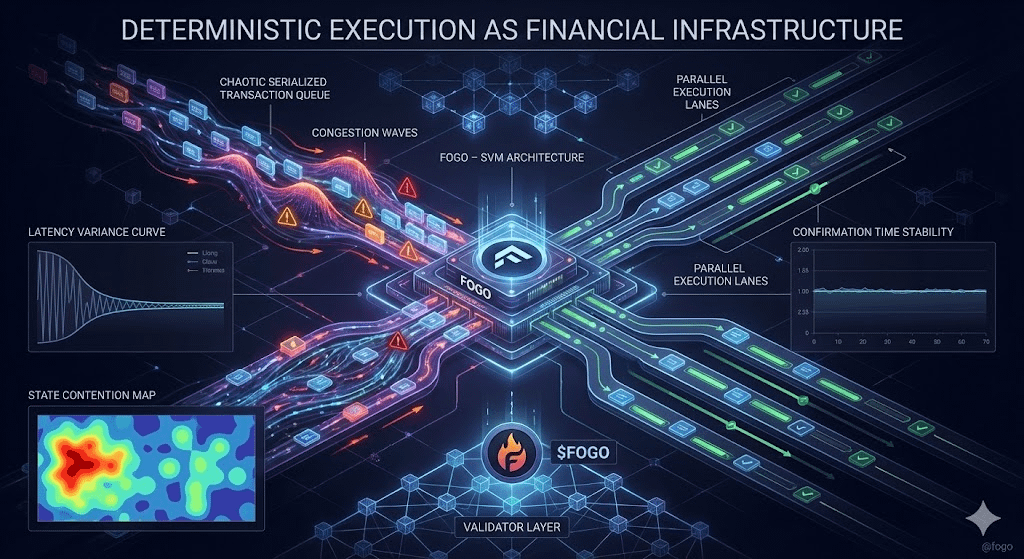
Under volatility execution variance intensifies. When a demand surge occurs, state contention rises, mem pools grow and order becomes economically sensitive. Popular networks based on serially executed computation inevitably make extraction asymmetry more common. The benefits related to timing are monetizable.
Fogo attempts to structurally constrain these asymmetries by design by working around parallel execution. Deterministic access to state space makes the surface area in which microsecond benefits result in disproportionate gain smaller. This is non exclusion of MEV, but diminution of execution unpredictability as a systemic enhancer.
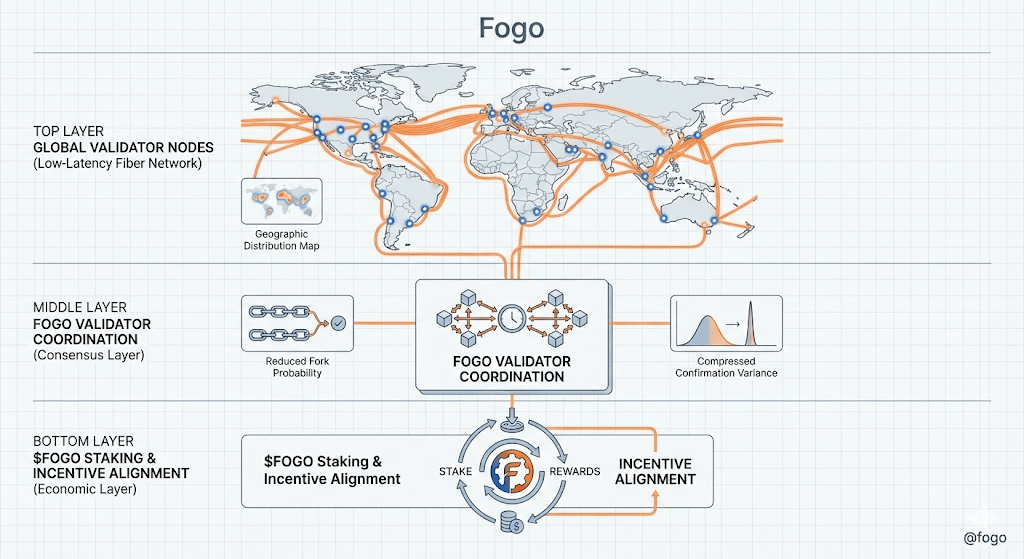
This architecture is supported by consensus and validator coordination. Increased propagation and reduced synchronization minimize the probability of forks and risk of stale block. At feature level, this enhances confirmation times. On the system level, it minimizes uncertainty of reorganization. It makes settlement finality more confident at the industry level and especially to capital-intensive protocols.
Behavioral alignment within this framework is pegged on the token, which is $FOGO. The process of incentive design is often reduced to staking rewards. The second deeper role is economic discipline in stress. Internalization by the validators, when they invest capital, implies that they internalize performance on the network in form of exposure. Asset value is directly influenced by infrastructure degradation.
This alignment is critical in high volatility. The validators are encouraged to ensure the quality of hardware, geographic redundancy and network optimization. The latency variance is enhanced by poor coordination and this affects the market confidence. Operational investment is consequently fostered by economic exposure.
Performance-centric networks, however, have a tradeoff in their structure. Reduced latency requirements usually mean increased hardware requirements. The validator concentration risk increases in case the cost of participation increases on a material basis. The situation with decentralization is that it cannot be measured only by the number of nodes, but it should also encompass autonomy, territorial diversification, and the distribution of capital among $FOGO owners.
The long term credibility of Fogo is pegged on this balance. Credible neutrality is essential to performance to build trust in infrastructure. On the other hand, determinism is destroyed by excessive indulgence in poor performance. The sustainable construction needs self-controlled balance.
To designers, deterministic execution eases the design assumptions. Protective latency buffers and asynchronous compensation logic can be minimized using applications. When the time of settlement is predictable, this enhances composability. This minimizes systemic weakness in linked protocols.
Structurally, the liquidity markets gain. Implicit risk premiums are lower by narrower confirmation variance. The market makers are able to operate at tighter spreads. Collateral efficiency by itself enhances when the liquidation engines are based on uniform timing assumptions. In the long run, these micro-efficiencies would add up to macro capital efficiency returns.
The wider industry implication is that there is a change in throughput competition to execution-quality competition. Tolerance of settlement unpredictability goes down as decentralized systems come to link with institutional capital flows. Financial infrastructure is not judged by capacity, but response in extreme events.
With the help of Solana Virtual Machine in its own architectural environment, @Fogo Official will be involved in this transition. The importance of $FOGO s that it has to be able to maintain incentive alignment and validator discipline without compromising decentralization integrity.
Deterministic execution is capital infrastructure converging to a common realization at Layer-1. The next phase of market maturation of blockchain will be characterized by networks that run with structural execution risk reduction.
Speed narratives are not the competitions that Fogo is fighting. It is positioning which is surrounding the variances compression. And compression in a financial system is more often better than crude expansion.