

Every cycle, a new chain publishes cleaner benchmarks, faster block times, tighter finality. And yet, once you deploy something that must survive real traffic, real volatility, and real user behavior, the gap between marketing and structure becomes obvious. What separates durable networks from temporary ones isn’t raw speed. It’s incentives.
Validator incentives determine how a network behaves when pressure rises. In Fogo’s case, participation isn’t casual. The validator set is intentionally limited,closer to 100 operators than 1,000+ globally distributed nodes seen elsewhere, and hardware expectations are non trivial. This isn’t hobbyist infrastructure. It resembles financial infrastructure. That raises the barrier to entry, but it filters for operators who treat uptime, latency discipline, and coordination quality as core responsibilities.
Users notice whether transactions settle predictably. Whether fees remain stable under load. Whether execution variance widens during volatility or compresses.
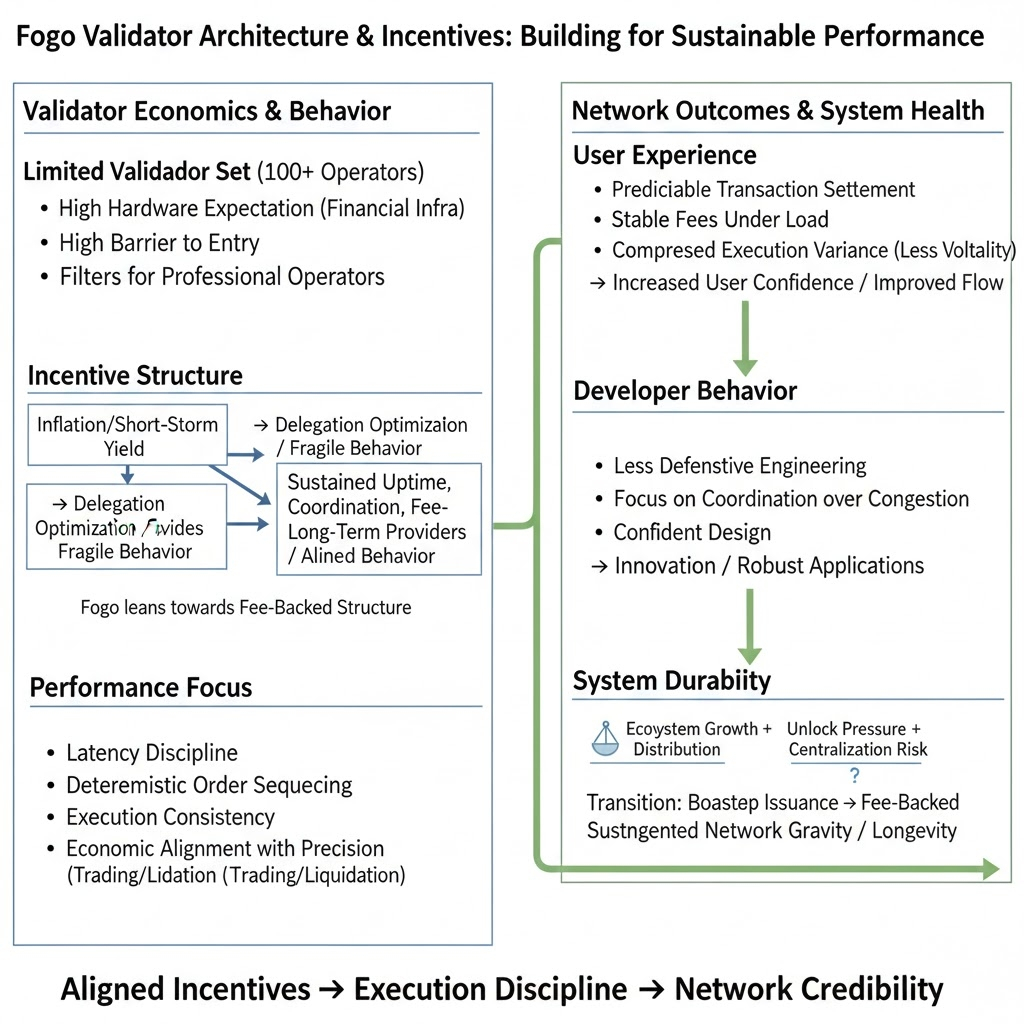
Those outcomes are shaped by incentives.
If validator rewards depend primarily on inflation and short term staking yield, behavior trends toward delegation optimization. If rewards increasingly depend on sustained uptime, coordination integrity, and fee backed activity, operators begin acting like long term service providers rather than yield maximizers.
Fogo leans toward the latter structure.
Latency discipline, deterministic order sequencing, and execution consistency are treated as structural constraints. For trading and liquidation sensitive workloads, sequencing integrity is not optional. A few hundred milliseconds of variance during volatility can alter spreads, impact liquidation timing, and shift arbitrage dynamics. Validators operating in that environment are economically aligned with execution precision.
I’ve deployed across both sequential and parallel systems. The difference isn’t visible in dashboards first. It’s visible in how much defensive engineering you feel compelled to do. On some networks, you design around congestion, padding gas, compressing flows, anticipating queue behavior. On others, you design around coordination.
That predictability is partly technical. It’s also economic.
When validator incentives align with long term network credibility rather than short-term fee spikes, congestion is handled structurally instead of through aggressive price rationing. Fee volatility narrows. Execution variance compresses. Users hesitate less. Developers overcompensate less. Flow improves.
Performance becomes coordination, not just speed.
Tradeoffs remain. A performance gated validator set improves consistency but reduces open participation. Governance power can cluster in early stages. That dynamic is not unique, early Ethereum and Solana exhibited similar concentration before broader dispersion. What determines durability is whether ecosystem growth and token distribution gradually dilute influence rather than entrench it.
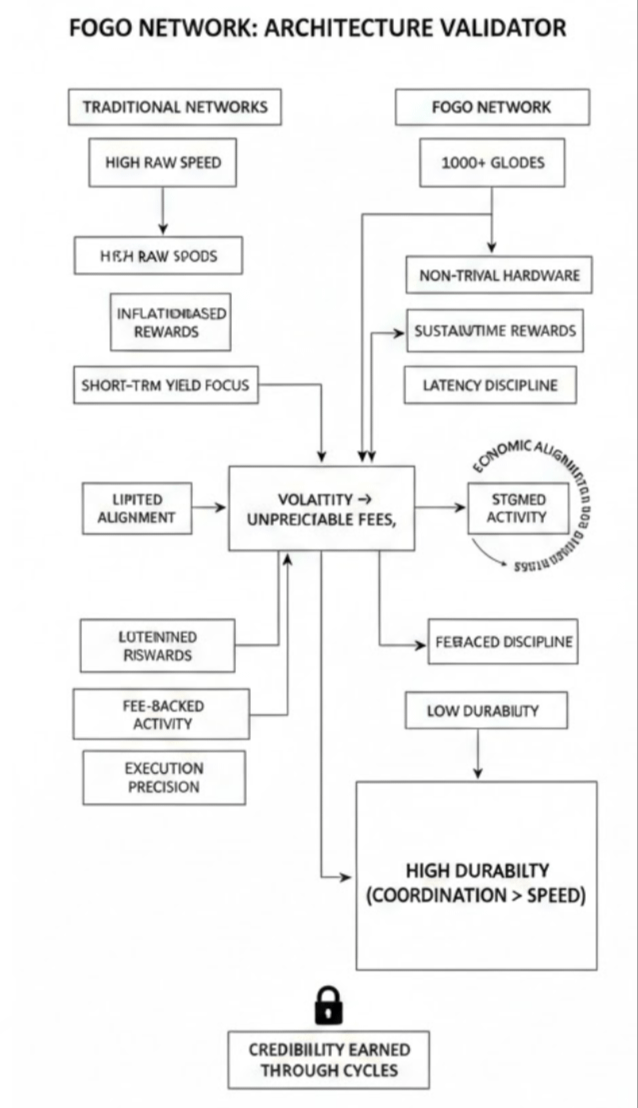
Early stage alignment is always fragile. Inflation supported rewards must evolve toward activity supported revenue. Validator economics must transition from bootstrap issuance to fee backed sustainability. That transition is where many networks falter, not in calm periods, but during volatility cycles that test microstructure integrity.
What gives me cautious confidence in Fogo is coherence. The architecture, validator expectations, and performance thesis point in the same direction. It does not feel like optics layered over unresolved economics. It feels engineered around the assumption that execution quality is the product.
Still, credibility is earned through cycles. Through liquidation cascades. Through congestion waves. Architecture builds conviction.
Aligned incentives determine whether execution discipline compounds or slowly erodes.
That alignment, more than any benchmark, is what decides longevity.
