

Most platforms are built for their first year.
You can tell by what they celebrate. Launch metrics. Early traction. The first big integration. The first spike of attention. Everything is framed around proving that the system can work.
Much fewer platforms seem to spend real time thinking about what happens after it already does.
Vanar Chain gives off the impression that it’s thinking about that second phase from the start.
Not the honeymoon phase where everything is new and flexible and forgiving. The phase where software becomes boring in the most important way: it becomes something people depend on without renegotiating that dependence every quarter.
In real production environments, growth is rarely smooth. Teams change. Priorities shift. Workloads evolve in directions nobody predicted. The systems that survive this aren’t the ones with the most features. They’re the ones with the least fragile assumptions.
A lot of platforms accidentally bake in assumptions about who will use them, how they’ll be used, and what “normal” looks like. Those assumptions hold for a while. Then reality drifts. And suddenly every new requirement feels like a workaround instead of an extension.
What’s interesting about Vanar’s direction is how much it seems to care about preserving shape while allowing change.
That’s not easy.
It usually means being conservative about what you promise. It means defining responsibilities clearly and resisting the urge to blur layers just to move faster. It means accepting that some kinds of growth are not worth the long-term cost.
From the outside, this can look like restraint. From the inside, it’s usually the difference between a system that can evolve and one that has to be kept alive.
There’s also a human side to this that doesn’t show up in specs or benchmarks.
When infrastructure keeps changing its mental model, teams suffer. Documentation rots. Onboarding gets harder. Decisions turn into folklore instead of rules. People stop trusting their understanding of the system and start relying on a few “experts” who remember why things are weird.
That’s not scalability. That’s institutional memory debt.
Platforms that prioritize structural clarity tend to age differently. The system doesn’t just grow; it stays explainable. New contributors can still reason about it. Old assumptions don’t silently fossilize into unchangeable constraints.
Vanar seems to be aiming for that kind of maturity.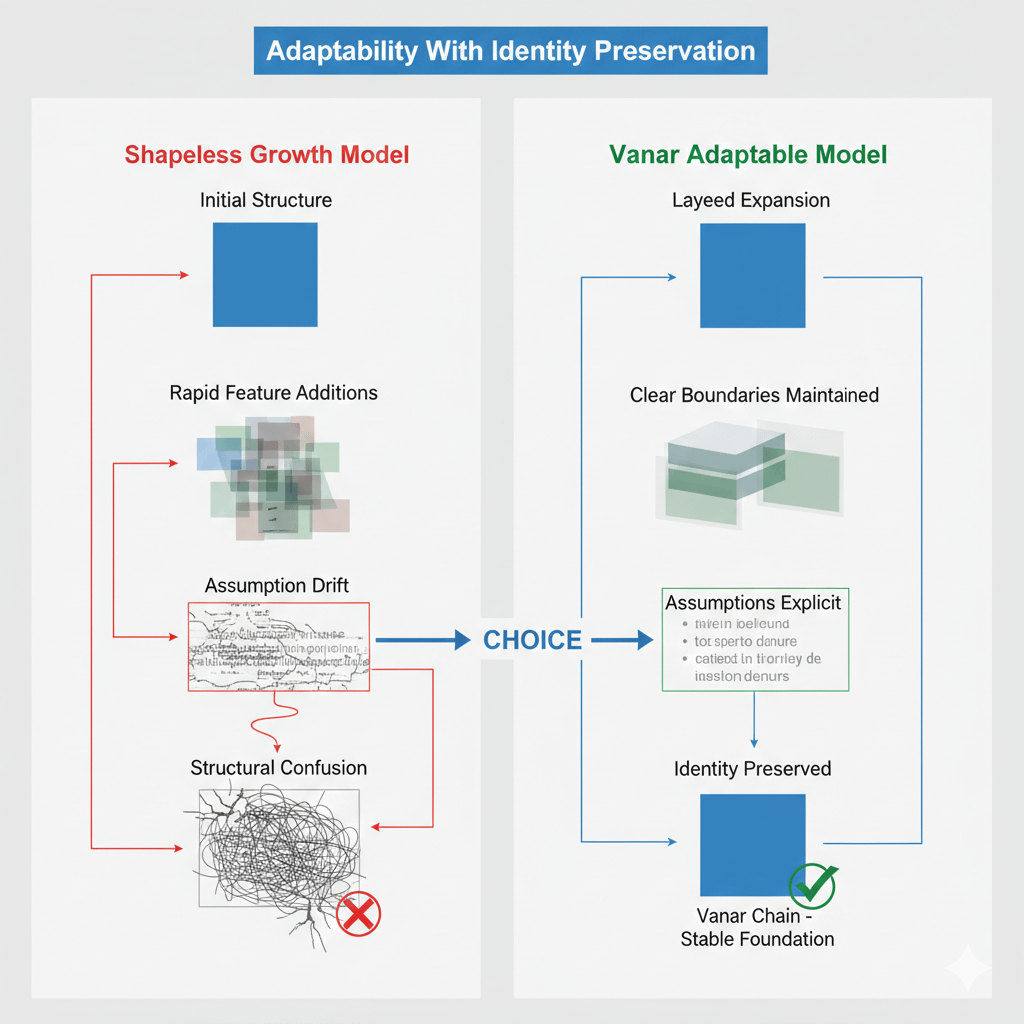
Not by freezing itself in time, but by being careful about what kinds of flexibility it allows. There’s a difference between being adaptable and being shapeless. Adaptable systems change without losing their identity. Shapeless systems change until nobody recognizes what they’re supposed to be anymore.
This shows up in how you think about upgrades, too.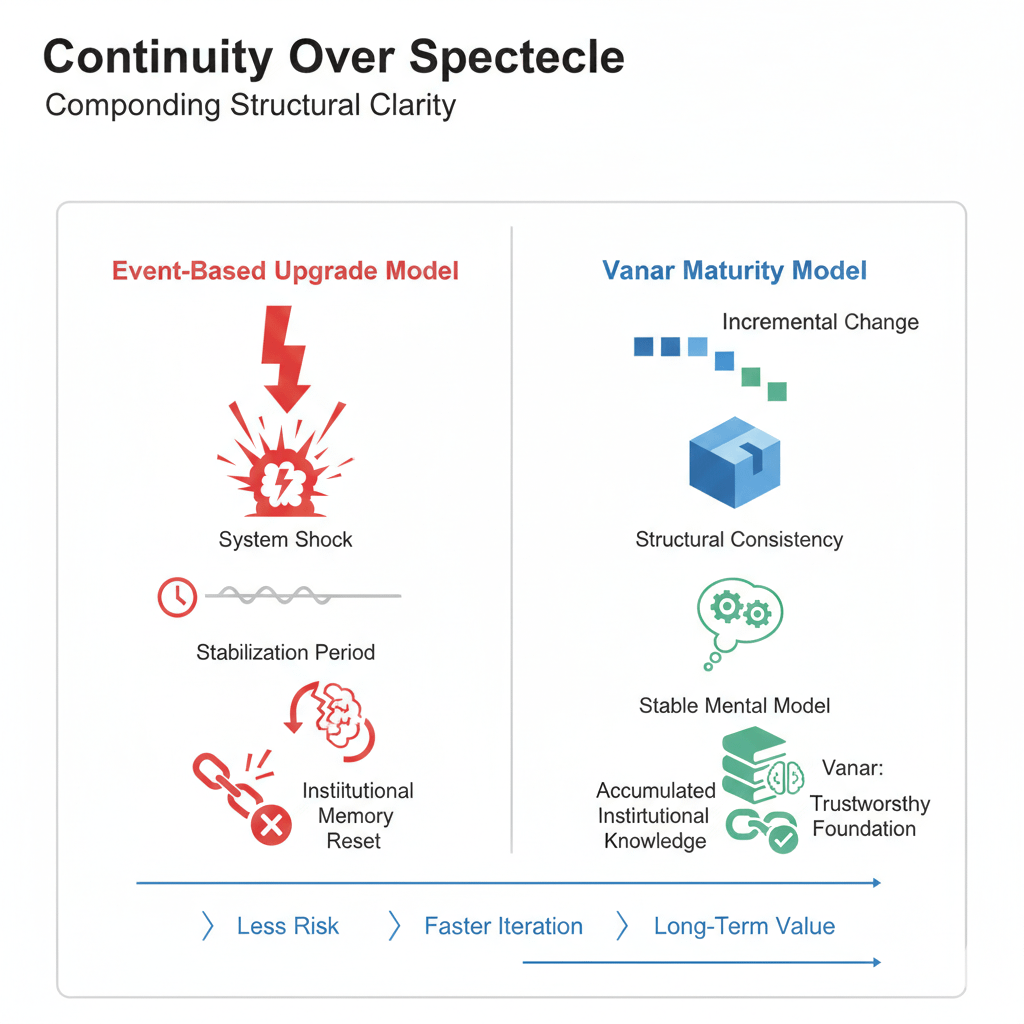
In many ecosystems, upgrades are treated like events. Big moments. Risky moments. Everyone holds their breath, hoping nothing breaks in a way that takes weeks to untangle. Over time, this creates a culture of caution that paradoxically makes change more dangerous, not less.
When systems are designed to evolve in smaller, more comprehensible steps, upgrades stop feeling like cliff jumps. They start feeling like maintenance. That’s a psychological shift as much as a technical one.
And psychology matters in infrastructure.
People don’t just interact with code. They interact with expectations. If a platform feels unpredictable, teams wrap it in process. If it feels stable, teams build directly on it. One path leads to layers of defensive engineering. The other leads to simpler products and faster iteration—not because the system is reckless, but because it’s trustworthy.
Vanar’s posture feels closer to the second path.
It doesn’t try to impress by doing everything. It seems more interested in doing a smaller set of things in a way that stays coherent as the ecosystem grows.
That’s not the strategy that wins every narrative cycle. But it is the strategy that tends to win time.
And in infrastructure, time is the real currency.
The platforms that matter five years from now won’t be the ones that had the loudest launches. They’ll be the ones that teams quietly built their workflows around because changing them felt riskier than keeping them.
If Vanar continues to prioritize structural clarity over short-term spectacle, it won’t just be another chain in the landscape. It will become the kind of system people stop arguing about—and start relying on.
And that’s usually the moment when infrastructure stops being optional and starts being foundational.