


Vanar is a Layer 1 blockchain built with a very specific mindset : make blockchain feel normal for people who don’t care about blockchain. That’s why you keep seeing gaming, entertainment, and brand-style experiences around it. They’re basically saying : “We’re not only building rails, we’re building rails that can carry mainstream traffic without scaring people away.” In their own developer messaging, they push the idea of predictable, low-cost usage, and that’s a quiet but important clue about how they think. Predictable systems usually earn more trust than systems that feel random when the network gets busy.
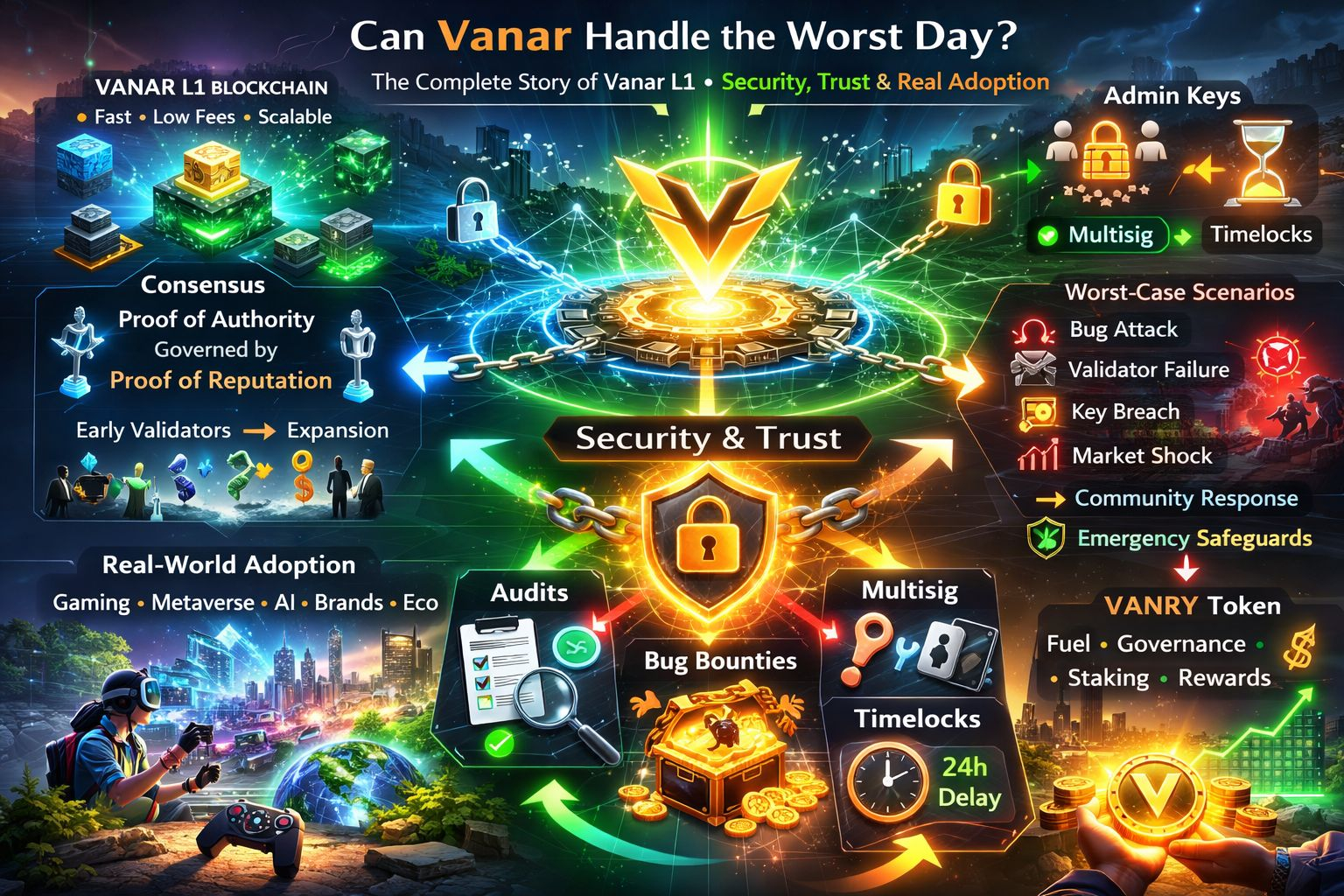
Now here’s where it gets real. How a chain reaches agreement on what is true : that choice shapes everything about security, reliability, and control. Vanar’s documentation describes their approach like this : "Proof of Authority governed by Proof of Reputation" . If you’ve never heard those words before, don’t worry, the feeling is easy to understand. Proof of Authority often means a smaller, selected set of validators produce blocks. That can make the chain faster and smoother early on, but it also means trust depends heavily on how those validators are managed. And Vanar explicitly says that, in the beginning, the foundation runs the validator nodes, and later it onboards external validators using a reputation-based process.
This is one of those moments where I don’t try to sound dramatic, but I do try to be honest. A more guided validator set can be a practical “starter engine,” yet it puts extra weight on governance and operational discipline. It’s like building a city with a smaller police force at first : things can run smoothly, but only if the people holding responsibility have strong controls and clear limits. If the transition to wider participation is real and visible over time, trust can grow. If it stays locked and unclear, trust usually gets thin.
And that brings us to the part you asked for прямо : security and trust : is it built to survive?
One of the most concrete things we can point to is audits. There is a published security audit report for Vanar dated May 24, 2024, and the summary shows that high-severity issues were found and tracked, with most marked as fixed and one marked as acknowledged. I’m not saying “audit” like it’s a magic spell. Audits don’t erase risk. But they do show the project allowed its code to be reviewed in a structured way, and they leave an evidence trail you can actually read. In a space full of noise, that kind of paper trail matters.
Bug bounties are the next layer of real security culture. A bounty is basically paying skilled people to hunt problems before bad actors do. Public ecosystem posts around Vanar’s builder programs reference bounty-style security support, which is a good sign of the mindset : security isn’t a one-day event, it’s a habit. If that habit is alive inside the project, it usually shows up as faster fixes, clearer disclosures, and less “we’ll handle it later” energy.
Now, the most sensitive trust topic is always the same thing, even when people avoid saying it out loud : admin power. Who can change important parameters? Who can upgrade critical code? Who holds the keys? And how hard is it to use those keys?
This is where multisig and timelocks matter so much. A multisig means more than one person must approve sensitive actions. A timelock means even after approval, changes wait for a delay window, giving the community time to see what’s happening. Together, they turn “one mistake can ruin everything” into “we need multiple failures at once,” and that’s the whole point of resilient systems. Because the worst failures in crypto are often not about math. They’re about humans : one compromised device, one rushed decision, one late-night panic move.
Vanar’s own docs make it clear that the foundation carries a lot of responsibility early on in validator operations. That’s why the upgrade and control story is so important : early central responsibility can be stable, but only if it’s surrounded by strong guardrails. The chain doesn’t “become safe” because a team is well-intentioned. It becomes safer because the system is designed so that even well-intentioned people can’t accidentally do dangerous things too quickly.
So what happens in worst-case scenarios? I like thinking about it in simple, human fears.
If a critical bug appears in node software, the chain needs a disciplined patch process : coordinated updates, clear communication, and a controlled response. If validators face instability, the chain needs monitoring, fast recovery, and transparent policies for validator changes. If a key is compromised, the chain survives only if controls force multiple approvals and delays. And if any part of the system relies on external inputs for fees or parameters, that input becomes a lever attackers may target, so it must be defended like a vault door, not like a normal web setting. The audit report itself discusses parts of the fee mechanism behavior, and that’s exactly the kind of area you want reviewed and monitored carefully.
Now let’s look at your “last 24 hours” request in a clean, grounded way, without making it sound like hype. As of today (Feb 18, 2026), the live price snapshots across major trackers cluster around the same area : roughly $0.0058–$0.0059, with the 24-hour change being mildly negative in most feeds. CoinMarketCap shows VANRY down about 2.9% in the last 24 hours with ~ $3.0M 24h volume in the snapshot it displayed. CoinGecko shows a similar price area and a negative 24h move in its own snapshot view. Binance’s price page shows a similar region and a small negative 24h change in the snapshot it displayed. When different trackers line up closely like this, it usually means the market is behaving “normally” for the day : not silent, not exploding, just trading in a band with gentle pressure.
On the “project update” side within the last day, what I found in this pass leaned more toward discussion and ecosystem narrative than a clearly sourced major protocol upgrade announcement. So the strongest 24h update today is mostly market movement and general visibility, not a confirmed “new release shipped” moment. If you want, I can keep checking daily, but I can’t auto-send it right now because your scheduled task list is already full (you’ve hit the limit). If you remove one existing task, tell me “set daily Vanar update,” and I’ll schedule it for 9:00 AM Asia/Karachi.
I’ll end this the way I actually feel about projects like Vanar. It’s easy to fall in love with the dream : “next billions,” big verticals, smooth onboarding, shiny words. But love isn’t what protects money or users. What protects them is boring discipline : audits that leave fingerprints, controls that slow down dangerous actions, validator policies that are visible, and a culture where security is treated like a daily responsibility, not a single announcement.
And if Vanar keeps moving in that direction — outward power, clearer controls, deeper transparency — then the project won’t be defined by one good week or one bad day. It’ll be defined by something rarer : the ability to take a hit, stay honest, fix what’s broken, and keep building while the crowd moves on. That’s the kind of survival that doesn’t just win attention. It earns trust.
