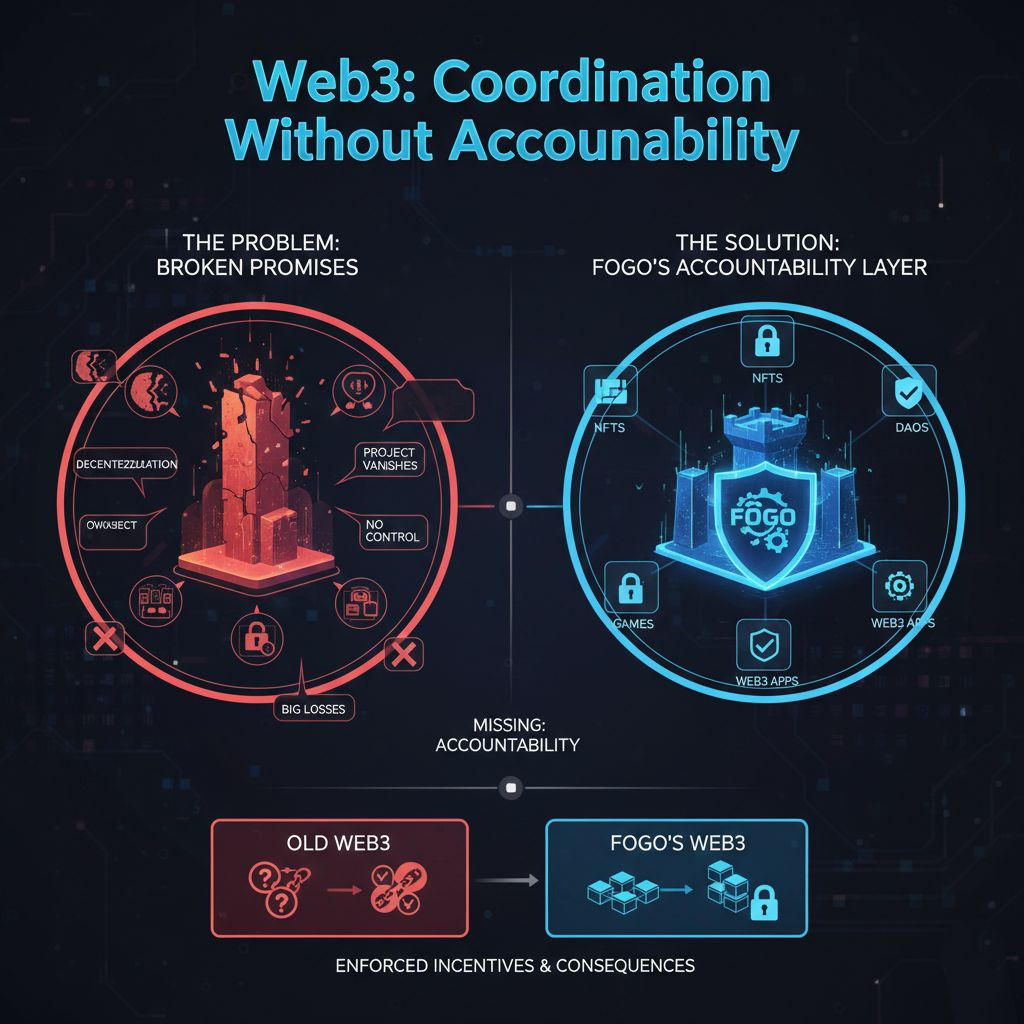
There’s a fundamental problem in Web3 that we’ve been trying to ignore, but it’s becoming impossible to overlook. The industry talks big—about decentralization, ownership, and innovation. But somewhere along the way, we’ve lost sight of something essential: accountability.
Web3 promises the world. It promises a decentralized future where we all own a piece of the digital pie. It promises that anyone can build, govern, and benefit from the systems they’re part of. But what happens when those promises start to fall apart? What happens when a project disappears overnight, or when the things we’ve been told are “decentralized” actually just end up in the hands of a few powerful players?
The truth is, despite all the talk, Web3 is still struggling with one major issue: coordination without accountability. Decentralization doesn’t automatically solve problems. Ownership doesn’t always mean control. And innovation doesn’t ensure stability. Too often, we end up with systems that are full of promise but lacking the mechanisms to actually make sure they work when it counts.
We’ve seen the consequences. Big promises followed by big failures. Projects that raised millions, then vanished, leaving communities wondering what went wrong. DAOs with token holders who have no real power. NFTs with no tangible utility. The space is full of hype, but when it comes to real-world results, things break quietly. People are left holding the bag, and no one seems to be accountable.
Here’s where things get frustrating. We’ve been sold on this idea that decentralization is the magic bullet. The thinking goes, if we distribute power enough, we’ll avoid the failures of traditional systems. But decentralization, by itself, is not a solution. It’s an ideal. A nice idea. But unless it’s paired with real structures to hold people and projects accountable, it’s just a buzzword.
And that’s where the existing solutions fall short. A lot of the so-called solutions we’re seeing in Web3 are incomplete. They sound good on paper but are lazy in execution. Too often, projects rely on blind trust, hoping that the community will take care of things. But when things go wrong, as they often do, that trust evaporates quickly. The structures in place don’t have real accountability mechanisms, and the results are predictable. People lose faith. Projects fail. And the space takes a step back.
This is where Fogo comes in—not as a savior, but as a serious attempt to address this exact issue. Fogo is a high-performance Layer 1 blockchain built on the Solana Virtual Machine. It’s not flashy, and it’s not trying to be. What it does is focus on something that too many projects in Web3 overlook: accountability.
Fogo takes a hard look at the mechanics that are needed to make decentralized systems actually function. It’s not about just building a faster blockchain or offering new tokenomics. It’s about creating a layer that enforces clear incentives and consequences, ensuring that the systems built on top of it are sustainable in the long run.
Why does this matter? For NFTs, DAOs, games, and any other Web3 project to survive long term, they need more than just the ability to coordinate. They need systems that work when things go wrong. That means making sure that there are checks and balances, clear rewards for good behavior, and consequences for bad behavior. Without these, projects will continue to collapse under the weight of their own hype.
Take NFTs as an example. The technology behind them is impressive, but too many projects are built on shaky foundations. A quick mint, a big initial sale, and then… nothing. The community moves on, and the creators disappear. It’s easy to see how this happens when there’s no real system in place to ensure that projects deliver on their promises. Fogo, with its focus on accountability, offers a more robust foundation for these projects to stand on. It ensures that bad actors are less likely to get away with disappearing, and that the systems they build are more likely to last.
DAOs face similar issues. They’re supposed to be decentralized, but too often, they end up being controlled by a few influential players. Voting power is concentrated in the hands of a few, and the community’s voice gets drowned out. Fogo’s design makes sure that incentives are aligned, and the consequences of bad decisions are clear. It’s not about creating a perfect system—it’s about creating a system that holds people accountable for their actions.
It’s easy to get caught up in the excitement of Web3. The newness of it all, the potential, the promises of a better, fairer world. But we’ve reached a point where we need to stop and ask ourselves: How sustainable is this? How much longer can we ignore the fact that accountability is missing from the equation? Without it, Web3 will remain in its infancy, a collection of bright ideas and half-baked projects that never quite live up to their potential.
The truth is, Web3 needs to grow up. It needs to stop relying on buzzwords and start building systems that work in the real world. It needs to focus less on innovation for innovation’s sake, and more on creating the boring but necessary mechanics that make systems function. Accountability, clear incentives, real consequences—these aren’t glamorous, but they’re what’s going to make Web3 a space that lasts.
So, as we continue to build this decentralized future, let’s remember that decentralization isn’t enough. Without accountability, it’s just a dream. It’s time for Web3 to stop talking big and start thinking about how to make things actually work. Only then can we build a future that’s not just revolutionary, but sustainable.