
When I first looked at vanar chain ,the first time I shipped an “AI feature” into a smart contract system, it felt groundbreaking for a moment. The interface worked. The automation looked clever. Then reality set in. The intelligence wasn’t really part of the chain. It lived off to the side, connected by APIs, reacting to events without truly understanding them. What looked like innovation was mostly presentation.
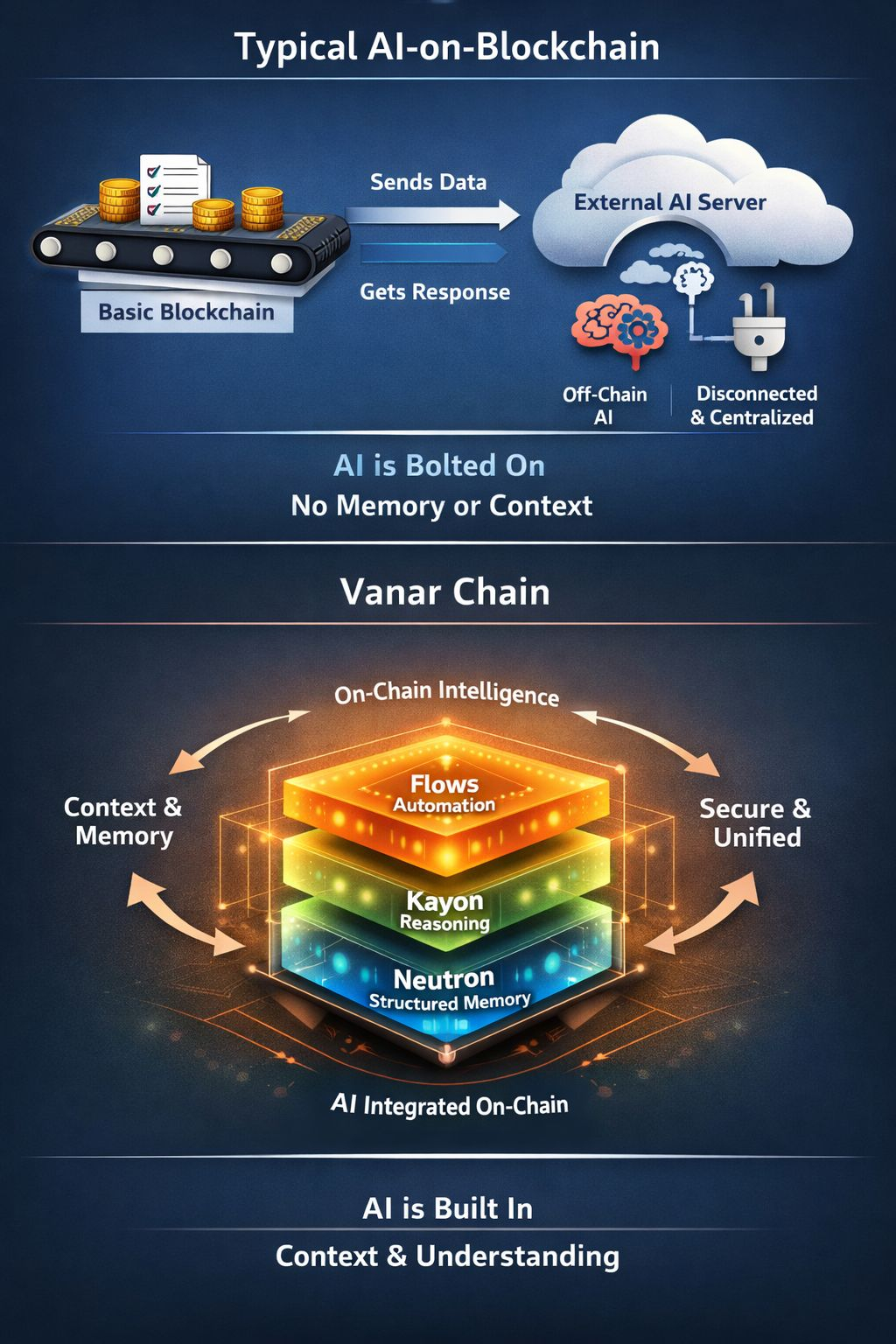
That pattern shows up across the market. Many networks talk about AI integration, agent-ready design, or intelligent automation. Under the surface, it usually means one of three things: off-chain models, oracle-fed outputs, or contracts triggering external services. The chain itself remains unchanged. It executes fast, but it does not interpret.
This matters because blockchains are built to be deterministic. They confirm state changes. They don’t hold context or memory in a way that supports intelligence. Even sub-second finality only confirms that something happened, not why it happened or how that history should shape future behavior. As a result, developers push memory and reasoning into external systems. That brings latency, extra trust assumptions, and failure points. When those systems stall, everything stalls with them.
This is where Vanar Chain feels structurally different. Instead of treating AI as a feature bolted onto a financial rail, its design separates security, memory, reasoning, and automation into layered components. Neutron focuses on structured memory, Kayon handles reasoning, and Flows manages automation logic. The goal is to move context closer to the protocol layer rather than rebuilding meaning off-chain every time.
On paper, Vanar Chain still competes in the same performance range as modern networks, with fast confirmations and steady throughput. The difference is that those performance targets aren’t meant to replace intelligence, but to support it. The intelligence layer isn’t an afterthought.
There are real risks here. On-chain reasoning can raise costs, complicate audits, and strain throughput under load. Promises don’t survive stress cycles. Still, designing for context from day one is not the same as retrofitting it later.
As AI agents and machine-driven transactions become more common, speed alone won’t carry networks forward. Systems will need memory, continuity, and the ability to adapt without leaning entirely on external servers. Intelligence that lives at the protocol layer is harder to fake—and harder to unplug—than intelligence attached at the edges.$VANRY @Vanarchain #vanar