
When I started examining how on chain trading actually functions today, what stood out was how discussions revolve around liquidity and rewards, while one factor is barely mentioned: time. Not valuation. Not returns. Time. Yet anyone who has navigated a fast, chaotic market knows that latency, the gap between placing an order and seeing it finalized, quietly influences everything beneath the surface.
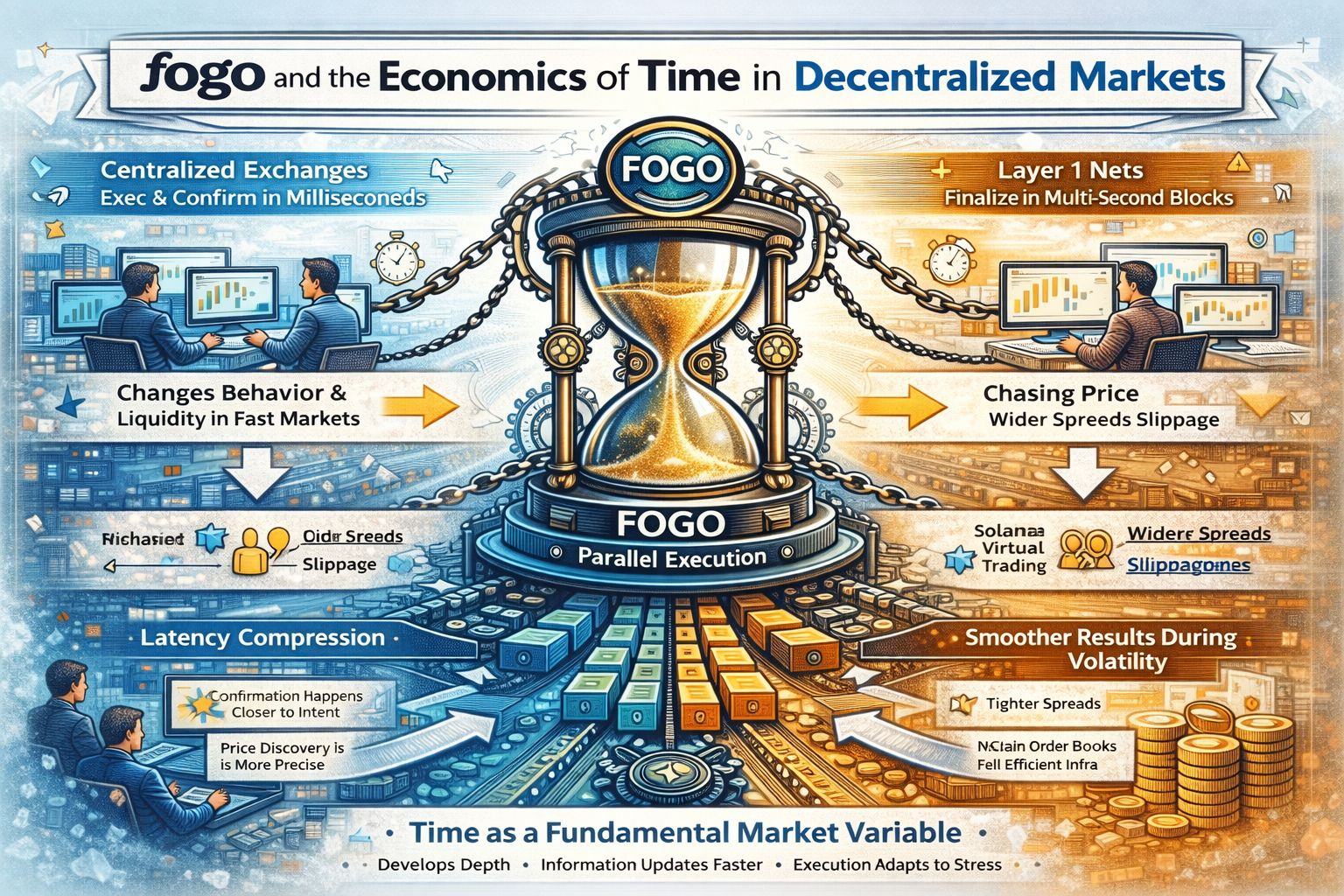
The first thing that started bothering me when I looked closely at on-chain trading was not liquidity depth or yield strategies. It was time. We speak endlessly about incentives and volume, but almost never about the delay between pressing confirm and seeing final settlement. In quiet markets that delay feels harmless. In violent ones, it quietly decides outcomes.
Anyone who has traded through a sharp move understands this instinctively. A few seconds can separate a clean entry from chasing price. They can widen slippage, distort spreads, and change how confident liquidity providers feel about staying active. Time is not just a technical detail. It shapes behavior.
Right now, crypto markets operate across two different clocks. Centralized exchanges match and confirm orders in milliseconds. Most Layer 1 networks still rely on multi second block times. That difference is structural. It influences which strategies are viable on-chain, how risk is priced into spreads, and how quickly liquidity pulls back when volatility accelerates.
This is the environment where fogo is positioning itself. Built on the Solana Virtual Machine, fogo treats parallel execution as a foundation rather than a patch. Independent transactions can be processed simultaneously instead of lining up in a single queue. Under stress, that distinction becomes visible. When activity surges, congestion does not stack up in the same way. The system is designed to absorb spikes more fluidly.
The philosophy aligns with high throughput experiments in the broader Solana ecosystem. The exact transactions per second number is less important than the direction it points to. If a network can consistently handle tens of thousands of transactions each second, on-chain order books begin to feel less experimental. They start to resemble centralized matching engines in responsiveness. Execution stops feeling like the weak link and begins to feel like infrastructure.
A latency focused design compresses the distance between intent and result. Sub second confirmations tighten price discovery. The window for slippage shrinks because the state you act on is closer to the state that settles. Market makers can quote narrower spreads since they are not compensating for extended confirmation risk. Liquidity depth becomes steadier in fast conditions because participants trust that what they see is close to reality.
On the surface, that translates into smoother user experience. Beneath it, the microstructure of the market changes. Risk models adjust. Capital becomes more comfortable remaining active during volatility instead of retreating.
Still, speed alone does not create gravity. Ethereum demonstrates that slower settlement can coexist with immense value because trust, composability, and ecosystem integration anchor activity. fogo’s approach suggests an understanding of that balance. Performance reduces friction, but lasting relevance requires reliability and broader integration.
What makes fogo compelling is not a single benchmark. It is the recognition that time itself is a market variable. When confirmation delays shrink, behavior shifts. Liquidity recalibrates. Risk compresses. The conversation moves beyond raw throughput and toward how quickly a network can absorb stress without fragmenting.
In that sense, fogo is not marketing speed as a headline. It is treating time as infrastructure. And if decentralized markets aim to compete with centralized venues on execution quality, that temporal gap cannot remain an afterthought.
