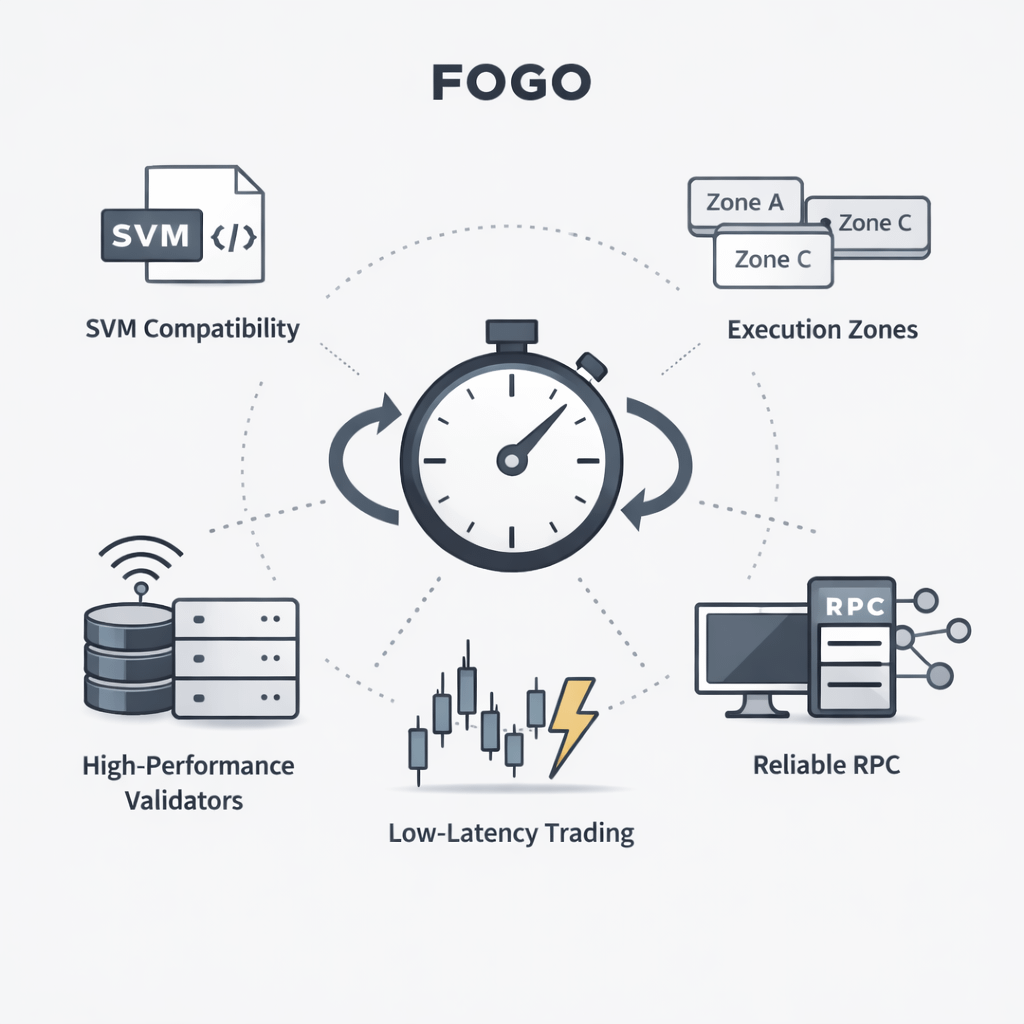
Most chains compete on TPS.
Fogo is competing on something far more operationally meaningful: time predictability under load.
When I analyze infrastructure, I don’t look at peak benchmarks. I look at service guarantees. Can a system maintain deterministic execution windows during volatility? Can traders, validators, and application developers rely on consistent latency profiles?
That is where Fogo’s architectural thesis becomes interesting.
1. SVM Compatibility Without Code Migration
At the base layer, Fogo is fully compatible with the Solana Virtual Machine (SVM). That detail is not marketing — it is strategic.
Developers do not need to rewrite applications. They do not need to refactor logic or redesign execution models. Existing Solana-based applications can deploy into Fogo’s environment without structural rewrites.
This reduces:
Migration friction
Audit overhead
Re-deployment risk
Engineering uncertainty
In infrastructure design, lowering developer friction is often more impactful than marginal performance gains. Fogo recognizes this.
The bet is simple: if builders can move without rewriting, they will move faster.
2. Zone-Based Architecture: Isolating Load, Preserving Determinism
Traditional monolithic execution environments degrade under concentrated demand. One application spike can introduce latency spillover across the network.
Fogo introduces a zone-based execution model.
Instead of treating all activity as a single shared bottleneck, zones compartmentalize workload. High-frequency DeFi execution does not contaminate unrelated throughput domains. This architectural isolation allows:
Predictable block propagation
Reduced cross-application congestion
Controlled performance envelopes
From an operational standpoint, this is closer to segmented infrastructure in traditional finance — where trading engines are not competing with unrelated system processes for compute resources.
Predictability is the product.
3. Low-Latency Execution for Trading Environments
DeFi adoption will not scale on narratives. It scales on execution guarantees.
For trading infrastructure, latency is not a convenience metric — it is economic edge. Slippage, liquidation windows, oracle timing — all depend on execution speed and consistency.
Fogo’s positioning emphasizes:
Sub-second confirmation profiles
Optimized transaction routing
Performance-tuned validator infrastructure
But what matters more than raw speed is variance control.
If latency fluctuates unpredictably during volatility, institutional participants disengage. Fogo’s architecture is attempting to reduce that variance envelope.
That is a different problem than chasing headline TPS.
4. Validator & Staking Mechanics: Operational Discipline
A chain is only as reliable as its validator set.
Fogo’s validator design emphasizes:
High-performance hardware standards
Structured staking mechanics
Coordinated infrastructure deployment
This is not laissez-faire decentralization. It is performance-aligned decentralization.
There is a tradeoff here — and it is intentional. Fogo prioritizes execution reliability over unconstrained validator sprawl. The goal is not maximum node count. The goal is consistent block production under stress.
From a systems engineering perspective, this aligns more with mission-critical financial infrastructure than experimental networks.
5. RPC Reliability: The Silent Constraint
Most chains do not fail at consensus.
They fail at RPC.
Retail users may tolerate delayed responses. Market makers and bots do not. When RPC nodes throttle, drop packets, or desynchronize, application-level performance collapses.
Fogo’s infrastructure roadmap highlights:
Optimized RPC distribution
Reliability-focused endpoint architecture
Reduced request queuing under demand spikes
If execution is the engine, RPC is the access layer. Without reliability at this layer, performance claims are irrelevant.
Fogo appears to understand this operational bottleneck.
6. Friction Reduction as Adoption Strategy
What I find structurally compelling is not just performance — it is friction compression.
Fogo reduces friction in three domains:
For Developers
No codebase rewrites
SVM compatibility
Faster deployment cycles
For Traders
Predictable execution timing
Lower latency variance
Reduced congestion spillover
For Infrastructure Operators
Performance-aligned validator standards
Coordinated execution zones
Adoption accelerates when friction declines. Not when marketing increases.
7. Performance as a Service-Level Commitment
The broader thesis I observe:
Fogo is not trying to be “another fast chain.”
It is positioning itself as a service-level performance environment for applications that cannot tolerate execution uncertainty.
In institutional finance, infrastructure is evaluated on:
Uptime guarantees
Latency variance bands
Deterministic finality windows
Fogo’s architecture suggests it is borrowing that evaluation framework and applying it to Web3 execution.
That framing matters.
Because if DeFi is to serve real liquidity — not just speculative retail cycles — the underlying infrastructure must behave like production-grade systems, not experimental networks.
Conclusion: Infrastructure That Respects Time
I view Fogo less as a throughput experiment and more as a time-discipline experiment.
Time predictability. Load isolation. Execution reliability. Developer portability.
If Fogo succeeds, it will not be remembered for peak TPS screenshots.
It will be remembered for compressing the operational uncertainty that currently limits serious capital from fully engaging onchain.
In infrastructure, credibility compounds slowly.
But once earned, it becomes defensible.
And Fogo appears to be building precisely for that compounding effect.