When I evaluate blockchain infrastructure, I don’t start with throughput metrics.
I start with friction.
Because adoption does not stall due to lack of speed alone. It stalls because operational complexity compounds across every layer — wallet management, gas unpredictability, fragmented tooling, inconsistent orchestration between services.
Vanar’s thesis appears straightforward:
If you compress infrastructure friction, you accelerate builder velocity.
That framing is materially different from competing on headline TPS.
1. The Real Constraint: Operational Drag
In production environments, developers are not blocked by theoretical limitations. They are slowed by coordination overhead.
Wallet abstractions require custom logic.
Gas behavior fluctuates unpredictably.
Tooling ecosystems fragment across incompatible stacks.
Each additional integration point introduces:
Audit overhead
Testing complexity
Latency in deployment cycles
Increased surface area for failure
Vanar’s architecture leans into abstraction and orchestration as primary levers.
The objective is not marginal performance gains.
The objective is to reduce the number of moving parts developers must manage.
2. Intelligent Orchestration as a Core Layer
Rather than treating the chain as a standalone execution environment, Vanar positions orchestration as a structural component.
That means:
Coordinating services across layers
Reducing manual infrastructure wiring
Abstracting backend interactions away from application teams
In traditional systems architecture, orchestration layers are what convert infrastructure into usable platforms. Without orchestration, infrastructure remains fragmented.
Vanar’s design direction suggests it understands that the platform layer — not raw execution — determines adoption velocity.
This is an architectural decision, not a marketing one.
3. Abstraction Over Raw Exposure
Many ecosystems expose developers directly to low-level primitives and call it flexibility.
Flexibility without abstraction becomes burden.
Vanar’s infrastructure focus appears to be:
Simplifying integration surfaces
Reducing wallet interaction friction
Minimizing gas uncertainty exposure
Aligning tooling into a cohesive stack
The benefit is compounding.
When abstraction reduces cognitive load, teams iterate faster. When iteration accelerates, product cycles shorten. When product cycles shorten, experimentation increases.
Infrastructure that lowers friction indirectly increases innovation density.
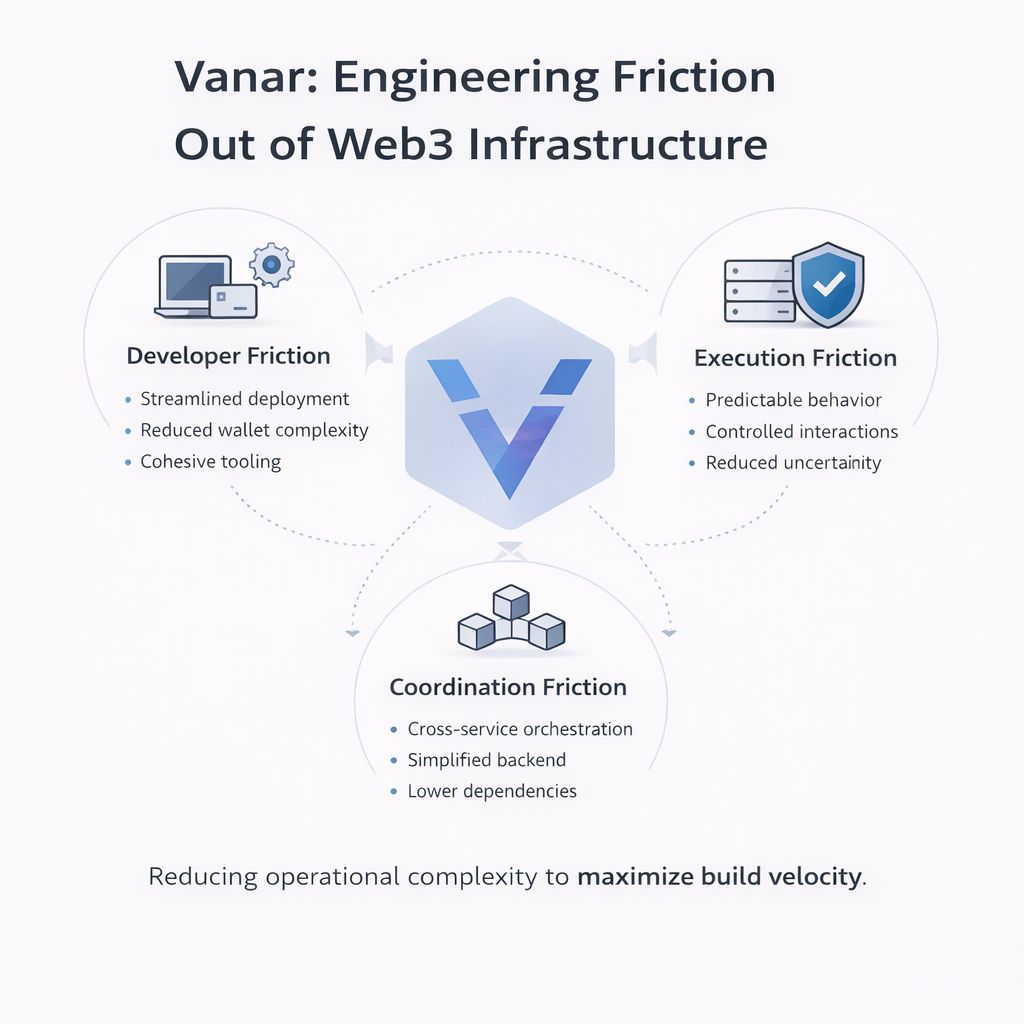
4. Friction Compression as Strategy
If we decompose Vanar’s positioning, it revolves around three compression vectors:
Developer Friction
Streamlined deployment workflows
Reduced wallet complexity
Cohesive tooling environment
Execution Friction
Predictable operational behavior
Controlled interaction layers
Reduced integration uncertainty
Coordination Friction
Orchestration across services
Simplified backend interactions
Lower dependency management overhead
The network is not presented as a raw execution engine.
It is framed as an environment where infrastructure complexity is deliberately hidden from application teams.
That framing matters.
5. Competing on Build Velocity, Not Benchmarks
Throughput numbers are easy to market.
Operational simplicity is harder to quantify — but more defensible long term.
If a developer can:
Move from concept to production without navigating wallet edge cases
Avoid unpredictable fee behavior
Deploy without stitching multiple incompatible tools
Then velocity increases.
Vanar’s strategic positioning suggests it understands that velocity compounds. The faster teams can ship, the more applications enter production. The more applications enter production, the stronger the ecosystem flywheel.
This is a structural bet on build acceleration.
6. Infrastructure That Becomes Invisible
The most mature infrastructure in traditional systems eventually disappears from the developer’s conscious thought.
It becomes assumed. Stable. Reliable.
Vanar’s trajectory appears aligned with that outcome:
Infrastructure that does not demand constant configuration. Tooling that does not fragment. Orchestration that does not require manual stitching.
When infrastructure becomes invisible, builders focus on product.
That is the real unlock.
Conclusion: Platform Discipline Over Performance Theater
I view Vanar less as a throughput competitor and more as a friction-minimization platform.
Its differentiation is not speed in isolation.
It is the reduction of operational drag across:
Wallet interaction
Gas behavior
Tooling cohesion
Service orchestration
If this compression strategy holds, Vanar’s advantage will not be benchmark screenshots.
It will be developer retention.
And in infrastructure markets, retention — not speculation — determines long-term defensibility.
Vanar is not chasing noise.
It is engineering away friction.
That is a much more durable strategy.