


I keep coming back to that “Frankendancer today, pure Firedancer tomorrow” line because it’s one of the few roadmap statements in crypto that accidentally tells the truth. It doesn’t promise perfection. It admits there’s a messy middle. And in infrastructure, that messy middle is where most projects either quietly slow down or break in public.
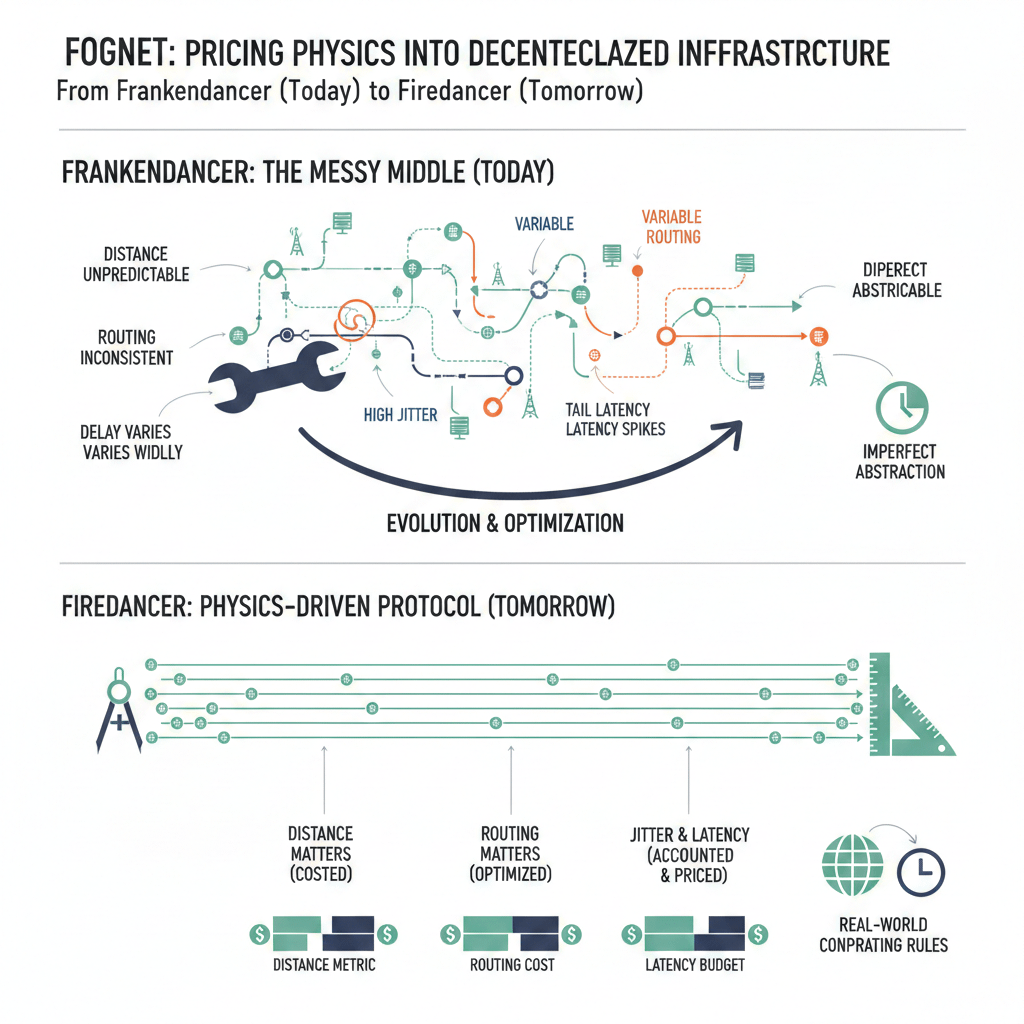
If you read Fogo as “another fast chain,” you’ll miss what’s actually being attempted. The more honest reading is that they’re trying to price physics into the protocol. Not as a metaphor. As an operating rule. Distance matters. Routing matters. Jitter matters. Tail latency matters. And once you stop pretending the internet is a clean abstraction, the whole design space changes.
Most chains treat latency like a dial you turn. Make the VM faster, optimize some networking, tweak block parameters, announce a smaller number. But if your validators are scattered across continents, you still don’t get to outrun the speed of light or the chaos of real-world networks. You can get better averages and still lose to variance. And when you’re building systems where timing affects outcomes—liquidations, order matching, risk engines, settlement flows—variance is what bites first.
Fogo’s “zones” idea is basically the protocol admitting that geography is not optional. Co-locate validators tightly enough that consensus messages don’t spend most of their life traveling. Then rotate that location over time so you don’t end up building a chain that is permanently tied to one region, one jurisdiction, one set of data centers. It’s not a perfect answer, but it’s an answer that starts from how networks actually behave, not how we wish they behaved.
That’s also why the curated validator approach matters more than people want to admit. I understand why it triggers alarms. “Curated” sounds like “closed,” and “closed” sounds like a step backward. But there’s a blunt operational point underneath it: in ultra-low latency systems, weak participants aren’t just weaker for themselves. They create externalities. They become the drag coefficient of the whole network. If your goal is to push block cadence down into tens of milliseconds, you can’t pretend everyone’s laptop in a random region is going to hold the line. Either you enforce operational standards or you accept that the slowest honest participants set the ceiling.
That doesn’t make curation harmless. It creates its own risks—capture risk, optics risk, political risk, governance risk. It shifts the burden onto the project to prove that selection doesn’t harden into permanent gatekeeping. But if you’re trying to understand the design as an engineering system, curation isn’t an afterthought. It’s part of the performance model.
The validator client story fits the same pattern. “Frankendancer” sounds like a joke until you recognize the point: they’re building toward a fully Firedancer-based validator stack, but they’re not pretending they can swap everything at once without consequences. Hybrid stages exist because reality exists. You ship pieces that move the needle first, you keep mature components where you need stability, and you earn your way into a full transition. That’s not glamorous, but it’s usually how serious performance work happens.
And the low-level details they highlight—process isolation, pinning work to cores, avoiding scheduler noise, using fast packet I/O paths—are the kind of choices you make when you’re trying to control jitter rather than just inflate throughput numbers. People often talk about speed as if it’s a single metric. It isn’t. There’s speed, and then there’s the shape of the distribution. If your chain is fast most of the time but occasionally stutters, developers building time-sensitive systems will treat it like it’s slow, because they have to design around the worst case.
That’s where I think the “structural value” angle actually lives. Not in a promise of more TPS. Not in a new narrative. In the possibility that Fogo becomes a more predictable execution environment when conditions get ugly—when there’s congestion, contention, bursts of activity, and participants behaving strategically. If they can make the chain’s behavior stable in those conditions, that’s not just a nice feature. It changes what kinds of applications are plausible.
This isn’t a bet on retail users suddenly caring about 40ms blocks. Retail users don’t wake up thinking about tail latency. The bet is that more on-chain activity starts to resemble real infrastructure: workflows that plug into existing operational systems, where timing and reliability are part of correctness. The moment you start integrating blockchains into systems that already have strict SLA thinking—whether that’s finance, settlement, risk controls, or any high-frequency coordination problem—chains get judged differently. They get judged like systems, not communities.
Fogo’s design feels like it’s aimed at that world. A world where “decentralization” isn’t only a static count of nodes, but also a question of how the system manages jurisdictional spread, resilience, and performance over time. A world where the question isn’t “can it be fast on a good day,” but “can it stay well-behaved on a bad day.”
I don’t think any of this guarantees success. The hardest parts are still in front of them. The migration from a hybrid client to a pure implementation is exactly where subtle edge cases show up. Zone rotation is governance-heavy and could degrade into ceremonial motion if incentives don’t hold. Curated validator sets invite constant scrutiny and will need a credible path that doesn’t calcify into permanent exclusivity.
But if you’re looking for something the market often underprices early, it’s this kind of uncomfortable, operationally grounded design. Not because it’s exciting. Because it’s the sort of work that becomes valuable only when adoption shifts from speculation to integration.
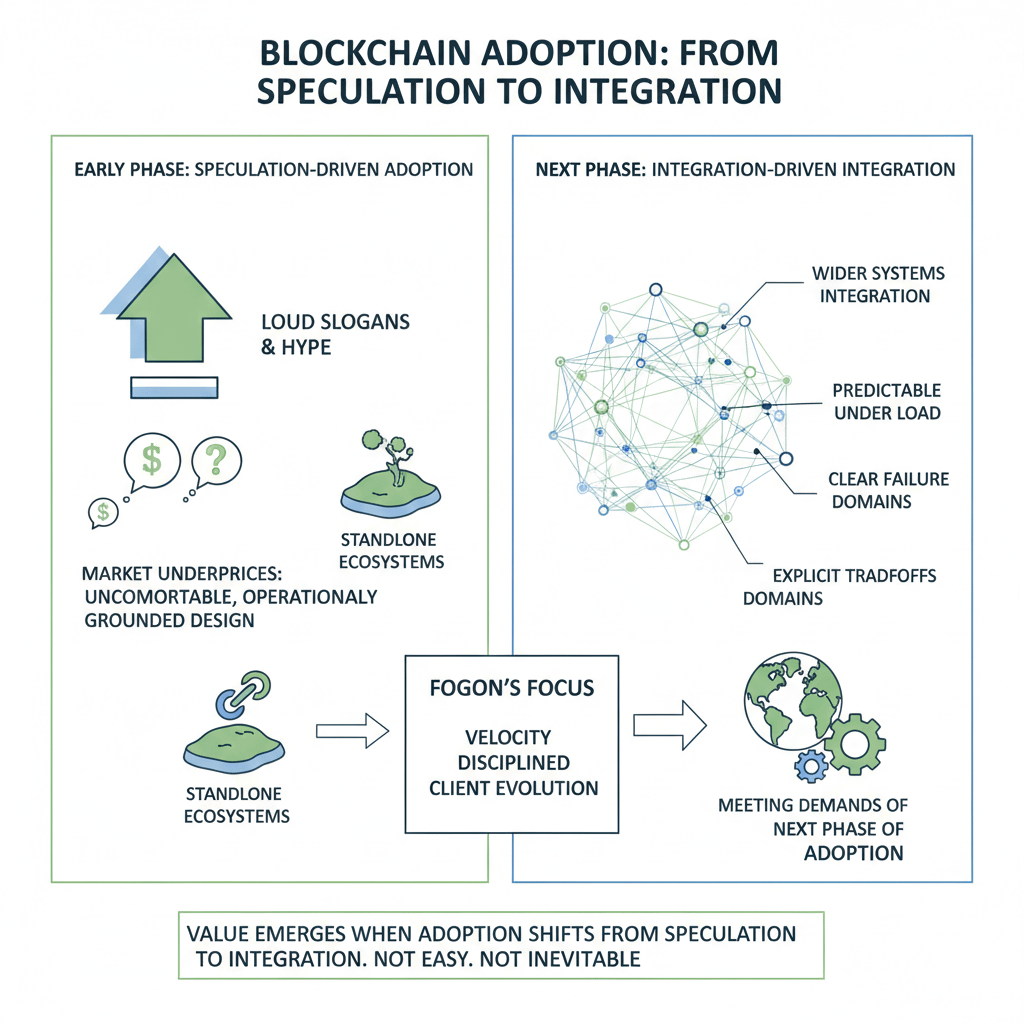
And that’s the macro connection that matters most to me: as blockchains move from being standalone ecosystems into being parts of wider systems, the winners won’t be the ones with the loudest slogans. They’ll be the ones that behave predictably under load, have clear failure domains, and make hard tradeoffs explicit instead of pretending they don’t exist. If that shift continues, Fogo’s focus on velocity, topology, and disciplined client evolution is less about chasing a number and more about trying to meet the demands of the next phase of adoption—without claiming it will be easy or inevitable.