
Fogo’s story feels less like a marketing pitch and more like an engineering diary. It started with a blunt realization: the internet isn’t neat, and pretending it is has been the downfall of many chains. Most projects try to look fast by tweaking block times or optimizing virtual machines, but physics doesn’t bend. Validators spread across continents can’t outrun the speed of light or the randomness of real-world networks. Fogo’s team leaned into that truth instead of hiding it.
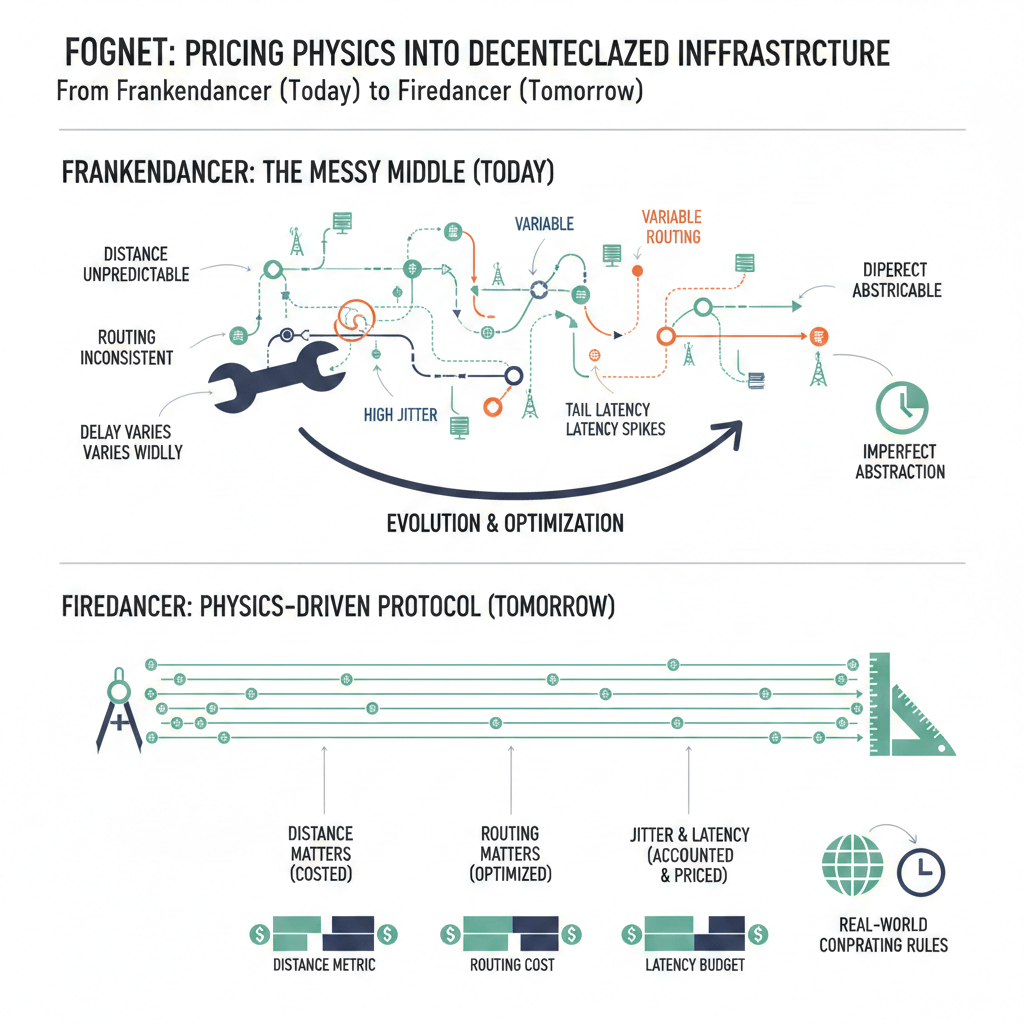
That’s why they built zones. Validators are grouped close together so consensus messages don’t waste time traveling across oceans. Then those zones rotate, so no single region or jurisdiction owns the chain forever. It’s not flawless, but it’s a design that starts from how networks actually behave.
The validator client story shows the same honesty. Right now, Fogo runs in hybrid mode, what they call Frankendancer. It’s a mix of components, some new, some mature, stitched together to keep the system stable while Firedancer modules are introduced piece by piece. The goal is a full Firedancer stack, but they’re not pretending it can happen overnight. That messy middle is real, and they admit it.
Curation of validators is another choice that sparks debate. In crypto, “curated” sounds like “closed,” and “closed” sounds like a step backward. But in ultra-low latency systems, weak participants don’t just slow themselves down, they slow everyone. If you’re aiming for block cadences measured in milliseconds, you can’t pretend every laptop in a random region will hold the line. Enforcing operational standards is part of the performance model. Of course, it creates risks: capture, optics, governance. The burden is on Fogo to prove curation doesn’t harden into permanent gatekeeping.
Technically, Fogo inherits Solana’s architecture, Proof of History, Tower BFT, Turbine, and the Solana Virtual Machine, so existing programs can migrate easily. But it layers its own innovations: multi-local consensus, curated validators, and a Firedancer-first stack. Engineers focus on details like process isolation, pinning work to CPU cores, avoiding scheduler noise, and using fast packet I/O paths. These aren’t glamorous, but they matter when you’re trying to control jitter. Speed isn’t just about averages, it’s about consistency. If a chain stutters occasionally, developers building time-sensitive systems will treat it as slow, because they must design around the worst case.
The bet isn’t that retail users will suddenly care about 40ms blocks. Retail doesn’t wake up thinking about tail latency. The bet is that more on-chain activity will start to resemble real infrastructure: finance, settlement, risk controls, high-frequency coordination. In those worlds, chains get judged like systems, not communities. If Fogo can behave predictably under load, during congestion, bursts of activity, and strategic behavior, that’s structural value. It changes what kinds of applications are possible.
The hardest parts are still ahead. Migrating fully to Firedancer is where subtle edge cases show up. Zone rotation is governance-heavy and could degrade into ceremonial motion if incentives don’t hold. Curated validator sets invite constant scrutiny and will need a credible path that doesn’t calcify into exclusivity. None of this is easy, and none of it is guaranteed.
But that’s what makes Fogo interesting. It’s not chasing hype. It’s building for integration. As blockchains evolve from standalone ecosystems into parts of wider systems, the winners won’t be the ones with the loudest slogans. They’ll be the ones that behave predictably under load, make failure domains clear, and admit hard tradeoffs instead of pretending they don’t exist. Fogo’s focus on velocity, topology, and disciplined client evolution is less about chasing a number and more about meeting the demands of the next phase of adoption.
If it succeeds, it won’t be because it was easy or inevitable. It will be because it faced the messy middle honestly, and built for the world as it actually is. That’s the real impact: a chain designed not for hype, but for systems that demand reliability. And if adoption continues to shift toward integration, Fogo’s uncomfortable design choices may turn out to be its greatest strength.