
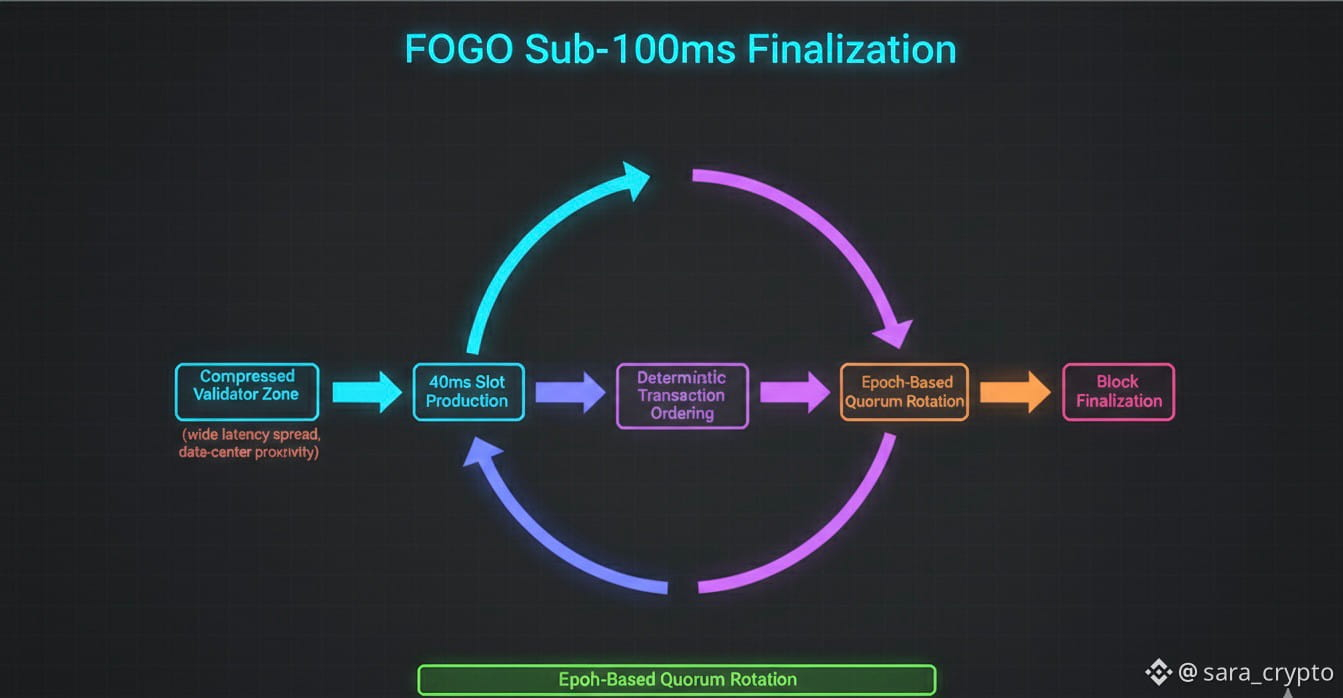
“Fogo is a high-performance L1 that utilizes Solana Virtual Machine.”
That sentence sounds calm.
Neutral.
Safe.
It isn’t.
Because once execution compresses into sub-100ms cadence, the chain stops being infrastructure and starts being tempo. And tempo exposes hesitation.
Your hesitation.
Coordination Is the Real Bottleneck
Most “fast chains” try to scale throughput.
Fogo scales coordination surface area instead.
It narrows consensus into a physically tight validator zone. Data-center proximity. Reduced propagation drag. Fewer geographic hops between agreement and finality.
Then it rotates that zone by epoch.
The whole world doesn’t vote on every block.
Only the active quorum does.
Forty-millisecond slots. Deterministic ordering. No soft reshuffling to protect indecision. No comforting delay layer.
If you miss the slot—
Locked.
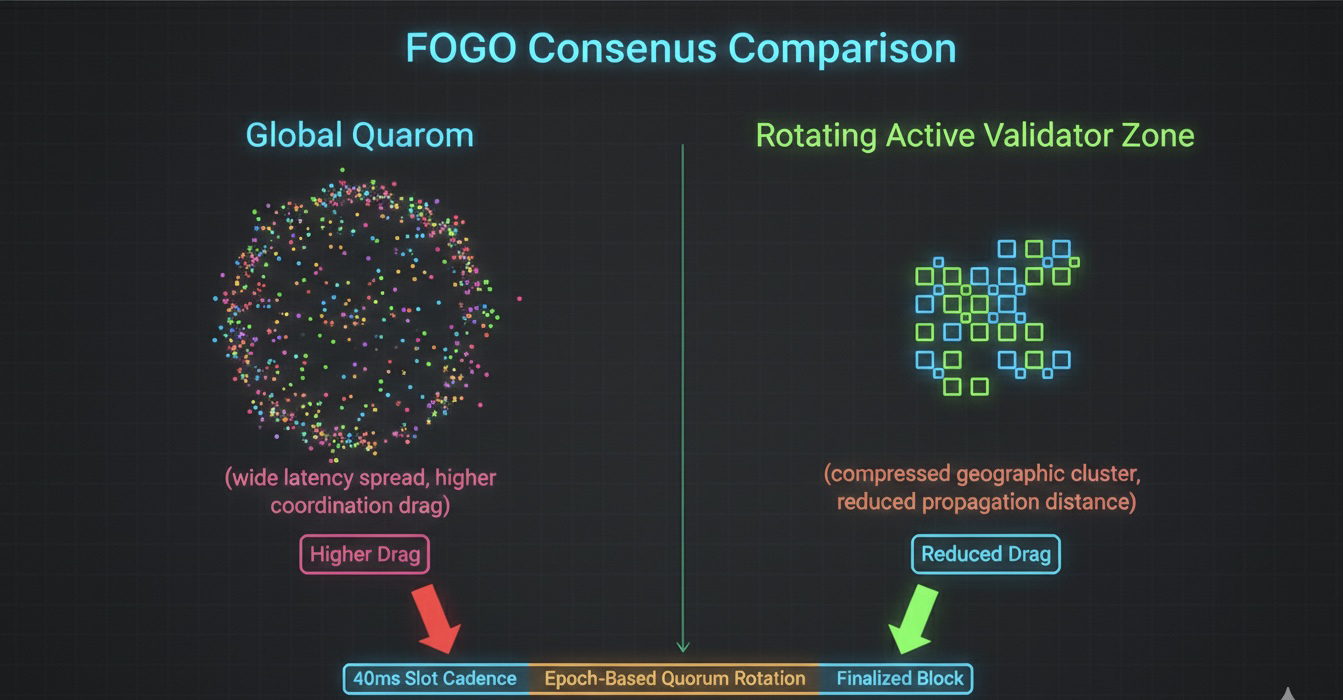
Speed isn’t TPS.
It’s how small you can make the coordination circle without breaking trust assumptions.
SVM Removes the Excuse Layer
Using the Solana Virtual Machine wasn’t aesthetic.
It was exposure.
Developers already understand SVM constraints. They know how accounts behave under parallel execution. They know where congestion forms. They know how state access patterns fracture performance.
There’s no experimental fog to hide behind.
If performance drops under real load, it’s visible. Immediate. Mechanical.
That’s uncomfortable.
Because stability under pressure is harder than innovation under hype.
Fogo didn’t redesign computation.
It redesigned how fast computation can agree.
And agreement is the expensive part.
The UX That Disappears
Sessions. Paymasters. SPL fee flows.
Most people call that convenience.
It’s actually cognitive compression.
Apps sponsor fees. Authority is bounded. Session approvals limit scope and duration. Expiry timers tick without asking for permission.
You don’t stop to think about gas.
You act.
And when action speeds up, biology shows up.
Your breathing shortens during volatility.
Your chest tightens as inventory shifts.
Your cursor pauses half a second too long.
The slot does not.
Paymaster quotas recalibrate mid-spike. Authority windows close exactly on schedule. Deterministic ordering doesn’t care that you were reconsidering size.
One micro-fragment of doubt—
Gone.
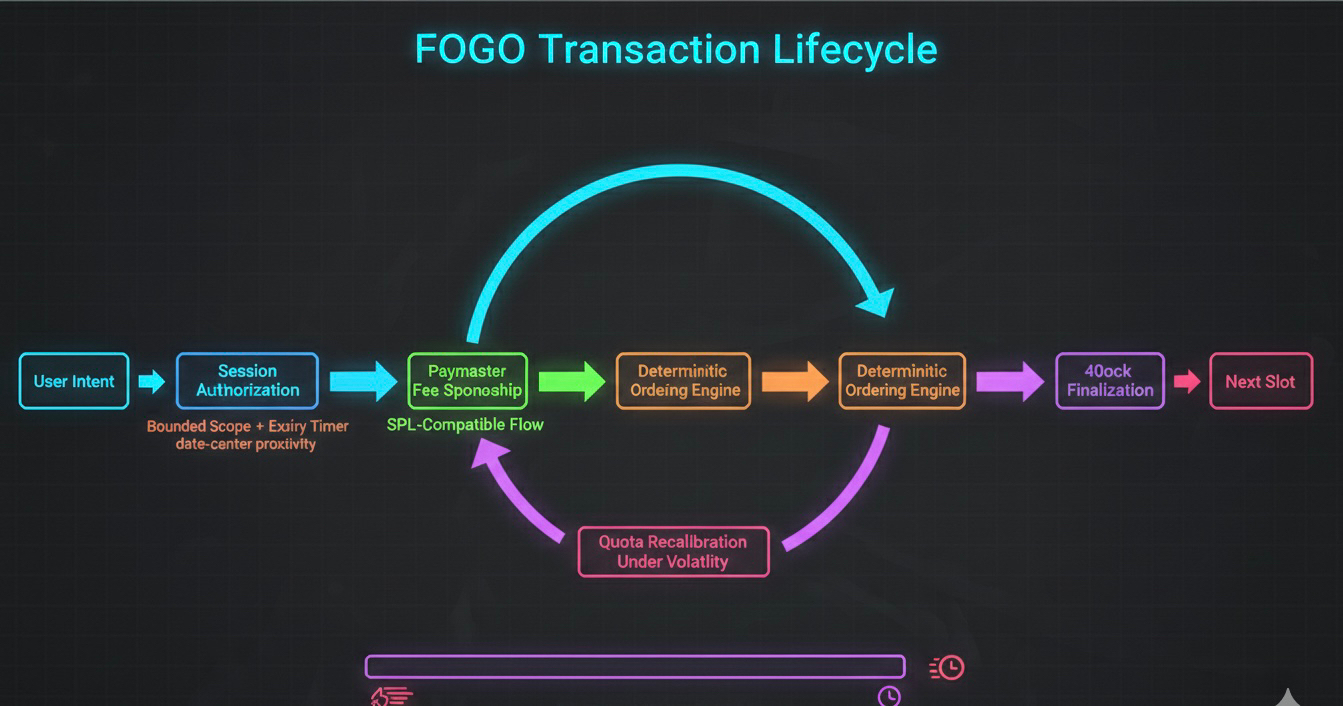
Parallel layer: Human perception → calculation → hesitation → confirmation delay.
The delta between those layers is exposure.
Where Most Systems Fracture
High throughput demos are easy in isolation.
Real pressure is different.
Volatility clusters. Transaction bursts overlap. Latency asymmetry appears between participants. One validator hiccups. A network path stalls for milliseconds.
In globally coordinated systems, those milliseconds compound.
In compressed zones, they localize.
But localization means something else: there’s less slack.
Less room for indecision.
Less buffer for error.
You either operate at tempo—
or you trail it.
Human Tempo vs System Tempo
This is the part most analyses ignore.
Machine tempo is fixed.
Human tempo fluctuates.
Fatigue slows reaction. Overconfidence accelerates error. Stress distorts perception. Even breath rhythm shifts decision timing.
Forty milliseconds doesn’t sound fast.
Until it repeats.
Slot after slot after slot.
And your nervous system tries to synchronize with something that doesn’t blink.
The book adjusts.
You adjust slower.
The chain finalizes without commentary.
And somewhere inside that gap between intention and execution, you realize something uncomfortable:
The system was never waiting for you.
It was measuring you.
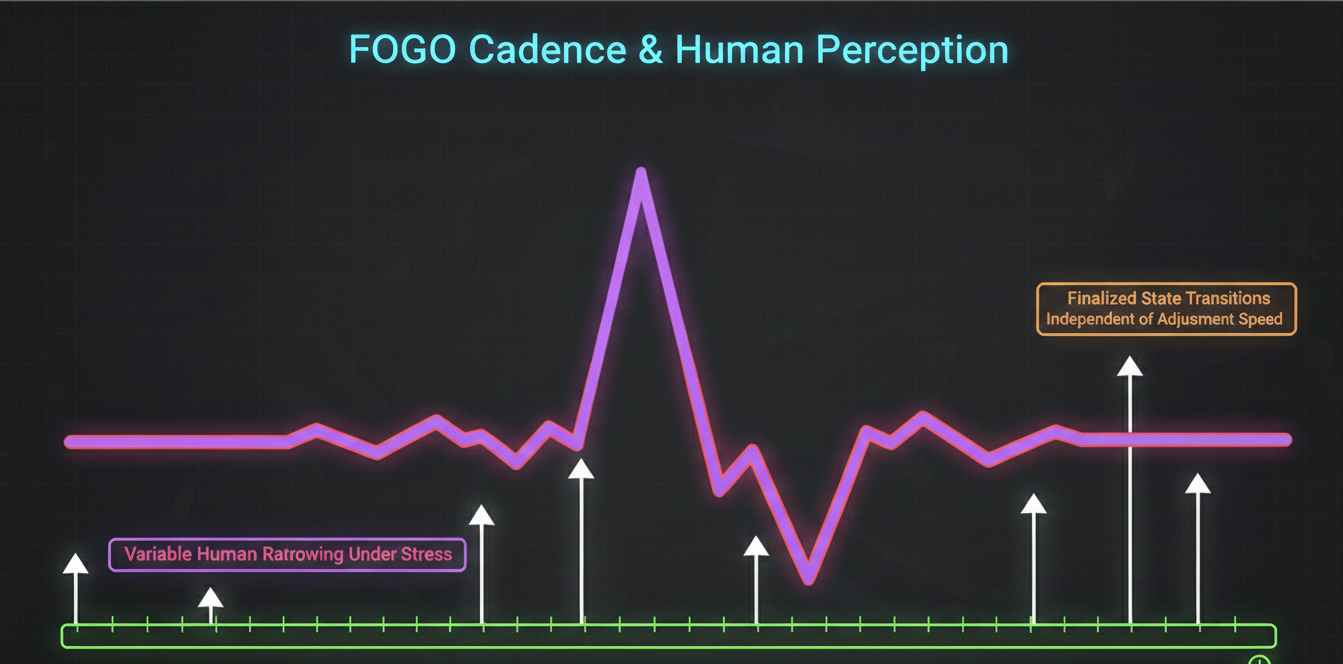
Fogo isn’t impressive because it’s fast.
It’s impressive because it refuses to slow down to match you.
And that tension—
lingers.