
Fogo is easy to respect on the engineering side. It is not vague about what it wants to be. It publishes numbers. It publishes cadence. It publishes how it wants validators to run. That is rare.
The issue is different. A fast chain does not automatically mean a strong token. The token has to carry security. It has to carry incentives. It has to carry governance. It also has to survive the messy part. Launch liquidity. Early selling. Future unlocks.
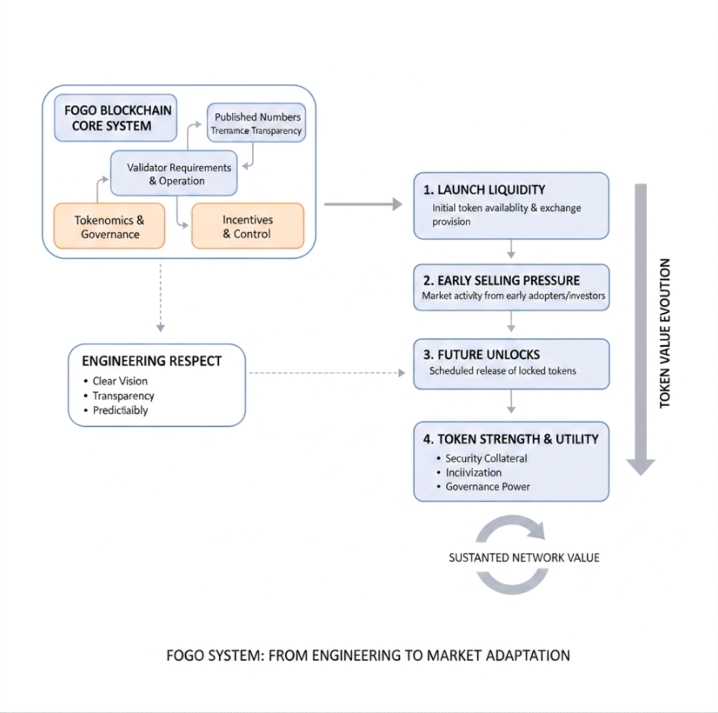
Fogo’s testnet parameters are aggressive. The docs target 40 millisecond blocks. Leader terms are set in short windows. Epochs are short too. And the design rotates leadership across zones. It is a follow the sun idea. That means more complexity. But it also means the architecture is intentional.
The validator plan is also direct. Fogo ties its approach to a pure Firedancer based client direction. It also says performance requirements are high. It emphasizes operator experience. It starts with a small set. The foundation stake is split across seven operators at launch. That supports stability early. It also concentrates influence early. Both can be true.
Now the token. This is where scrutiny matters.
Fogo states that 36.26 percent of genesis supply is unlocked at launch. It states 63.74 percent is locked. It also notes 2 percent burned. Those numbers look balanced. But the composition of the unlocked part changes the risk profile.
The Foundation allocation is listed as 21.76 percent and fully unlocked. Launch liquidity is 6.5 percent and fully unlocked. The airdrop is 6 percent and fully unlocked. The Prime Sale is 2 percent and fully unlocked. These are not small. They shape early market behavior.
This is why early price discovery can get distorted.
Airdrops are often sold. Not always. But often. People treat them like inventory. They rotate into other positions. They pay expenses. They reduce risk. That selling is not a moral failure. It is normal behavior.
Launch liquidity has its own effect. It can make the market look deep. But depth funded by one actor is not the same as depth funded by many. It can mask weak organic demand. It can also vanish if support is pulled.
The Foundation being fully unlocked is the big lever. It gives flexibility. It can fund builders fast. It can respond to issues fast. It can seed new apps. But it also concentrates control. It can steer incentives. It can shape liquidity programs. It can set the tone of adoption. That creates a centralization vector that is economic, not technical.
Fogo also describes a flywheel model. The Foundation supports partners. Partners commit to revenue sharing. Value routes back to Fogo. Several agreements are said to be in place. This is interesting. It is also risky.
Why risky. Because it is partly contractual. Contracts can change. Partners can underperform. Deals can be renegotiated. Accounting can be messy. Jurisdictions can conflict. If value capture depends on off chain agreements, tokenholders inherit counterparty risk. That is not the same as fee based value that is visible on chain.
Now inflation. Fogo’s validator design notes a decaying inflation schedule. From 6 percent to 4 percent to 2 percent over three years. With an option to reduce to 1 percent. Sounds conservative. But it still starts with emissions. And emissions meet reality.
Reality is validator cost. Performance validators are expensive. Hardware is costly. Networking is costly. Ops is costly. If rewards are paid in the token, validators often sell to cover bills. That creates steady sell pressure. Especially early. Especially when demand is not yet sticky.
Locks help later. But they also create future events.
Core contributors and advisors have multi year vesting with a 12 month cliff. Institutional unlock starts after one year from the September 26, 2025 reference date. Those cliffs are standard. The risk is timing. If organic usage is not strong before those unlocks, markets price the future supply as a threat. Often months in advance.
So the real question is not, is Fogo fast. It is, does Fogo translate speed into durable value capture for the token.
Here are the risks, clearly, without drama.
Execution risk. Ultra short block targets reduce margin for error. Zone rotation adds more moving parts. Things can look fine until stress. Stress is adversarial load. Stress is partial outages. Stress is real users spamming. If the chain degrades, nothing else matters.
Inflation pressure. A decaying schedule still dilutes early. If adoption depends on incentives, emissions can become the product. When incentives fade, activity fades. That is the failure mode.
Regulatory exposure. A strong Foundation role plus revenue sharing agreements increases surface area. It looks more managed. It looks more like an ecosystem operator. That can attract questions. Even if the code is solid.
Centralization vectors. High performance requirements limit who can validate. Early staking spread across seven operators is a start, not decentralization. Expansion needs to be real. Otherwise a small set becomes the permanent set.
Dependency on partnerships. If value recirculation depends on agreements, token value depends on counterparties. That is not always bad. But it is a different risk class.
Macro liquidity cycles. Early unlocked supply plus airdrop flow plus incentive budgets can amplify downturns. If liquidity dries up, the token needs a reason to be held. Not just a reason to be farmed.
Now the structural outlook.
Fogo can matter if it becomes the place for applications that truly need low latency execution. The docs suggest it is built for that.
But long term relevance will depend on three proofs.
First proof. Usage stays when incentives taper. That means real users. Real fees. Real retention.
Second proof. Governance broadens. Validator participation expands. Influence becomes less concentrated than it is at launch.
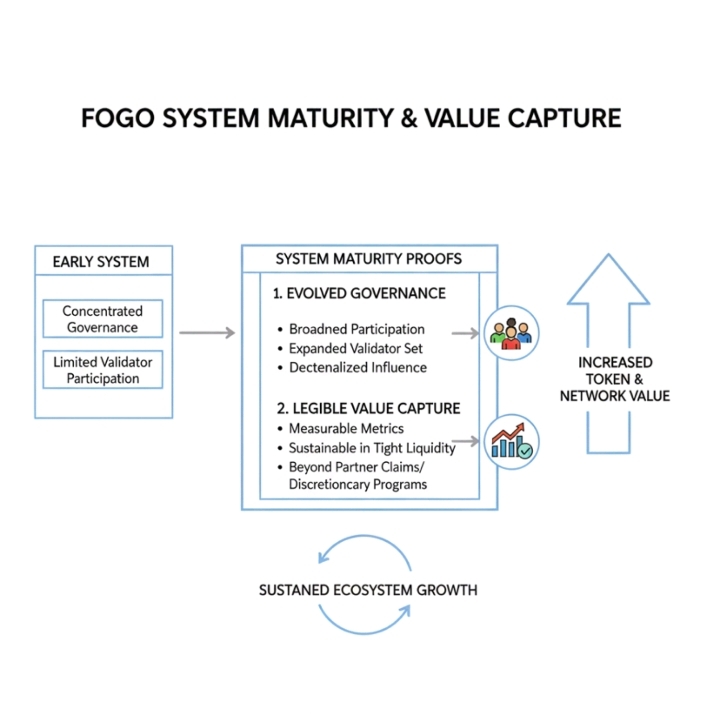
Third proof. Value capture becomes legible. Not just partner claims. Not just discretionary programs. Something measurable that survives a tight liquidity environment.
If Fogo hits those proofs, the token starts to look like a durable coordination asset. If it misses them, the chain can still be technically impressive, but the token will carry persistent risk premia.
