
Introduction
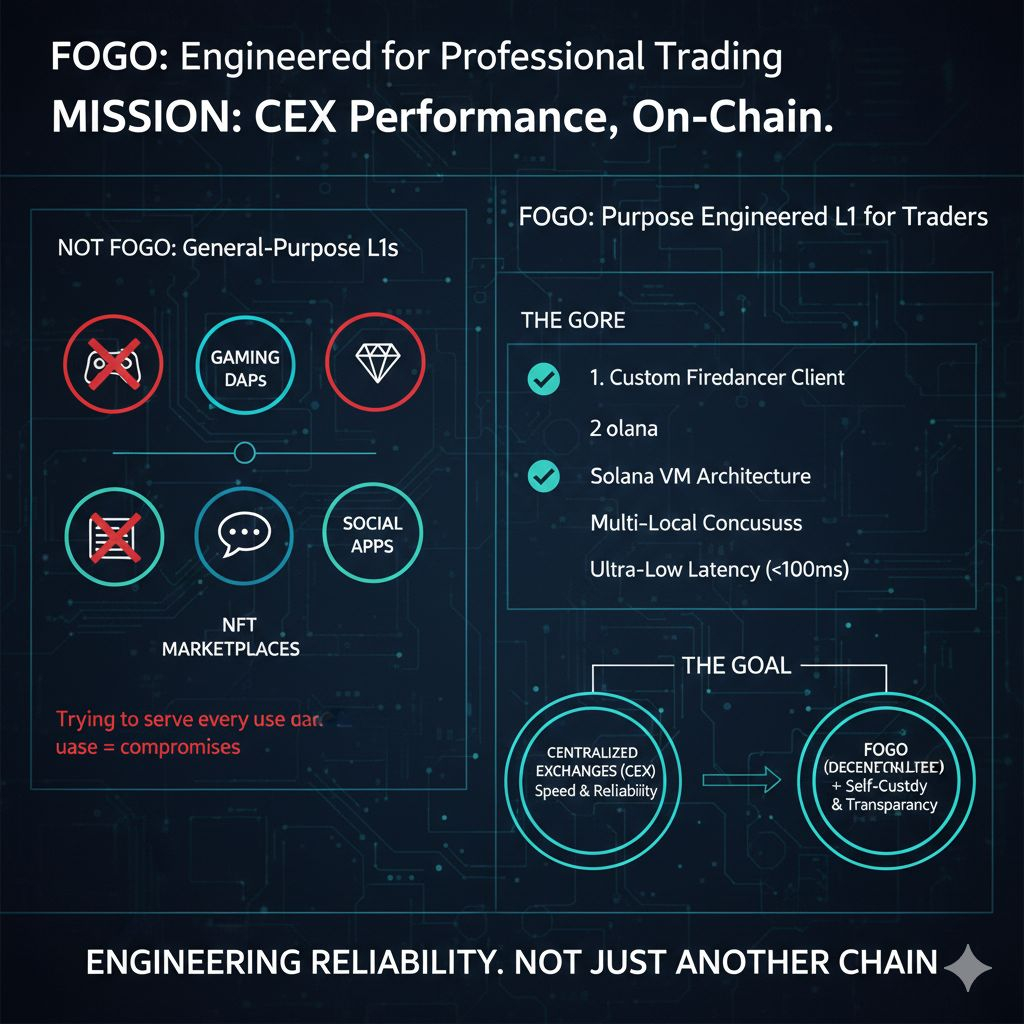
When I look at Fogo, I do not see another Layer 1 trying to compete in a crowded field. I see a deliberate design focused on one mission. Fogo is built as a decentralized Layer 1 specifically for traders and professional capital markets. It runs a custom Firedancer client on the Solana Virtual Machine architecture, and it aims for extremely low latency through multi local consensus.
What stands out to me is that Fogo is not trying to serve every possible use case. It is not positioning itself as a general purpose chain for gaming, NFTs, or social apps. It is focused on high performance on chain trading. The goal is simple but ambitious: match the speed and reliability of centralized exchanges while preserving self custody and transparency.
That focus shapes everything, from architecture to token design.
Built for Performance
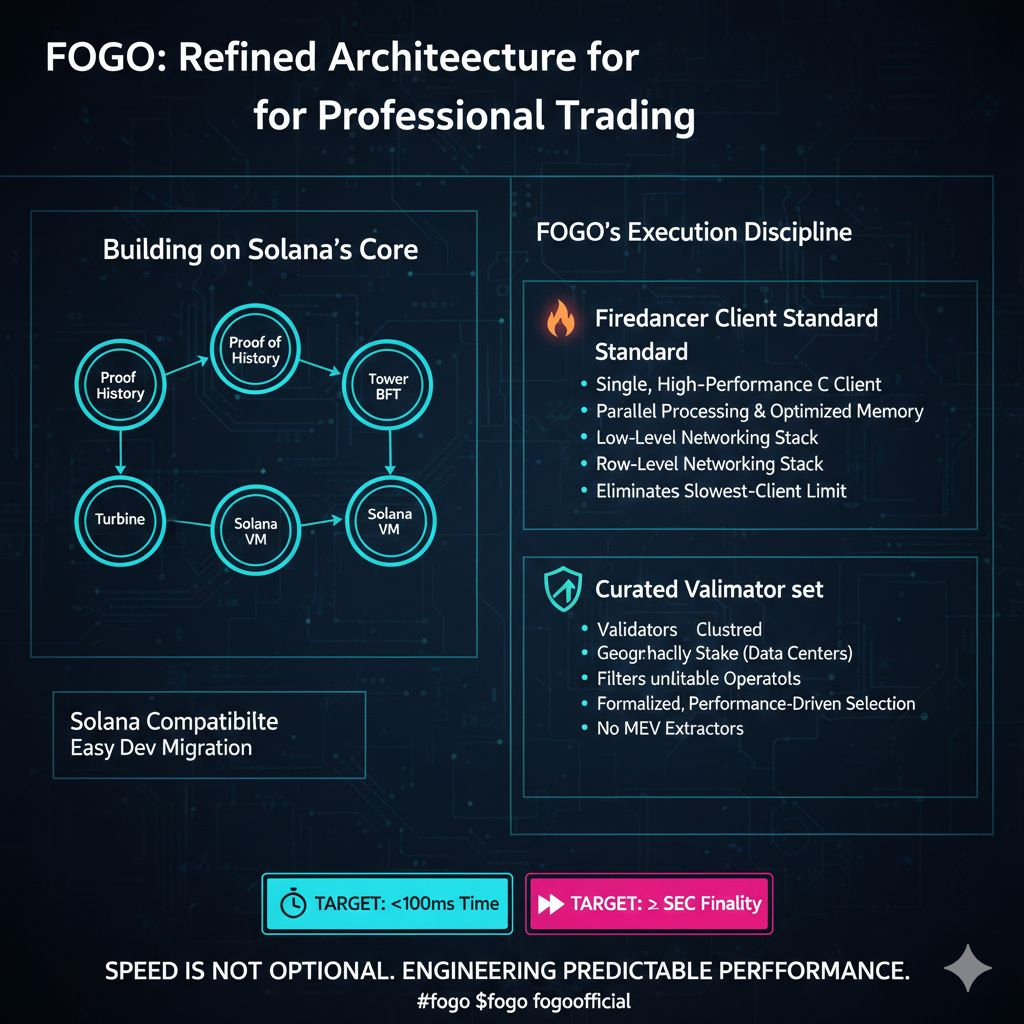
Fogo does not attempt to reinvent the foundations laid by Solana. It keeps Proof of History as the global clock, Tower BFT for consensus, Turbine for block propagation, the Solana Virtual Machine for execution, and leader rotation. What it does instead is refine and optimize.
Because it remains compatible with Solana tools, developers can migrate without rewriting major parts of their code. That matters. It lowers friction and shortens the path to liquidity.
Where Fogo differentiates itself is in execution and infrastructure discipline.
First, it standardizes around a single high performance client based on Firedancer. Instead of allowing slower clients to drag the network down, it encourages the fastest possible implementation. Parallel processing, optimized memory usage, and a high performance networking stack push the chain toward extremely low latency targets.
Second, it uses zone based consensus. Validators cluster within specific geographic regions, often inside the same data center environments, to reduce physical latency. These zones rotate over time to preserve resilience and jurisdictional diversity. It is a trade off, but a calculated one.
Third, Fogo curates its validator set. Performance standards matter. Validators must meet operational and stake requirements. This filters out unreliable operators and prioritizes predictable execution. In practice, many proof of stake networks already concentrate power among top validators. Fogo simply formalizes performance expectations.
The target is clear: sub 100 millisecond block times and finality under one second. For order book trading and derivatives, that level of speed is not optional.
The Three Pillars
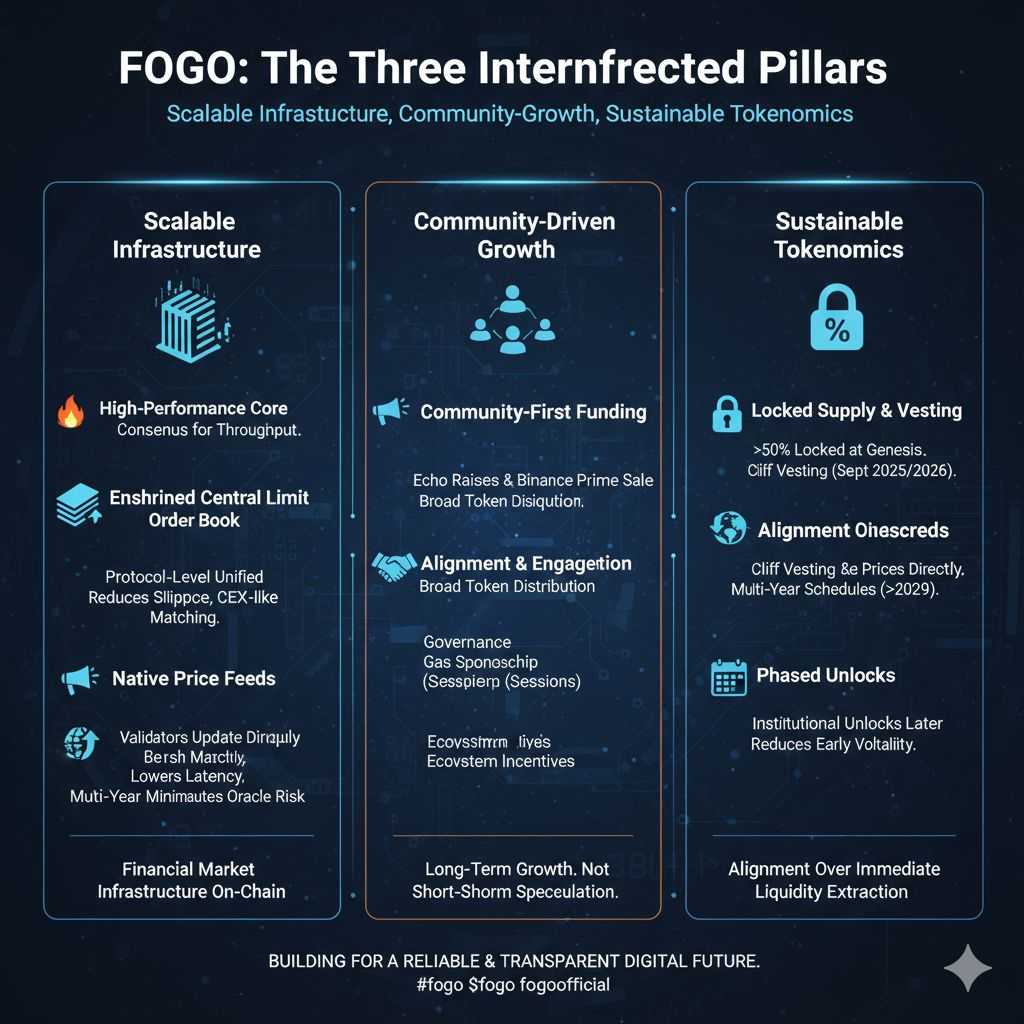
From my perspective, Fogo rests on three interconnected pillars: scalable infrastructure, community driven growth, and sustainable tokenomics.
Scalable Infrastructure
The infrastructure is designed to handle high transaction volume without congestion or sudden fee spikes. The integration of Firedancer and regional consensus supports throughput and consistency.
What I find especially important is the enshrined central limit order book at the protocol level. Instead of fragmented liquidity across separate exchanges, traders interact within a unified on chain order book. That structure reduces slippage and mimics the experience of centralized matching engines.
Native price feeds further reduce dependency on external oracle systems. Validators update pricing directly, lowering latency and minimizing external risk.
The result feels less like a traditional blockchain and more like financial market infrastructure built on chain.
Community Driven Growth
Fogo adopted a community first funding approach. Through Echo raises and a Binance Prime sale, tokens were distributed to thousands of participants rather than concentrated in a small venture group.
This broad ownership creates alignment. Governance participation, gas sponsorship features such as Sessions, and ecosystem incentives encourage builders and users to grow together.
To me, this distribution model strengthens long term engagement instead of short term speculation.
Sustainable Tokenomics
The token design reflects long term thinking. A significant portion of supply was locked at genesis and structured with cliff vesting. Most categories begin unlocking after September 2025 with multi year schedules extending toward 2029.
More than half of supply was initially locked, limiting early sell pressure. Institutional allocations unlock later than community portions, which reduces early stage volatility.
The structure shows an emphasis on alignment rather than immediate liquidity extraction.
Competing With Centralized Exchanges
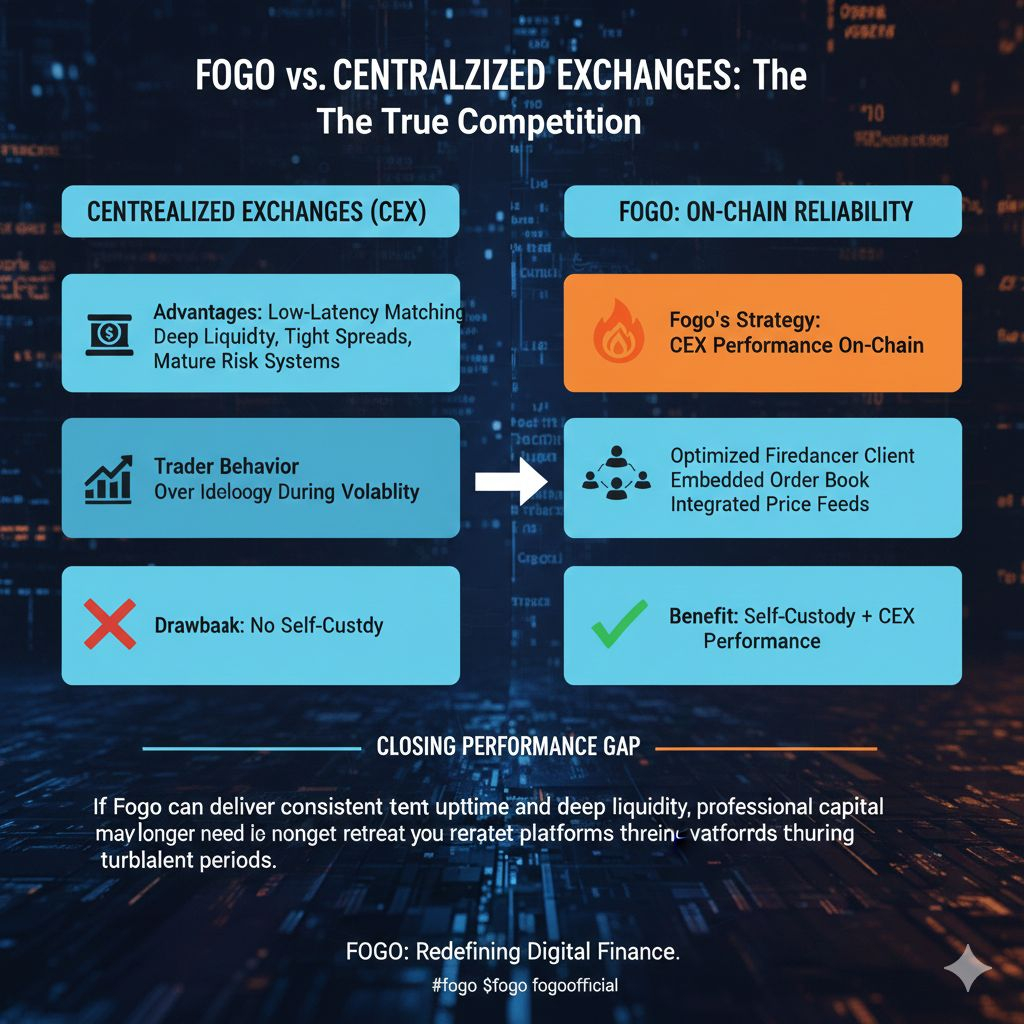
I do not believe Fogo’s real competitor is another Solana based chain. The real competition is centralized exchanges.
Centralized venues dominate because they offer low latency matching engines, deep liquidity, tight spreads, and mature risk systems. When volatility rises, traders choose reliability over ideology.
Fogo’s strategy is what I would call bringing centralized exchange performance on chain. By optimizing execution speed, standardizing validator hardware expectations, embedding an order book, and integrating price feeds, it aims to close the performance gap.
If it can deliver consistent uptime and deep liquidity, professional capital may no longer need to retreat to centralized platforms during turbulent periods.
Final Thoughts
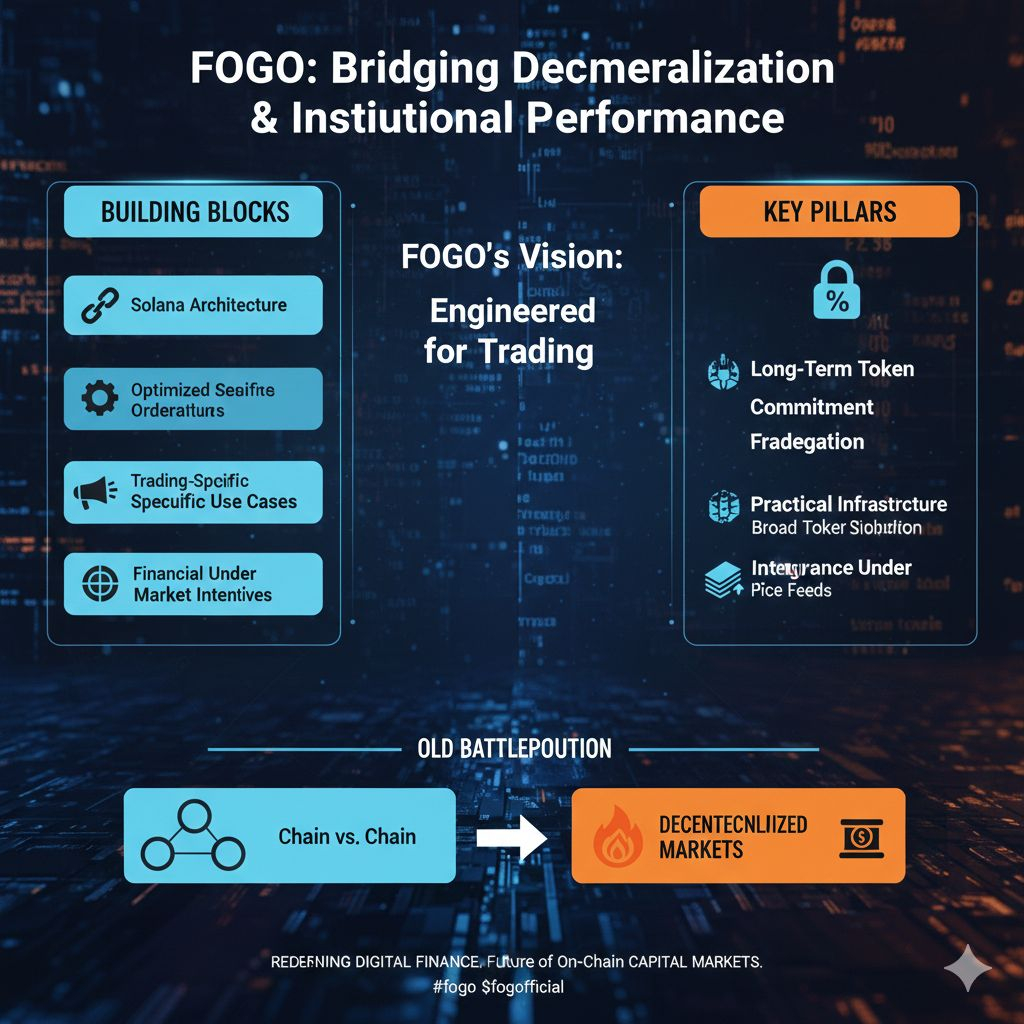
In my view, Fogo represents a focused attempt to bridge decentralization and institutional grade performance. It builds on proven Solana architecture while optimizing execution and latency for trading specific use cases.
Its token structure signals long term commitment. Its infrastructure decisions reflect practical trade offs. Most importantly, its success will not be measured by theory but by execution under real market stress.
If Fogo can remain stable during volatility and attract meaningful liquidity, it could redefine the competition from chain versus chain to on chain markets versus centralized exchanges.
That is a much more important battle for the future of digital finance.