

There’s a subtle but important divide emerging in crypto infrastructure that most people miss because both sides use the same language. Everyone says they’re building for AI. Everyone talks about agents, automation, and intelligent systems. But underneath the shared vocabulary are two very different philosophies.
One group is building AI-first chains. The other is moving toward AI-integrated chains. And the difference between those approaches might decide what actually lasts once the excitement settles.
AI-first chains usually start from the narrative. They design the ecosystem around AI as the main identity. The chain exists to signal alignment with intelligence itself. That creates strong early momentum because it’s easy to understand: this is the AI chain, this is where agents live, this is where the future happens. But the risk is structural. When the core identity depends on a trend, the infrastructure can end up chasing the narrative instead of solving the underlying coordination problems that AI introduces.
AI-integrated chains begin from a different question. Instead of asking how to make AI the headline, they ask how intelligence fits into existing systems. They treat AI as another layer interacting with execution, data, and permissions rather than as the entire reason the chain exists. The goal is not to build a separate universe for AI, but to make intelligence operate smoothly inside a predictable environment.
That’s where @Vanarchain starts to look interesting.
Vanar doesn’t position itself as pure AI infrastructure in the loud, identity-driven sense. The direction feels more like integration designing an execution environment where AI can exist as part of broader workflows rather than the center of attention. That sounds subtle, but it changes the architecture conversation. If AI is integrated, then the priorities become continuity, data coherence, and predictable execution rather than just raw experimentation.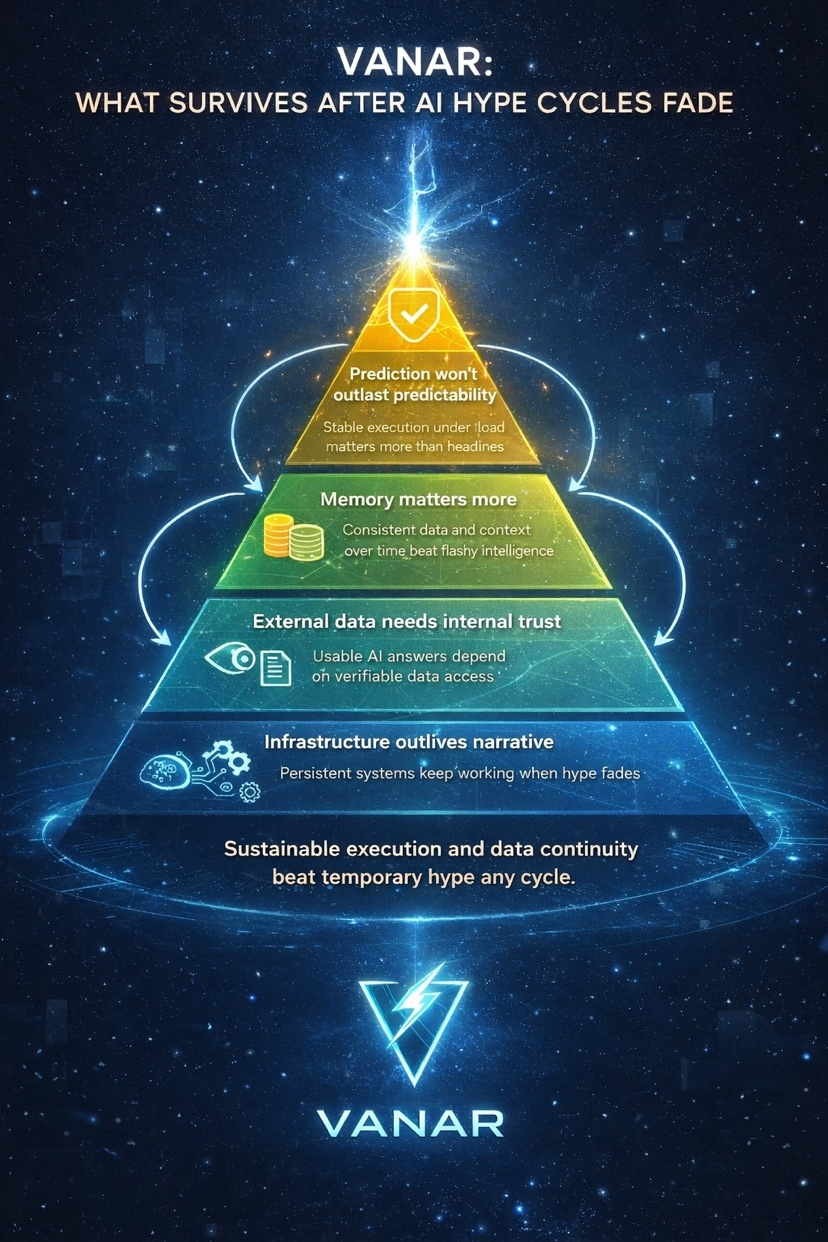
The reason this distinction matters is that AI systems don’t live well in isolated ecosystems. Real intelligence workflows pull data from multiple sources, move across environments, and depend on stable assumptions. Chains built purely around AI hype often underestimate how messy that becomes in practice. Intelligence alone doesn’t create value. Reliability does.
That’s why integration tends to age better than specialization. When hype cycles cool, users stop looking for “the AI chain” and start looking for systems that simply work. They want infrastructure that supports intelligent behavior without requiring everyone to think about AI all the time.
Vanar’s approach increasingly feels aligned with that future. Instead of turning AI into a separate category, the focus leans toward making intelligence native to how data and execution behave something embedded rather than advertised. The chain becomes less about showcasing AI and more about enabling persistent workflows where memory, context, and execution can stay consistent across interactions.
This difference also changes how you think about adoption. AI-first chains attract attention quickly because they promise a clear identity. AI-integrated chains grow slower but often align better with real integration paths, where businesses, systems, and developers care more about stability than branding.
None of this guarantees one path wins. There’s always room for experimentation. But if blockchains are moving toward being parts of larger operational systems instead of isolated ecosystems, then integration starts to look more durable than identity.
And that might be the real long-term question around Vanar. Not whether it becomes the loudest AI chain, but whether it becomes the chain where AI quietly works, where intelligence is not a feature people notice, but an assumption baked into how the system behaves.
Because once the market stops chasing labels, the chains that survive won’t be the ones that claimed AI the loudest.
They’ll be the ones that made AI feel normal.