
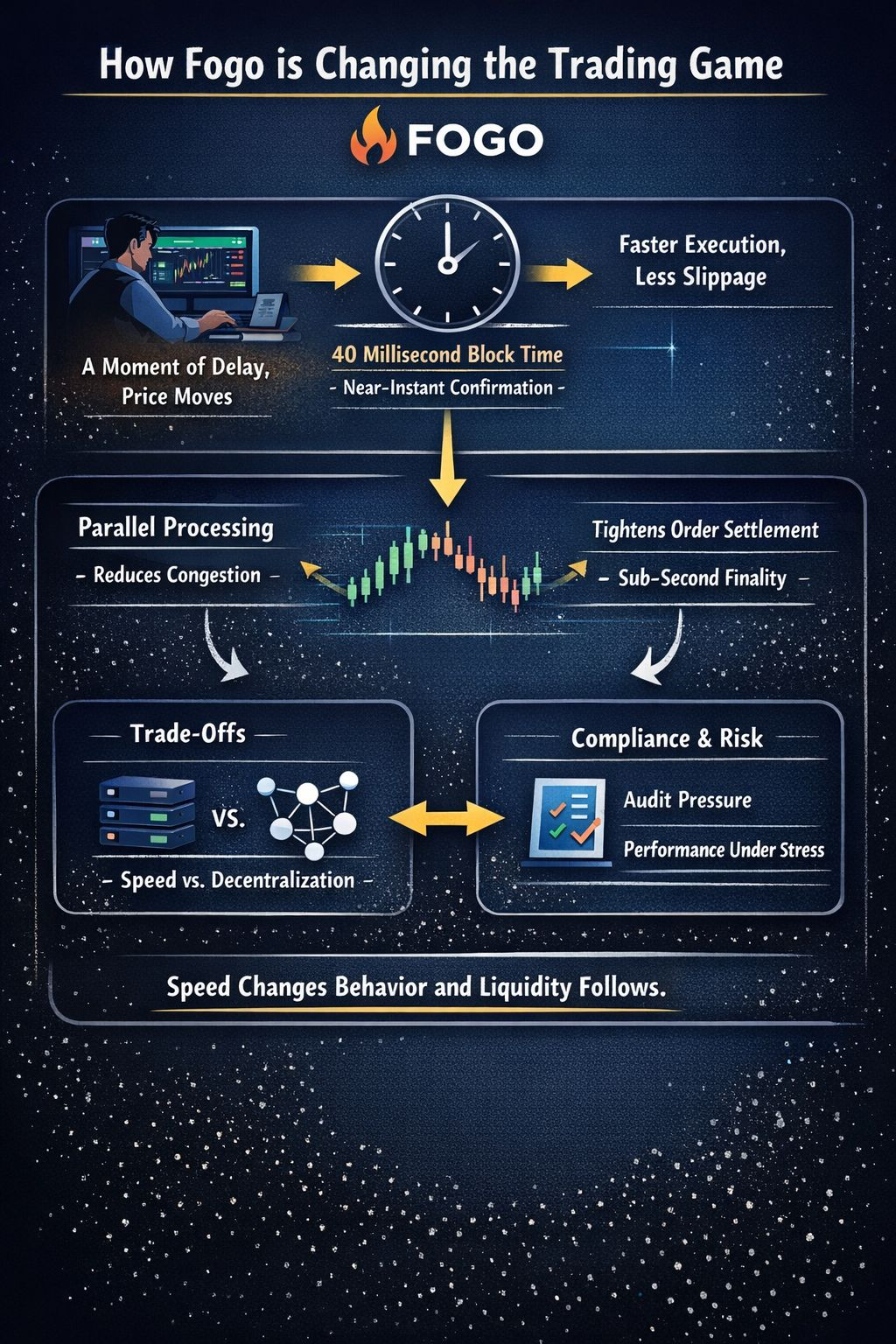
When I first looked at Fogo, I still remember the first time I tried to hit a trade right in the middle of a volatility spike and the screen just… paused. Not long—barely a heartbeat. But in that tiny gap, the price had already shifted. The market moved on without me. That brief hesitation was enough to shake my confidence, and it stuck with me. It made me realize how little attention we actually pay to those in-between moments that quietly decide whether a trade works or not.
Traders don’t usually think in milliseconds. But markets do. A brief delay between intent and execution is enough for price to slip, spreads to widen, or conviction to waver. That hesitation isn’t just technical friction—it shapes behavior. Speed quietly rewires how traders perceive risk, and that is where Fogo enters the conversation.
Crypto culture tends to treat latency as a solved problem. Centralized venues like Binance feel instant, so blockchains are framed as needing to be merely “fast enough.” But speed is contextual. Fogo’s 40 millisecond block time compresses confirmation into something that feels continuous rather than sequential. When settlement approaches the threshold of human perception, traders stop budgeting for delay. The psychological gap between decision and outcome narrows.
Under the hood, this is not just about faster blocks. Fogo’s architecture follows the parallel execution model of the Solana Virtual Machine, reducing congestion when order flow spikes and tightening the link between order intent and settlement outcome. That design choice matters most in volatile conditions, where time risk dominates volume risk. Throughput is about how many trades clear. Latency is about whether your trade clears before price moves. Markets care more about the latter.
The trade-off is structural. Ultra-optimized validator networks tend to favor performance-heavy setups. That pressure can compress decentralization over time. Speed pushes networks toward execution certainty, while governance diversity becomes harder to maintain. This tension isn’t ideological—it’s economic. Liquidity follows reliability. Traders will accept less distribution if uptime and confirmation are consistent during stress events.
The macro environment amplifies this shift. Liquidity is thinner than in prior cycles, derivatives dominate price discovery, and automated agents increasingly shape spreads. Faster finality allows on-chain venues to compete with centralized execution not just philosophically, but functionally. If confirmation windows shrink to sub-second, capital begins to treat on-chain liquidity as deployable infrastructure, not experimental plumbing. That invites algorithmic strategies that assume immediacy, tightening spreads while increasing feedback risk during volatility.
Compliance pressure adds another layer. Faster, deterministic settlement narrows the ambiguity window for monitoring and audit. Predictable execution paths simplify regulatory interpretation even as they reduce reaction time for intervention. Infrastructure becomes easier to reason about precisely because it leaves less room for interpretive delay.
The unresolved question is resilience. History shows that pushing performance toward hardware limits tightens failure margins. If coordination falters, small errors can cascade. Fogo’s emphasis on validator efficiency rather than raw throughput aims to contain that risk, but confidence will depend on performance under real volatility, not benchmarks.
As confirmation times fall below human hesitation, markets adapt. Traders stop compensating for lag. Algorithms assume immediacy. Liquidity providers tighten spreads. When time disappears from the execution budget, it becomes the hidden risk. Fogo’s wager is that compressing time changes behavior first—and market structure follows.$FOGO @Fogo Official #fogo