
I remember the sound of the room more than the words. The air conditioner that never quite reached the corners. The projector fan. Someone tapping a pen like they were trying to keep their hands from doing something else. Nobody wanted drama. Everyone wanted a quiet night where the dashboards stayed flat and we went home without learning anything new the hard way.
The story on the screen didn’t look like a crisis. It looked like a normal person trying to do a normal thing at the wrong moment. A small hedge. A quick swap. Then the wallet started firing approvals back to back, like paperwork thrown at you while the floor is moving. The market moved while the person was still reading. You could see it in the timestamps, that dead space between intent and execution, the gap where the user is doing what they were trained to do: click carefully, confirm, comply. In that gap, the price does not wait. It never waits. It doesn’t care if you’re careful.
The first comment in the meeting was predictable. We need to be faster. It wasn’t said with excitement. It was said like a coping mechanism. Faster blocks. Faster confirmations. More throughput. You could almost feel the relief of having something clean to blame. A number you can chase. A chart you can improve. A way to avoid saying the uncomfortable thing out loud.
Then someone from security leaned forward and said, quietly, that it wasn’t a speed problem. They didn’t say it like an argument. They said it like a fact that had been sitting in their throat all week. The screen was still showing approvals. The scope. The duration. The authority implied by one casual word: approve. Everyone in the room knew what that word actually means when you strip the friendliness away. It means power. It means capability. It means you are letting a thing act as you, and you are doing it in a moment when your attention is being auctioned off to the highest bidder.
That’s where most failures start. Not with slow blocks. Not with a chain that can’t keep up. They start when a system asks a human for a decision that is too broad, too permanent, too easy to misunderstand, and too often made under pressure. They start when “good UX” gets defined as fewer prompts, regardless of what those prompts were protecting. They start when unlimited approvals become normal because they’re convenient, and convenience is treated like a right instead of a risk.
The blunt version is this: the real failure comes from permissions and key exposure, not “slow blocks.” We repeat it in audit rooms because it keeps being true. We repeat it at 2 a.m. because nothing about the charts changes that reality. We repeat it in postmortems because the exploit path is rarely magical. It’s usually patient and ordinary. It’s usually “the permission was there.”
Fogo makes more sense when you start from that sentence instead of from performance slogans. Yes, it’s an SVM-based high-performance L1 with Firedancer roots. It can move quickly. It’s designed for environments where latency shows up as slippage and missed fills, where waiting even a little bit has a cost you can measure. That matters. But speed isn’t the moral core. Speed is a tool, and tools can be used in two directions. You can use speed to make people sign more things faster, or you can use speed to make people sign fewer things with tighter boundaries and less room for regret.
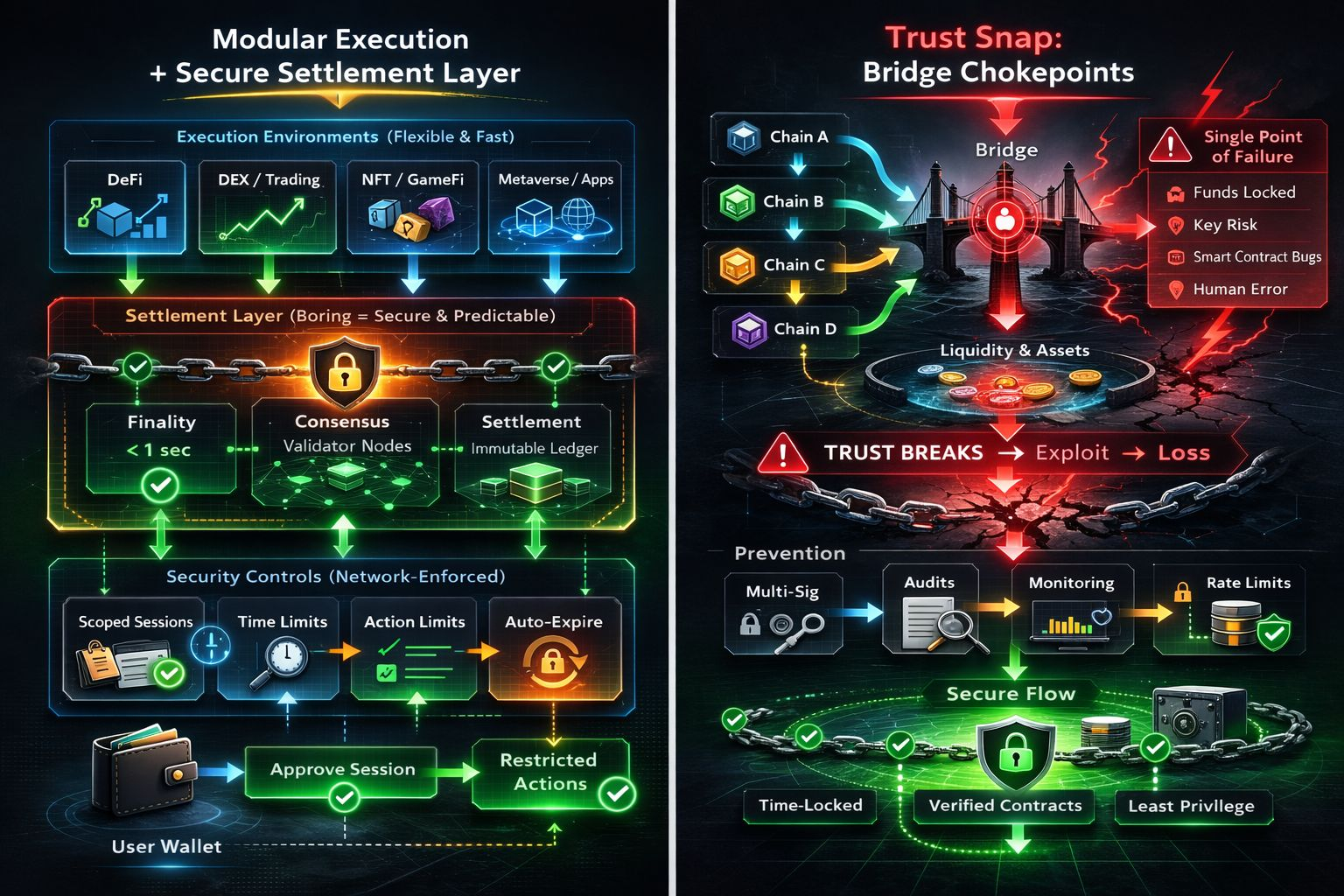
Fogo Sessions is where that choice becomes concrete. It’s not just “one less click.” It’s a shift in what the click stands for. A session is enforced, time-bound, scope-bound delegation. You approve a session and then actions can run without paying gas or re-signing every single step, but only inside a defined operating envelope. It’s closer to a visitor badge than a master key. You’re allowed into these rooms. You can do these actions. Up to these limits. Until this time. After that, the badge stops working whether you remember to revoke it or not. The network enforces the limits so the user doesn’t have to stay sharp forever.
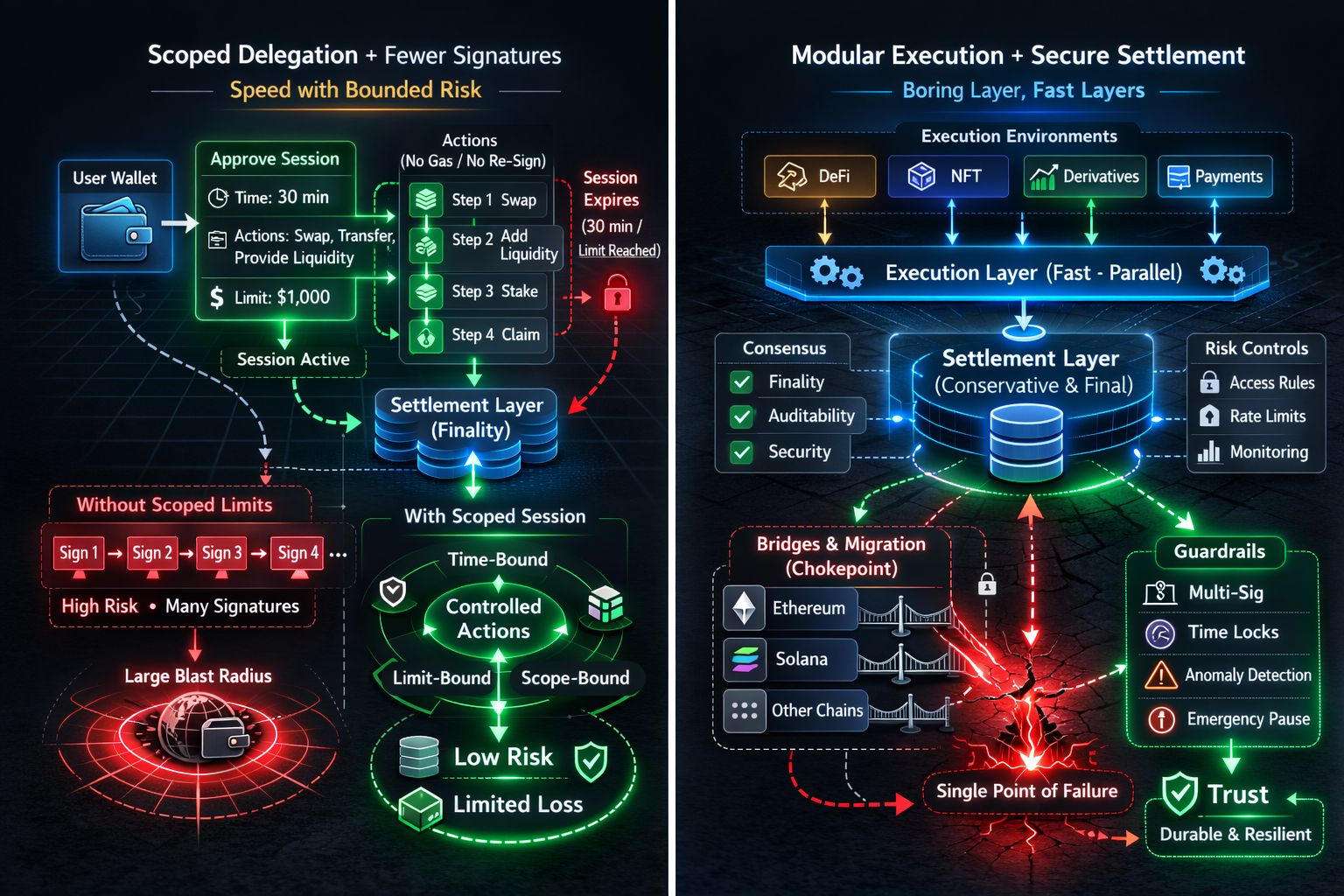
That enforcement is the quiet point. It moves safety out of promises and into constraints. It means the user doesn’t need to be perfect, and perfection is an unrealistic requirement in a world where phones buzz, charts flash, and decisions happen in seconds. It means a tired person isn’t pushed into granting full wallet control just to complete a simple chain of actions at market speed. It means “do this sequence” doesn’t have to imply “own me indefinitely.”
Scoped delegation + fewer signatures is the next wave of on-chain UX.
That line is true for reasons that aren’t fashionable. Every signature is a high-stakes moment where a human can be rushed, distracted, or fooled. Every extra prompt is another chance to click through, another chance to treat consent as routine. Reducing signatures isn’t about making people reckless faster. It’s about reducing the number of times a person has to make a dangerous decision in a low-attention moment. Scoping delegation isn’t about limiting power for the sake of control. It’s about limiting blast radius when something inevitably goes wrong, because something always goes wrong somewhere.
Underneath, the architecture lines up with the same philosophy. Modular execution environments above a conservative, boring settlement layer. “Boring” is the compliment people only learn to give after they’ve been through a failure. Boring means predictable. Boring means the bottom doesn’t improvise. Boring means the settlement layer behaves like infrastructure, not like a stage performance. Above that, you can be flexible. You can be fast. You can support different execution contexts without making the foundation a moving target.
Even the EVM compatibility angle fits best when you treat it as friction reduction rather than vanity. Tooling people already know. Solidity muscle memory that reduces accidental mistakes. Audits that have established patterns and hard-earned instincts. Familiarity doesn’t guarantee safety, but it reduces the number of ways teams can harm themselves while shipping, and self-inflicted wounds are still some of the worst wounds.
Then the conversation always gets economic, because technology doesn’t stay neutral once value flows through it. If you want incentives without whale capture, you have to respect how power actually accumulates. It doesn’t only accumulate through early buys. It accumulates through operational capacity, through being the only class of user who can move quickly without taking on reckless permission risk, through being able to absorb losses, through having the time and tooling to exploit every edge that normal people can’t even see.
Fairness isn’t just distribution math. It’s about what the system rewards over time. It’s about whether participation feels possible without becoming a full-time operator. If safety requires constant vigilance, the vigilant minority wins by default. If safety is enforced by the network, careful behavior stops being a luxury and starts being normal. That’s a quiet kind of fairness, but it’s real. It’s the difference between a system that looks open and a system that feels usable by people who have lives.
The token story should be spoken about like adults, too. The native token exists as security fuel. Staking is responsibility, skin in the game, not a promise of effortless upside. Long-horizon emissions signal patience, the willingness to build for years instead of quarters. If a system is serious, it doesn’t need to scream about incentives. It needs to align incentives with durability.
And still, the honest paragraph has to be there, because optimism without it is just marketing. Bridges and migrations are chokepoints. They concentrate risk. They concentrate complexity. They concentrate the kind of operational fragility that audits can reduce but never erase. This is where human error shows up: a rushed deploy, a misunderstood checklist, a misplaced assumption, a key that was protected until the day it wasn’t. This is where you learn that “compliance-aware” is not a vibe, it’s a discipline that lives in procedures and access controls and the unglamorous habit of saying “stop” when everyone wants to move.
Trust doesn’t degrade politely—it snaps.
It snaps when a control path becomes too powerful and too quiet. It snaps when a bridge becomes the single throat everything must pass through. It snaps when a permission that should have expired keeps living, and nobody notices until it’s used against them. This is why guardrails matter more than bravado. This is why a system that can enforce boundaries is not less free. It’s more honest about how humans behave.
By the end of the meeting, nobody was talking about throughput anymore. They were talking about what the network should refuse to do, even if a user accidentally asks for it. They were talking about consent that survives distraction. They were talking about limits that don’t rely on remembering. They were talking about the difference between speed that flatters you and speed that protects you.
A fast ledger that can say “no” at the right moments isn’t limiting freedom; it’s preventing predictable failure. And if you’ve ever watched someone realize they signed away too much authority too quickly, you understand why that sentence matters more than any performance chart ever will.
