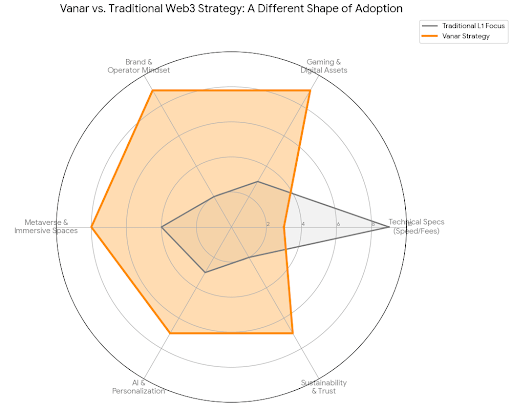
I’ve spent enough time watching blockchain projects rise, stall, and disappear to know when something feels different. Not better. Not guaranteed. Just… grounded. The way I see it, Vanar isn’t trying to win attention by sounding revolutionary. It’s trying to solve a very practical problem: how do you make blockchain matter to people who don’t care about blockchain?
That’s a massive hurdle. Still is.
Most Layer-1 networks lead with tech specs. Speed. Fees. Architecture. And sure, those things matter. But let’s be honest—normal users don’t open a wallet because a protocol shaved milliseconds off finality. They come in through something familiar. A game. A brand. A digital experience that feels worth their time. If that entry point isn’t there, adoption stalls. Every time.
Vanar seems to understand that. Or at least it’s trying to.
The project leans heavily on gaming, entertainment, brand partnerships, and digital environments instead of pushing raw infrastructure as the main selling point. That tells me the team isn’t thinking like pure engineers. They’re thinking like operators. People who’ve already worked in industries where users are impatient and loyalty is fragile. If something doesn’t click in seconds, people leave. No second chances.
And that mindset changes how a blockchain gets built.
Because instead of asking, “How do we build the best chain?” the question becomes, “Where do people naturally spend time, and how do we quietly plug blockchain into that?” That’s a completely different starting point. It shifts the focus from tech bragging to user behavior.
Gaming is the obvious example. Always has been. Players already understand digital value. Skins, assets, progression, trading—none of that is new to them. They don’t need a lecture on ownership. They’ve been living it for years. So when something like the VGN games network enters the picture, it doesn’t feel foreign. It feels like an extension of what already exists.
Short learning curve. Big advantage.
The metaverse angle—through platforms like Virtua—is trickier. Let’s not pretend otherwise. The term itself is overloaded and, frankly, damaged by hype cycles. But strip away the buzzword and the core idea still holds: persistent digital spaces where identity, community, and commerce mix. That’s not science fiction anymore. It’s already happening in fragments across the internet.
The real question is whether those fragments can connect into something cohesive.
That’s where Vanar’s approach gets interesting, and also risky. It’s not building a single flagship product and calling it a day. It’s spreading across gaming, AI, environmental initiatives, brand ecosystems, virtual worlds—basically trying to meet users wherever they already are. That’s smart in theory. In practice? Hard to execute. Coordination alone is a nightmare.
If those pieces don’t align, the whole thing feels scattered. And users notice that instantly.
The VANRY token sits in the middle of all this as the economic glue. But here’s the thing—tokens only work when they’re tied to real activity. Otherwise they drift into speculation loops, and we’ve seen that story too many times. The real clincher here is whether VANRY becomes something people actually use inside experiences, or just another asset people trade and forget.
That’s a make-or-break moment.
Artificial intelligence adds another layer. Not as a gimmick, but as a practical tool. Personalization, adaptive environments, smarter digital interactions—those things matter because they make experiences feel alive. Static platforms don’t hold attention anymore. People expect systems to respond, evolve, and feel tailored to them. When AI meets blockchain in a meaningful way, you get ecosystems that don’t just store ownership—they react to users.
That’s powerful. If done right.
Then there’s the environmental piece, which honestly surprised me at first. But the more you think about it, the more it fits. Digital ecosystems can’t pretend they exist in a vacuum. People care about impact now. Transparency. Accountability. If blockchain can track and verify environmental efforts in a way traditional systems can’t, that becomes more than a feature—it becomes a reason to trust the infrastructure.
And trust is the real currency here. Always has been.
Look, none of this guarantees success. Far from it. Web3 is littered with projects that had strong ideas, experienced teams, and solid tech… and still faded. Adoption isn’t logical. It’s emotional. Messy. People join for reasons you can’t predict and leave for reasons that barely make sense.
Vanar is betting that familiarity beats novelty. That people will enter through games, brands, and immersive environments instead of financial incentives alone. That’s a bold bet. And honestly, probably the only realistic one left.
Because the average person doesn’t want to “enter Web3.” They just want things to work. They want to play, collect, interact, belong. If blockchain supports that quietly in the background, great. If it demands attention and education first, they’re out.
Simple as that.
So the challenge now isn’t building more features. It’s stitching everything together so it feels like one living ecosystem instead of a set of disconnected experiments. Games have to connect with virtual spaces. Brands have to feel authentic, not opportunistic. AI tools have to enhance experiences, not complicate them. And the token has to move naturally across it all.
No friction. No confusion. No forced learning curve.
That’s the standard. Brutal, but fair.
And if Vanar pulls it off, adoption won’t arrive with fireworks. It’ll creep in. Quietly. A player earning assets without thinking about the chain underneath. A brand launching a digital experience that feels natural, not technical. A community forming inside a virtual space because it feels alive, not because it’s “Web3.”
One day people will look around and realize they’ve been using blockchain all along. Not consciously. Just naturally.
That’s the real finish line. Not hype. Not headlines. Just relevance.