
Hey,I want to share my thoughts and experience about Vanar Chain.I’m here to talk about why it works, what makes it structurally strong,and how AI agents are changing the way infrastructure demand is created in crypto. When I analyze networks like Vanar Chain,I don’t focus on trends or marketing narratives.I focus on demand mechanics who is using the chain, why they are using it, and whether that usage can scale sustainably.
One of the structural limitations in traditional crypto activity is human triggered throughput.Most blockchain transactions begin with a person clicking a button, signing a wallet request, or reacting to market volatility.Even during strong bull markets,this activity is episodic. Volume spikes during excitement and collapses during uncertainty.Human behavior naturally caps throughput because participation is emotional,reactive,and time bound.
AI agents fundamentally break that ceiling.Unlike humans,AI systems operate continuously. They monitor API feeds, sensor inputs,on chain data,and market conditions without interruption.When predefined logic conditions are met, execution occurs automatically. This creates a machine native economic loop:data leads to decision, decision leads to transaction,transaction leads to settlement,and settlement generates new data.That loop repeats without fatigue or sentiment bias.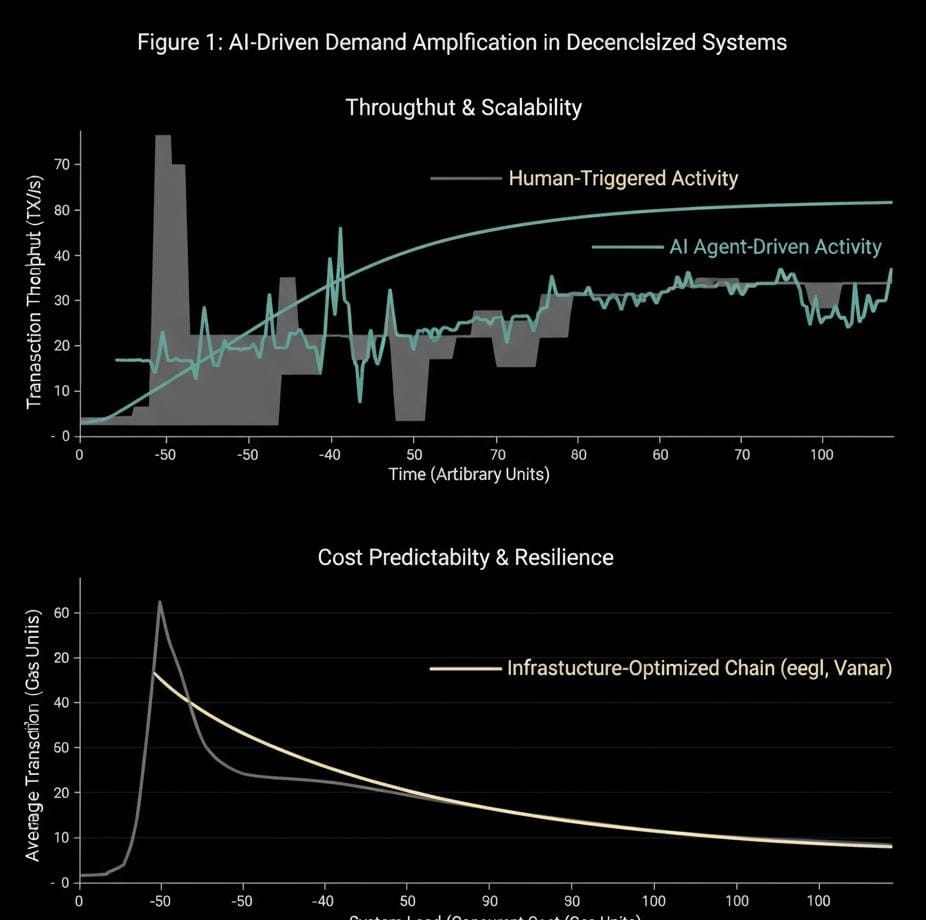
Every loop consumes infrastructure.It requires execution layers to process transactions, storage layers to manage data, interoperability systems to access cross chain liquidity,and fee markets to price activity.If one AI agent executes 1,000 micro transactions daily and thousands of agents operate simultaneously, demand scales non linearly.This is not speculative growth it is structural expansion driven by automation.
From my perspective, this is where Vanar’s infrastructure focus becomes relevant.A network built primarily for periodic retail traffic may struggle under constant machine driven flows.AI driven activity stresses latency,finality,and cost predictability.Machines operate in milliseconds,not minutes.They require deterministic settlement and stable transaction costs.If gas prices spike unpredictably or confirmation times fluctuate,automated systems break economically.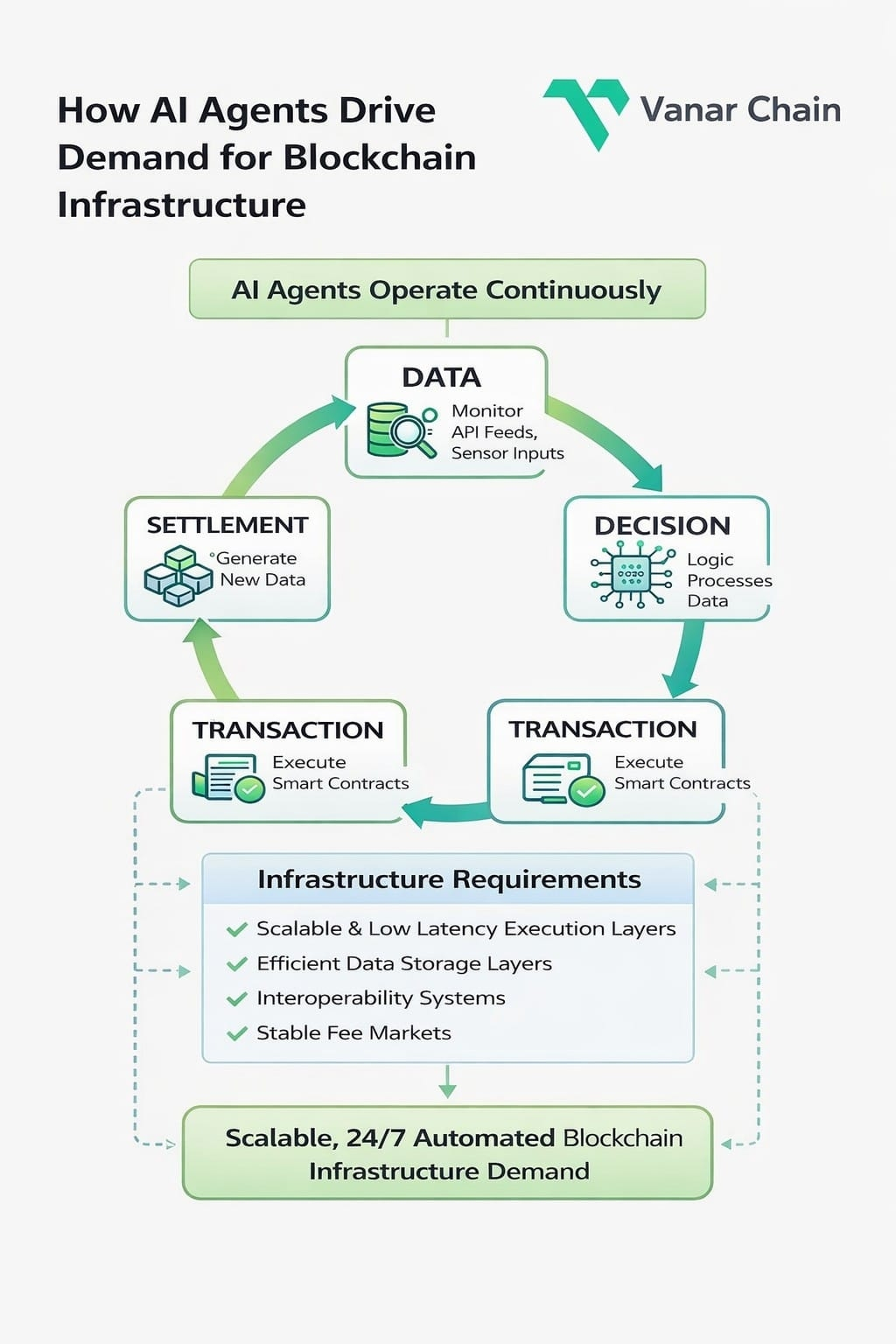
Recent capital flows across the crypto sector reinforce this shift. Investment is moving toward decentralized compute,data availability layers, restaking security models,and cross chain communication frameworks.These trends signal anticipation of higher baseline transaction demand rather than temporary volume spikes.In valuation terms,this changes token modeling.Instead of pricing tokens solely on speculative momentum,analysts begin evaluating recurring infrastructure consumption and consistent fee generation.
However,I also recognize risks.AI adoption could be slower than expected. Centralized AI providers may bypass on chain settlement entirely. Regulatory challenges around autonomous financial execution remain unresolved. There is also the possibility of infrastructure being overbuilt ahead of real usage,which would recreate inefficiencies from previous cycles.
My overall view is that AI agents transform blockchains from event driven systems into continuously operating economic platforms.The networks that design for persistent machine demand,rather than emotional retail participation,are better positioned structurally. When I evaluate Vanar Chain,I ask whether its architecture anticipates that 24/7 automated demand.If it does,then it is not just participating in a narrative it is aligning with a fundamental shift in how blockchain infrastructure will be used.