
I keep seeing people reduce Vanar to “just another token,” and honestly, that misses the bigger picture. When I look at Vanar, I don’t see a project trying to win attention for one week. I see an ecosystem trying to solve a much harder problem: how to make Web3 useful, trustworthy, and easy enough for normal users, brands, and builders to actually stay. That’s a very different game.
What makes Vanar interesting to me is that it sits at the intersection of things that are already huge on their own: gaming, AI, digital ownership, and brand experiences. Most chains pick one lane and build a story around it. Vanar feels more like it’s trying to build the infrastructure layer underneath all of them. And if that works, the value doesn’t come from hype cycles alone — it comes from becoming part of how people interact with digital products every day.
The Real Opportunity Is Not Speed Alone — It’s Trust and Usability
A lot of blockchain projects lead with speed, low fees, and scalability. Vanar can talk about those things too, but I think the more important angle is usability. Fast chains are nice. But if the user experience still feels confusing, most people will never care. That’s the truth across Web3.
Vanar’s direction stands out because it feels like it understands this. The goal is not just to make transactions cheaper. The goal is to make the technology feel invisible in the right way. If someone is playing a game, joining a virtual experience, or using an AI-powered app, they should not need to think about wallet complexity, gas mechanics, or blockchain jargon every few minutes. They should just use the product.
That “invisible infrastructure” approach is a bigger advantage than many people realize. The next phase of adoption will not come from people wanting to learn crypto mechanics. It will come from products that quietly use blockchain while giving people a smoother experience than the old systems.
Why Vanar’s AI Angle Feels More Practical Than Most
AI is the biggest narrative in tech right now, but there’s a gap between AI hype and AI systems people can trust. That gap matters. In real environments, especially enterprise and brand-facing use cases, people don’t just want outputs. They want accountability. They want to know what happened, what changed, who approved it, and whether the process can be verified later.
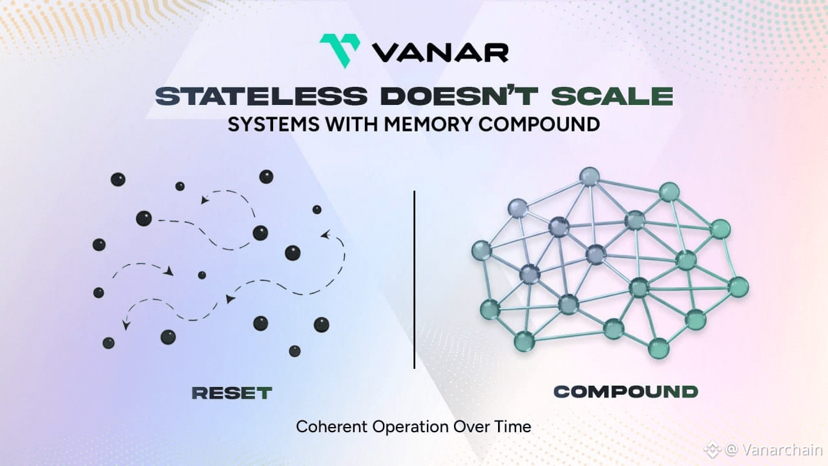
This is where Vanar’s direction becomes more interesting to me. Instead of talking about AI like a marketing add-on, the ecosystem keeps leaning into memory, context, and persistent interaction layers. That matters because useful AI isn’t just about answering a prompt once. The real value comes when systems remember context, preserve user preferences, and maintain continuity across sessions.
That is a very different use case than “AI meme token” narratives. It points toward something much more durable: AI-powered applications that can actually operate in real user environments without starting from zero every time.
And if Vanar becomes a trusted layer for that kind of AI workflow — where memory, logic, and verifiable records matter — then the chain’s value proposition gets much stronger than a simple transaction network.

Gaming and Digital Experiences Give Vanar a Real Testing Ground
One thing I like about $VANRY is that it doesn’t only speak in abstract infrastructure terms. It has an ecosystem direction that naturally fits consumer behavior, especially through gaming and digital experiences. That’s important because gaming is where user friction gets exposed immediately. If onboarding is bad, users leave. If transactions feel slow, they leave. If ownership is confusing, they leave.
So when a blockchain builds around gaming, metaverse-style environments, and digital identity experiences, it is forced to solve real problems. That pressure is healthy. It pushes the chain to become more usable, not just more technical.
This is also why I think Vanar’s brand and entertainment positioning matters. Mainstream users won’t enter Web3 because they suddenly care about consensus design. They will enter because the experience feels fun, useful, and familiar. Games, digital collectibles, virtual spaces, and creator-led ecosystems are natural entry points. Vanar seems to understand that better than a lot of infrastructure projects.
To me, that gives VANRY a stronger long-term story: not just “we built a chain,” but “we built a chain that can support experiences people actually want to return to.”
$VANRY Role Gets Stronger Only If Activity Becomes Real
I always try to stay honest with low-cap infrastructure plays: the upside can be huge, but execution is everything. VANRY can have a compelling narrative, but price only holds if the token becomes tied to real activity across the ecosystem. That means usage, not just attention.
The good part is that this is exactly where smaller-cap projects can surprise the market. It doesn’t take massive capital to reprice a project when traction starts to show up consistently. If Vanar keeps improving tooling, onboarding, and product usability while builders continue launching actual applications, then VANRY can benefit from network effects in a very real way.
But I also think the market will become more demanding. People won’t reward vague “AI + gaming” language forever. They’ll want proof. They’ll want to see repeat users, developer retention, and products that don’t disappear after one campaign. That’s the standard now.
Personally, I think that’s good for Vanar. Projects with substance usually perform better once the noise fades, because they’re still building while others are chasing the next trend.
Why I’m Watching $VANRY as a Long-Term Infrastructure Story
When I step back and look at Vanar, I don’t see a project trying to be the loudest in the room. I see a chain trying to become useful in places where Web3 usually struggles: trust, usability, continuity, and mainstream experience design. That’s a harder path, but it’s also the one that matters if we’re serious about bringing the next wave of users on-chain.
@Vanarchain edge won’t come from one headline or one pump. It will come from whether it can keep turning its AI-first and user-first vision into products people actually use. If it can do that, VANRY won’t need constant hype to stay relevant. The activity itself will speak.
That’s the part I find most compelling. In a market full of short-term stories, Vanar still feels like a project trying to build something that lasts. And if it keeps moving in that direction, this could be one of those ecosystems people underestimate early — then spend the next cycle trying to catch up to.