
That night the market jolted hard. I opened Fogo explorer to trace a trade that had just filled, and my heart rate spiked simply because the page loaded a few beats slower than usual.
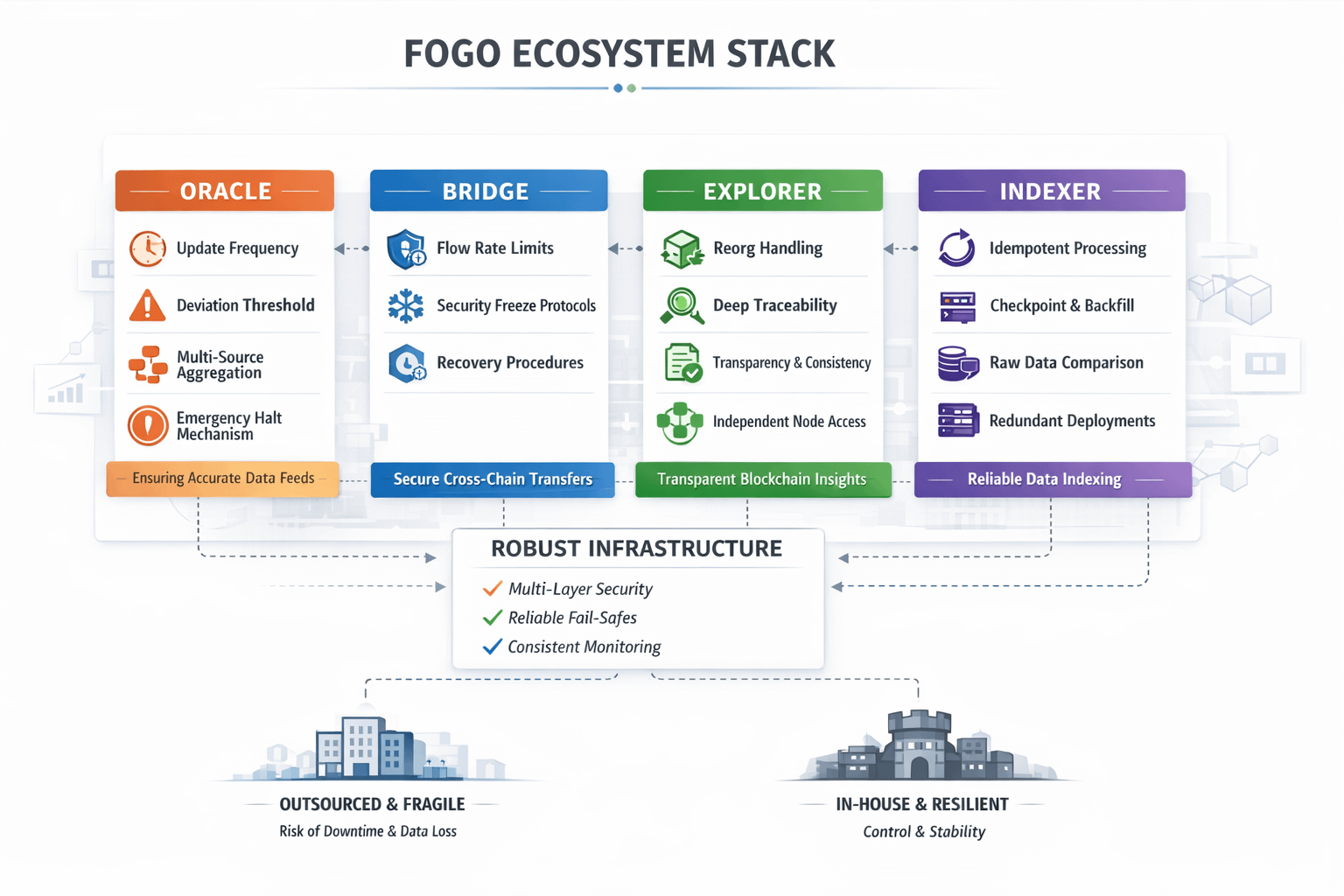
If I’m being blunt, what caught my attention in Fogo wasn’t the promises or the charts, but the ecosystem stack under its feet: oracle, bridge, explorer, indexer. The problem is that many teams build products like houses on sand, and only when the wind hits do they realize they never had a foundation. I think any system that wants to last has to answer a very dry question: does the data stay correct when things are at their most stressed, and when one piece of infrastructure glitches, how does the system react so a small fault doesn’t snowball into a disaster.
Oracle is the first layer I scrutinize, because I’ve paid tuition in a way no one wants to remember. Honestly, a price feed that lags by a few dozen seconds during a volatile move is enough to trigger cascading liquidations, and then the community starts guessing and blaming. Looking at Fogo oracle design, I care about four very specific things: is the update cadence stable, how is the deviation threshold set to block abnormal jumps, is there multi source aggregation and cross validation, and does the emergency halt mechanism concentrate too much power. Ironically, the things that keep a system safe are rarely what people show off, because they feel more like discipline than features.
The bridge is the part that keeps me on guard, because this area has too many scars. No one would have guessed that a “bridge” would repeatedly become the fastest place for assets to evaporate. When I look at Fogo bridge, I don’t ask how quickly it can “open liquidity”. I ask whether it has brakes: are there time based flow rate limits, can it freeze by region or scope when anomalies are detected, and is the recovery procedure as transparent as bookkeeping. Maybe moving a bit slower is worth it if it buys you containment, because on bad days, speed without control is practically an invitation for accidents.
Explorer sounds like “presentation”, but in practice it’s a trust contract between the system and people. I’ve watched a chain keep producing blocks, while the explorer lagged, displayed inconsistent states during a reorg, and that alone was enough to send crowd psychology into free fall. If Fogo explorer is meant to serve the long run, it has to do something very ordinary yet hard: reflect canonical data consistently, handle reorgs cleanly, provide deep traceability, and most importantly, let users verify for themselves without needing to trust anyone’s explanation.
Indexer is where builders feel pain most directly, because it touches dashboards, alert bots, and operational decisions. I once lost an entire day proving the ledger was still correct just because an indexer backfill drifted by a few blocks, showed the wrong balances, and then everything started reacting to that wrong data. For the indexer in Fogo stack, I look for idempotent processing so reruns don’t create divergence, clear checkpoints for recovery, and reconciliation between raw data and indexed outputs. If it can run multiple independent deployments for cross checking, that’s not flashy, but it helps both the technical team and the community sleep better.
From my experience, there are two infrastructure paths projects tend to take. One is outsourcing almost everything, which feels fast and cheap at first, but when the network congests or a provider gets flaky, no one truly holds the source of truth and everyone just waits. The other is keeping critical points within your control, which costs more effort, but when incidents happen you still know where you are and you can still contain risk. What I want to see in Fogo system is the ability to swap layers without breaking trust, and what I want to see in Fogo team is operational discipline: monitoring, alerting, upgrades with a rollback path, and incident reports written coldly and completely, because the market doesn’t wait for explanations.
The ecosystem stack isn’t a decorative checklist. It’s a commitment that truth can be verified and risk can be bounded. I’m tired of pretty stories, so I only trust things that can be measured, reconciled, and survive pressure. If the market stretches every assumption again one day, will you bet on how Fogo builds its foundation, or keep chasing something shinier in the short term.