

I’ll start with honesty. Whenever I hear about a new Layer-1 blockchain, I usually expect the same recycled promises: faster, cheaper, more scalable. Over time, those words lose meaning. So when I first came across Fogo, I wasn’t excited. I was skeptical.
Instead of dismissing it, I decided to slow down and actually study how it’s designed. Not the marketing threads. Not the surface-level claims. I wanted to understand the assumptions behind the system — because in distributed systems, assumptions matter more than slogans.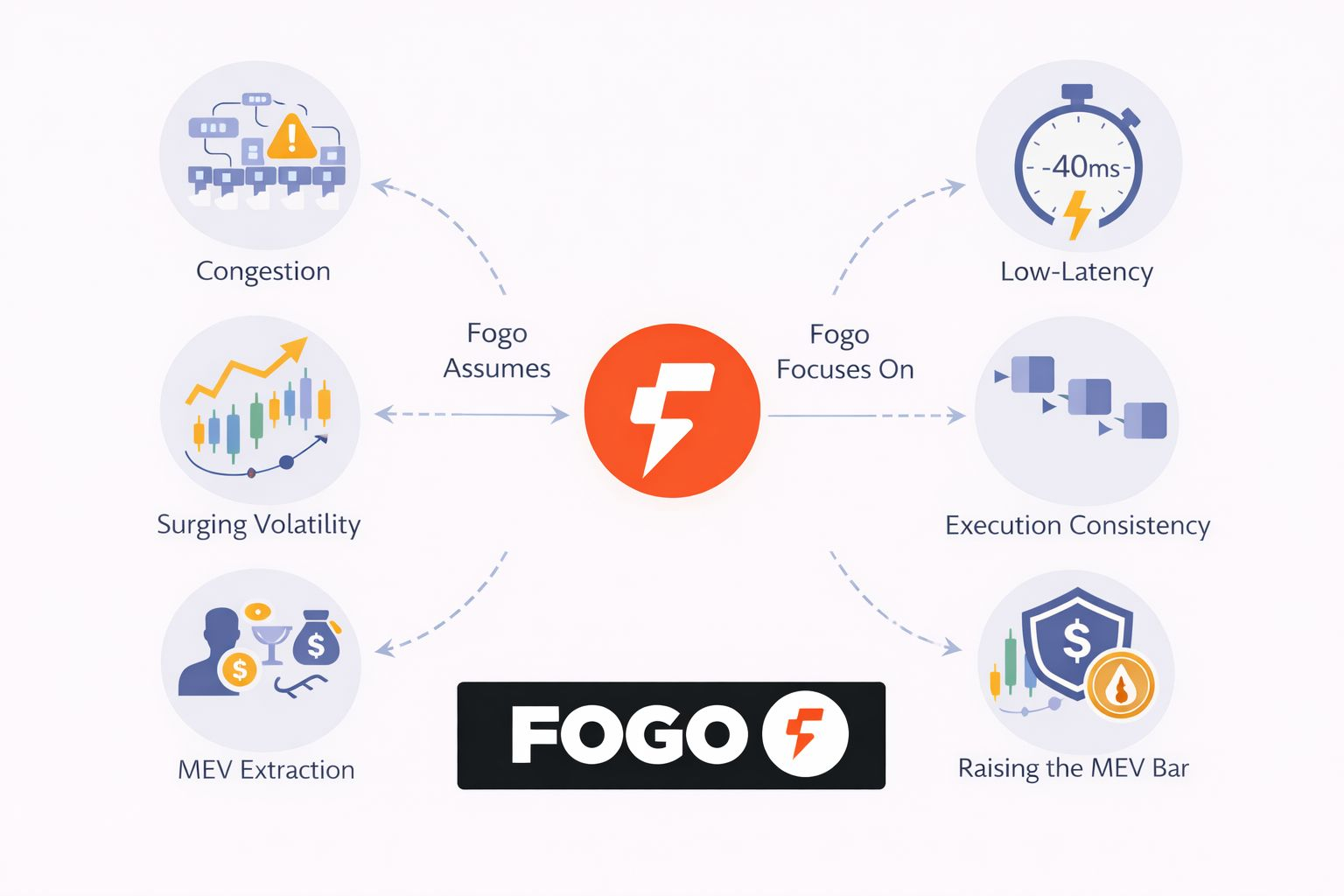
What I found was a project that doesn’t pretend markets are calm, users are polite, or traffic is predictable. Fogo assumes the opposite. It assumes congestion. It assumes bursts of activity. It assumes adversarial behavior. And instead of hoping those things don’t happen, it’s built to operate through them.
At the core, Fogo is built on the Solana Virtual Machine. That immediately signals intent. SVM isn’t about elegance or simplicity — it’s about raw execution power. Parallelism. Throughput. Determinism under load. This choice alone tells me Fogo is optimized for environments where many things happen at the same time and failure isn’t an option.
But the more interesting part is why they chose this path. Fogo isn’t trying to win benchmarks in isolation. It’s trying to survive real market conditions — the kind where volatility spikes, liquidations cascade, and systems that look fine on paper suddenly fall apart.
Most blockchains perform well when nothing stressful is happening. The real test is when everything breaks at once. That’s where Fogo positions itself.
One detail that genuinely caught my attention is Fogo’s obsession with latency. We’re not talking about shaving milliseconds for vanity metrics. We’re talking about designing a blockchain that behaves more like a real-time financial system than a slow settlement layer.
Block times around tens of milliseconds aren’t just impressive — they fundamentally change what’s possible on-chain. Order books start to make sense. Rapid liquidations become manageable. Execution becomes predictable instead of chaotic.
To put this into perspective: traditional blockchains often operate on timescales measured in seconds. Fogo operates closer to the rhythm of modern trading infrastructure. That difference is massive.
And this isn’t just about speed. It’s about consistency. A system that’s fast only when conditions are perfect isn’t useful. Fogo’s design focuses on degrading gracefully rather than catastrophically — something many chains fail to do when demand spikes.
This design philosophy becomes especially important when thinking about MEV and execution fairness. In chaotic environments, slow systems create opportunity for extraction. Front-running thrives where timing is uncertain and execution is inconsistent.
Fogo’s emphasis on deterministic execution and tight timing windows doesn’t magically eliminate MEV — nothing does — but it raises the bar. It makes exploitative strategies harder and less reliable, especially during the moments when markets are most vulnerable.
That matters if you care about building serious DeFi infrastructure instead of short-lived experiments.
Then there’s the FOGO token itself. I won’t overhype it, because tokens should be evaluated based on utility, not narrative. What’s clear is that the token exists to support the network’s operation and ecosystem alignment — not to act as a meme or a promise of instant riches.
With a multi-billion circulating supply and a larger capped total supply, the tokenomics lean toward long-term infrastructure usage rather than artificial scarcity. Whether that model succeeds depends on adoption — as it should.
What I respect here is the lack of theatrics. The token exists because the network needs one, not because speculation demands it.
Stepping back, the biggest thing Fogo changed for me wasn’t a single metric or feature. It was the mindset behind the system. This is a blockchain designed by people who understand that real systems fail under pressure — and who decided to design for that pressure instead of away from it.
Fogo isn’t for every use case. If you’re building slow-moving applications or low-interaction contracts, you probably don’t need this level of performance. But if you’re trying to build real-time DeFi, on-chain markets, or financial infrastructure that must remain functional during chaos, Fogo makes a strong case for itself.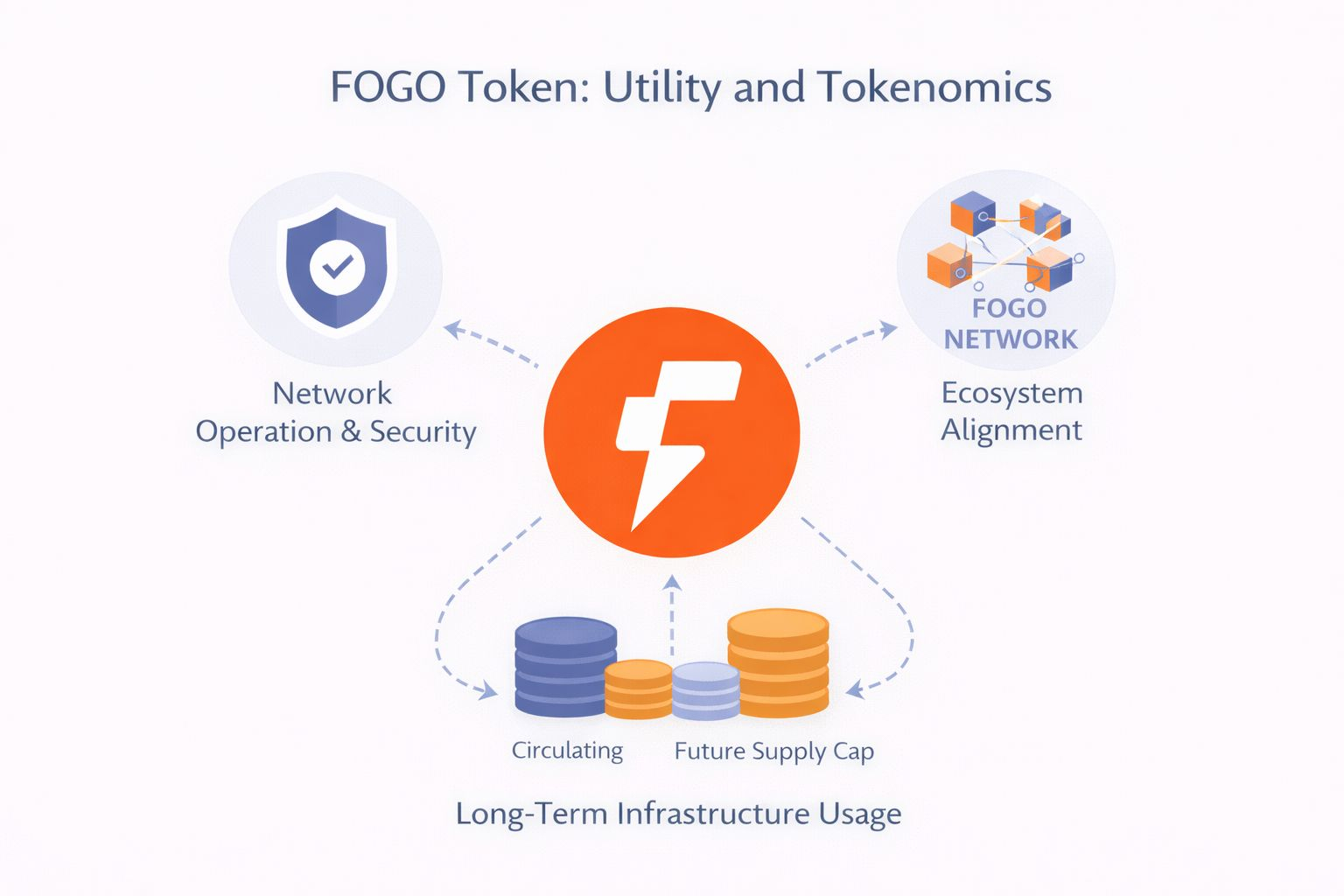
I didn’t expect to say this, but studying Fogo forced me to recalibrate how I think about Layer-1 blockchains. Not as abstract settlement layers — but as systems that must behave predictably when everything else goes wrong.
That’s rare. And it’s worth paying attention to.
If you’ve looked into Fogo yourself — or if you disagree with my take — I’d genuinely like to hear your perspective.
Drop your thoughts in the comments.