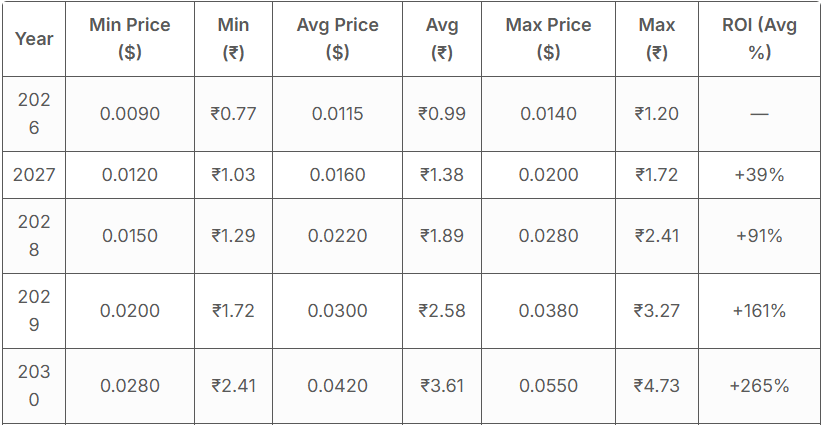
I’ve noticed something about this cycle. The market isn’t just chasing new narratives anymore. People are quietly revisiting older projects that kept building during the boring months. Not the loud launches, not the overnight meme spikes, but the ecosystems that slowly kept shipping features while nobody was paying attention.
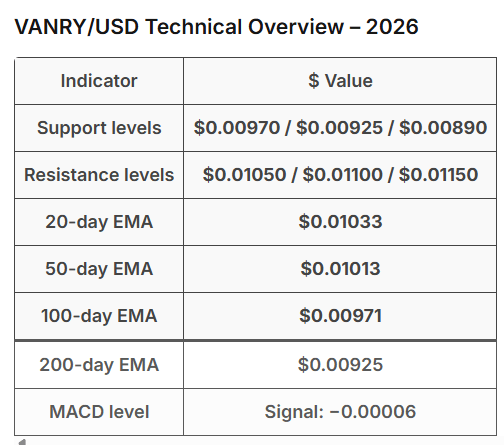
Vanar Chain has been one of those names for me.
I remember first seeing VANRY when most conversations were still dominated by L2 scaling wars and meme coins. It wasn’t trending daily, and honestly that’s probably why I started watching it more closely. In crypto, constant hype sometimes hides weak fundamentals, but quiet development often hides real work.
So when I started thinking about 2026 to 2030 price expectations, the question didn’t feel like a normal prediction. It felt more like a bigger question about where utility based tokens actually fit in the next phase of the market.
One thing that stands out to me is that Vanar Chain is positioned around real digital ownership, gaming infrastructure, and entertainment tech. Those sectors don’t move fast in price, but they move deep in adoption. Games, media platforms, and consumer apps don’t care about token hype. They care about reliability, speed, and user experience.
From what I’ve seen across multiple cycles, infrastructure tokens behave differently than speculative tokens. They rarely explode overnight. Instead, they slowly gain value as usage grows. It’s almost boring while it’s happening, and then one day the market suddenly notices the network activity.
I’ve also noticed that gaming related blockchain projects tend to follow adoption waves rather than bull runs. A bull market can boost attention, but real growth usually comes later when actual users arrive. That’s why predicting VANRY is tricky. The price won’t only depend on crypto traders. It will depend on whether non crypto users interact with apps built on the chain.
This is where things get interesting.
If Web3 gaming and digital ownership platforms actually onboard regular users, tokens like VANRY could benefit indirectly. Not because people want to trade them, but because developers and applications need them. Demand driven by usage feels very different from demand driven by speculation.
However, I’ve also learned to be cautious. Many projects promised gaming adoption in the past cycle, and most never reached real player bases. Building a blockchain is one challenge. Building a game ecosystem is another level entirely. Players don’t care about decentralization if the game itself isn’t fun.
When I look at VANRY, I don’t try to imagine a sudden price explosion. I try to imagine network growth. If the chain hosts active applications, partnerships, and content platforms, the token gradually becomes part of an economy instead of a trading chip.
Now about the specific number, $0.0116.
On paper, it doesn’t sound like a massive target. In crypto we’re used to hearing predictions like 10x or 100x, but smaller targets sometimes require more real progress. A token reaching a modest valuation through genuine usage can actually be harder than a short term speculative pump.
From what I’ve seen in previous cycles, price moves usually happen in phases. First comes accumulation, when almost nobody talks about the project. Then comes narrative discovery, when analysts and smaller communities begin discussing it. Only after that comes broader market recognition.
Right now, VANRY feels somewhere between accumulation and early discovery.
For 2026, I think the biggest factor will simply be whether the project stays visible. Surviving in crypto is underrated. Many tokens disappear before they ever get a chance to mature. If Vanar Chain continues development and maintains partnerships, even modest adoption could slowly lift the price.
By 2027 and 2028, the picture becomes less about crypto cycles and more about product adoption cycles. If entertainment platforms, NFT utilities, or gaming ecosystems start retaining users, that’s when a token like VANRY could gain more consistent valuation support rather than sudden spikes.
I’ve also noticed something else. The market has matured a bit. Investors now ask who is actually using this network. That question barely existed in 2021. In the next cycle, usage metrics may matter more than social media hype. That environment tends to favor infrastructure projects.
But there’s still risk.
A chain can be technically solid and still fail commercially. Partnerships can be announced and never produce users. Tokenomics can also affect long term price stability. Even strong projects struggle if emissions outpace adoption.
So will VANRY reach $0.0116 by 2030?
Personally, I don’t see it as unrealistic, but I don’t see it as guaranteed either. The target depends less on trading momentum and more on whether the ecosystem becomes economically active. If applications are built, used, and retained, the price could naturally drift toward that range over time.
What I find most interesting is that the answer isn’t really about VANRY alone. It’s about whether Web3 finally moves from speculation to digital utility. Tokens connected to real services only grow if people actually need them.
Sometimes I think the next phase of crypto won’t look dramatic at all. Instead of explosive charts, it might look like steady lines and quiet user growth. Less excitement on social media, more usage behind the scenes.
If that world arrives, projects like Vanar Chain could finally make sense to the broader market.
And honestly, that possibility feels more important than any single price target.