

For a long time, I believed I understood the real cost of trading on-chain. I looked at gas fees, slippage, and MEV as the main enemies. Those were visible. Measurable. Easy to complain about.
What I didn’t account for — and what quietly cost me more than all of those combined — was time.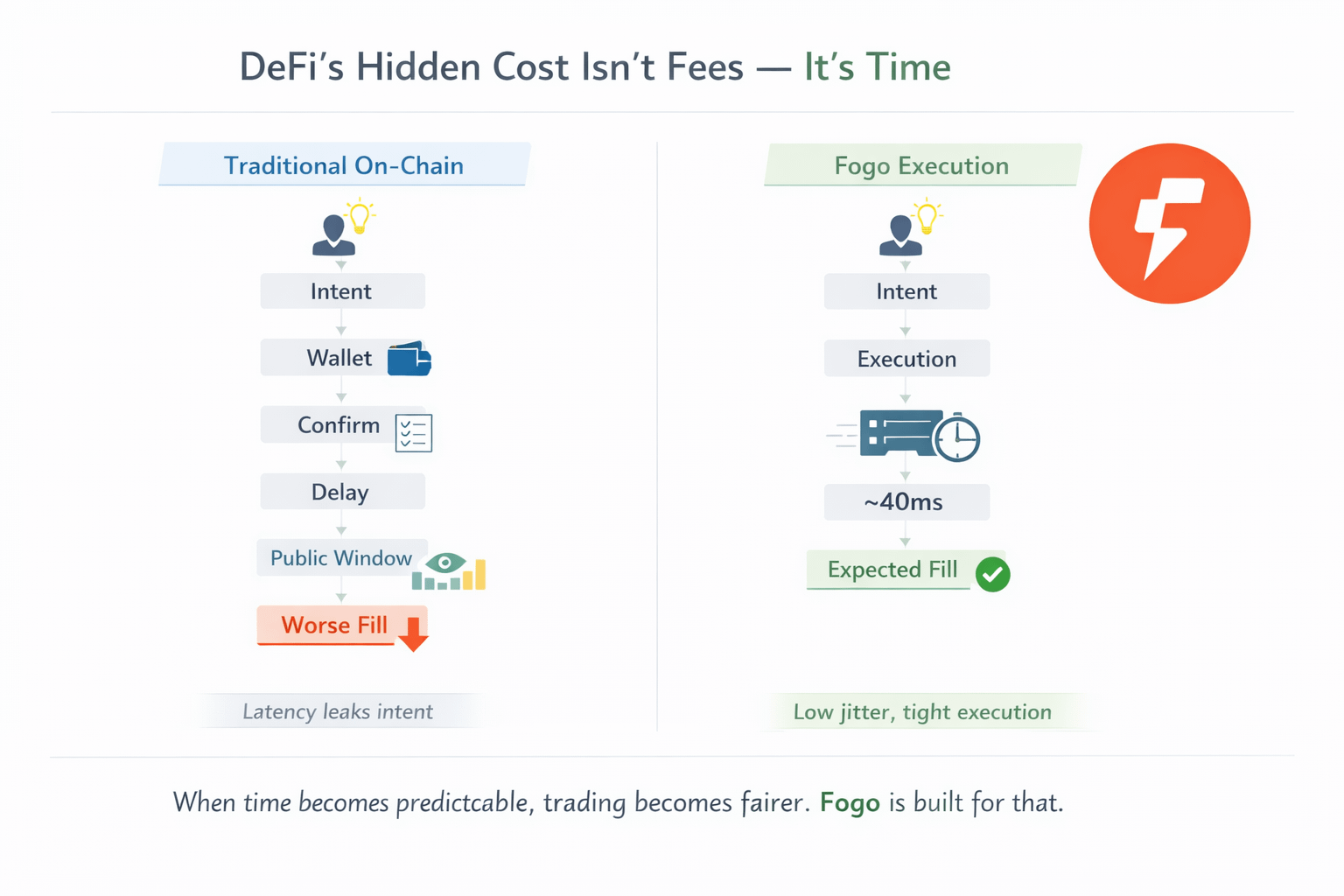
Not minutes. Not even seconds.
Milliseconds.
The most frustrating part is that I was often right. Right on direction. Right on structure. Right on timing — at least from a human perspective. Yet fills would come back as if I had hesitated. As if I had arrived late to my own trade. That kind of experience slowly changes how you behave. You stop trusting execution. You hesitate. You over-optimize confirmations instead of ideas. And without realizing it, you start paying a tax that doesn’t show up anywhere on a dashboard.
In DeFi, we’ve normalized waiting. Wallet pop-ups, approval prompts, spinners, silent failures — all of it has become background noise. We no longer notice how often we’re pulled out of flow. But markets notice. Markets always notice time.
The moment your intent exists but isn’t final, it becomes information. If that intent is visible while it’s still in transit, someone else can treat it as a signal. That delay isn’t neutral. Someone owns it. And if it’s not you, it’s being monetized against you.
This is the lens through which I started looking at Fogo. Not as another “fast chain,” but as an attempt to remove a structural inefficiency that on-chain traders have been forced to live with for years.
When execution happens in roughly forty milliseconds, something subtle but important changes. You stop bracing for friction. You stop mentally pricing in delay. The infrastructure fades into the background, and all that’s left is intent. That’s not just faster execution — that’s a different experience entirely. It feels less like operating software and more like interacting with a market.
A big part of this comes from Firedancer, built by Jump Crypto. Firedancer isn’t an incremental improvement. It’s a rethinking of how a blockchain should interact with hardware. It’s designed around parallelism, cache efficiency, and predictable behavior under load. The result is that when activity spikes, the system doesn’t fall apart. Fees don’t explode. Finality doesn’t drift unpredictably. Performance degrades gracefully instead of collapsing.
That matters more than headline throughput. Markets don’t just care about speed — they care about consistency. Traders can adapt to a known delay. What destroys confidence is jitter. When latency changes from moment to moment, fills start to feel random. Spreads widen. Liquidity pulls back. Eventually, only strategies that exploit uncertainty feel comfortable participating.
This is why Fogo’s approach to validator coordination is interesting to me. Its colocated, optimized design — while remaining compatible with the Solana Virtual Machine — reads less like a blockchain philosophy and more like a venue decision. Distance in distributed systems isn’t ideological. It’s physical. Messages travel. Latency compounds. Under load, inconsistency emerges. And inconsistency is where traders get punished.
If a venue leaks time, someone will collect it. That’s how toxic flow emerges. Not because participants are malicious, but because the system makes it profitable. Over time, this changes the personality of a market. Market makers quote wider to protect themselves. Traders reduce size. Posting liquidity feels risky. Slowly, the only actors who thrive are the ones feeding on delay itself.
Another layer that often gets overlooked is human latency. Every approval prompt and wallet interruption turns live intent into stale intent. By the time your transaction reaches the engine, the market may have already moved. Fogo’s use of session keys directly addresses this problem by allowing defined, permissioned actions without constant confirmation — without sacrificing custody. It shifts the experience from clicking through steps to operating within a workflow. For active traders, that difference is enormous.
At first, I asked the wrong questions about Fogo. I compared it the way people compare every Layer-1 — decentralization optics, narrative strength, theoretical scalability. None of that really explained it. What made it click was thinking like a trader running a latency-sensitive strategy. In that context, what matters is execution consistency, stable finality, and behavior under stress. That’s where Fogo starts to make sense.
If this approach works long term, the biggest change won’t be a metric on a dashboard. It will be a feeling. The feeling that when you click, your intent arrives intact. That you’re trading the market again — not fighting the chain’s timing quirks.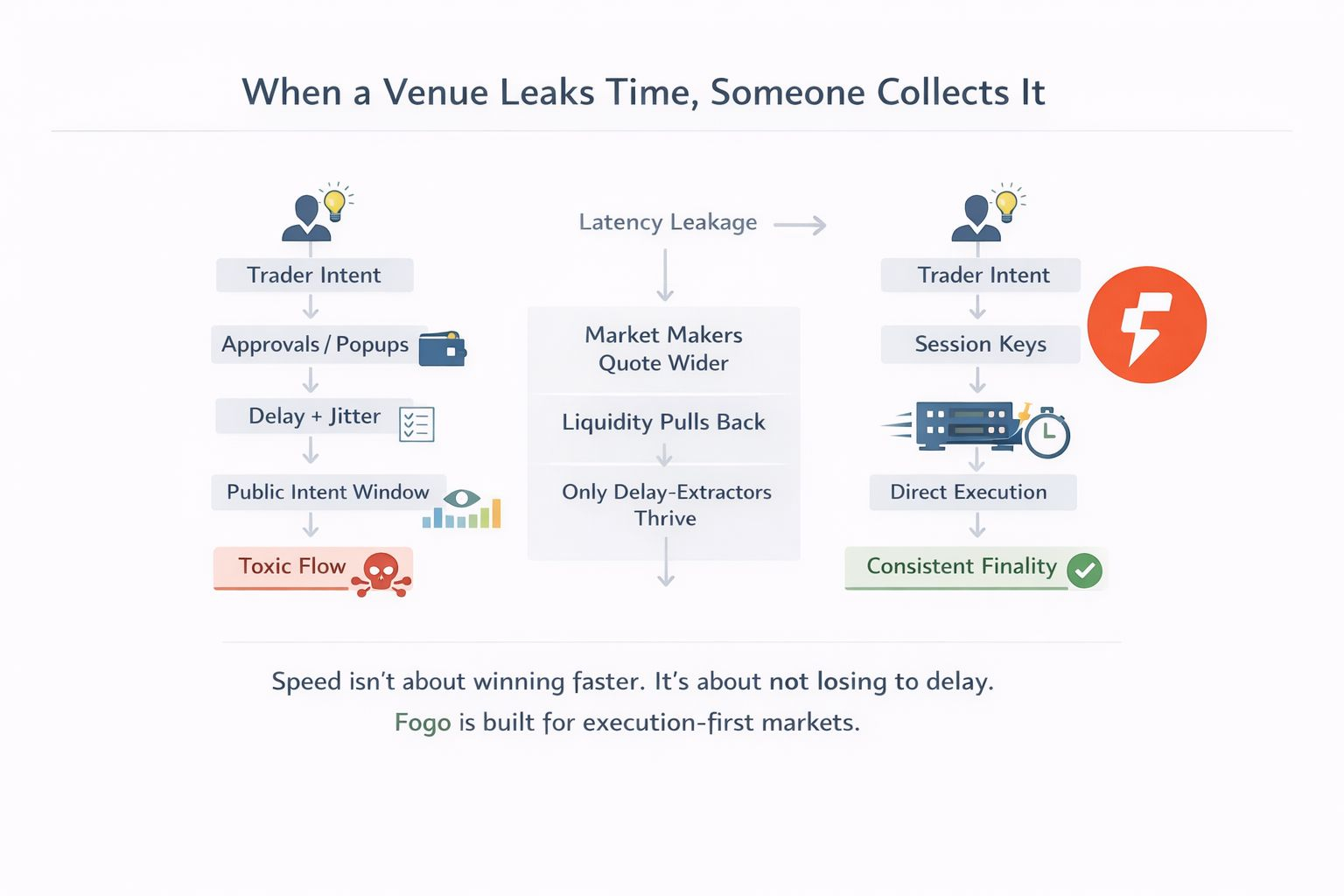
I’m not interested in speed for bragging rights. I’m interested in speed because it changes who gets to win. In a healthy execution-first system, edge should come from reading the market better, not from reading infrastructure delays better.
Once you realize that DeFi has been taxing you in time instead of fees, it’s impossible to unsee. And once you can’t unsee it, you start looking for systems that treat execution with the seriousness it deserves.
If this resonated with you, I’d genuinely like to hear your perspective.
Do you feel this latency tax in your own trading, or do you think it’s overstated?