
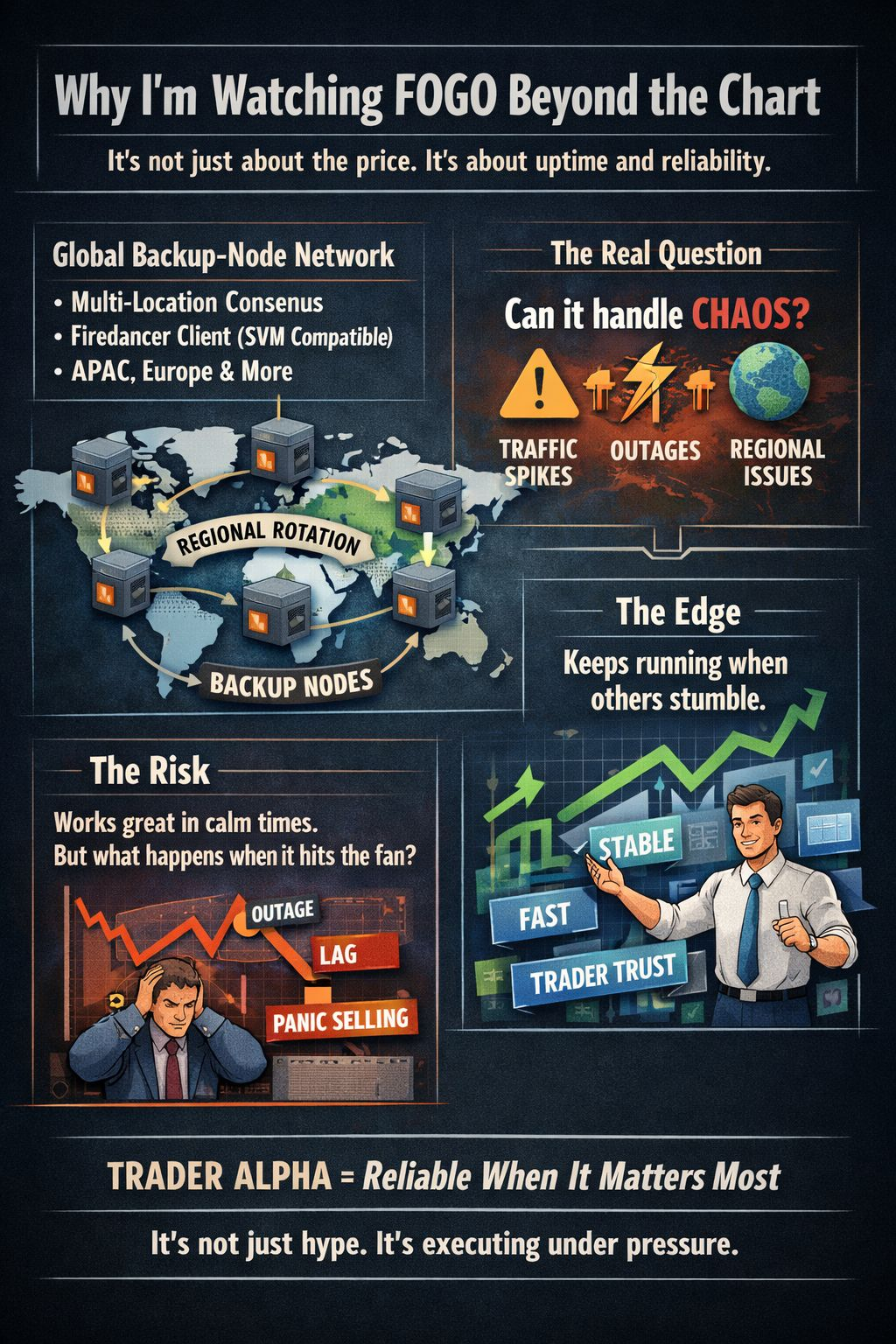
I’m looking at FOGO from a totally different angle right now, and I think a lot of traders are missing what actually matters. Most people start with the chart, watch the price move, and then build a story around it after the fact. I’m flipping that around.
I’m paying attention to how Fogo is structuring its validator locations and backup infrastructure, and then asking a simple question: does this setup still hold up when conditions get chaotic? Because if you’re trading something that markets itself on speed, reliability isn’t some extra feature you can hand-wave away. When the tape gets ugly, uptime isn’t a detail — it’s the entire bet.
Yeah, the market’s waking back up to this. CoinMarketCap has FOGO hanging out in the upper two-cent zone with a double-digit move on the day and around mid-$30M in 24-hour volume. CoinGecko is telling the same story — activity has clearly picked up, and the market cap’s sitting in the low $100M range.
What’s interesting is that CoinGecko still shows FOGO a long way below its January 15, 2026 peak. That’s the kind of spot where traders start getting serious about the question: is this just a quick pop that fades out, or the beginning of a real second leg higher?
Here’s how I’m framing it in my own head. If Fogo’s whole global backup-node setup actually does what it claims — keeping things running when regions go down or validators get stressed — then the payoff isn’t just “cool infrastructure design.” The real edge is execution that still works when everyone else is scrambling. That’s trader alpha. That’s not some nerdy backend detail.
It’s the same idea as a trading desk that runs one main internet line but also has backup connections routed through different locations. On a normal, sleepy day, nobody even notices. But the moment a macro headline hits and everything gets chaotic, that redundancy is the difference between getting filled and sitting there watching candles rip without you.
Here’s what jumped out at me digging through Fogo’s own material. They describe the chain as a Solana-style L1, built around multi-location consensus to keep latency tight, running a Firedancer-based client with SVM compatibility. In the testnet docs, they go further and lay out a zone-based model where consensus rotates across regions by epoch — they even call out zones like APAC and Europe. That detail matters. It tells you this isn’t just another “fast blocks” pitch. It’s also about network layout: where validators live, how leadership moves around, and what happens when one region starts having a bad day.
Then there’s the operator side, which most traders never bother to read. A post from Firstset mentions they’re running a whole fleet of Fogo validators plus backup nodes as part of the multilocal consensus design. That one line says more than a bunch of glossy performance charts. When real operators talk about fleets, backups, and automation, they’re not chasing screenshots — they’re planning for uptime, failover, and repeatable deployment under stress. That’s usually where the real signal leaks out if you’re paying attention.
The downside case is pretty straightforward too. If this turns into one of those hype cycles where the price outruns the actual reliability of the network, then even a small, visible stumble can hit confidence hard. A brief outage, laggy performance, or a sloppy handoff between primary and backup nodes is all it takes. With a token this size, sentiment reprices fast. You don’t need a total meltdown — you just need enough traders to decide, “Yeah, I don’t trust this when things get wild.”
So what would actually change my mind, in either direction? It’s not another slick thread or a clean diagram. I want to see this thing behave properly when conditions are ugly. Stable execution during heavy traffic. Smooth continuity if a region starts wobbling. No recurring pattern of “looks fast on paper, feels annoying in real life.” The mainnet docs showing one active zone right now with multiple entry points is a helpful snapshot, but the market isn’t going to price a config page forever. It’s going to price how the network behaves when people are leaning on it.
That’s the bigger frame for me. There’s no shortage of “fast chain” stories out there. What’s rare is a chain traders actually trust when the tape gets noisy. If Fogo’s global backup-node design helps it earn that kind of trust, the token can rerate on credibility, not just hype and momentum. If it doesn’t, then it’s just another good narrative with a choppy chart.
Yeah, I’m watching price. But more than that, I’m watching whether the infrastructure story starts showing up in how traders actually behave. That’s the moment this goes from interesting to real.$FOGO @Fogo Official #fogo