
I opened the logs of Fogo right at peak hours, when bots and real users squeeze into a very narrow time window. I am not looking for emotion. I am looking at cadence, latency, and whether the system can keep its own order.
Solana once showed the market that speed can carry an entire ecosystem far. But speed also increases sensitivity to bursty load. A small bottleneck repeated long enough drags the experience down, and trust gets worn away faster than price.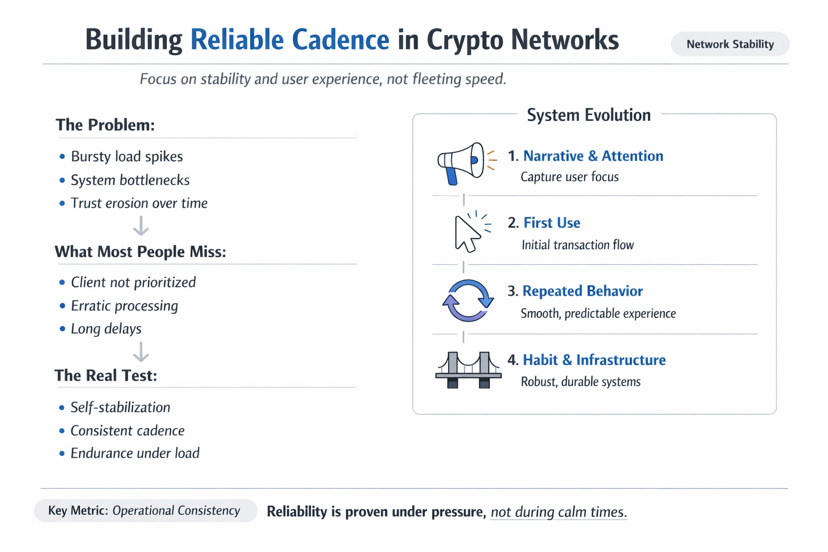
What feels different with Fogo is that it puts the client at the true center. Fogo treats the client as the place where cadence largely lives or dies, from how transactions are received, queued, prioritized, and kept from fighting over resources, to how backlog is prevented from swelling and then collapsing like a wave.
When Fogo talks about client optimization, I read it as optimizing to reduce jitter, reduce erratic swings, reduce chains of small delays that join into a long freeze, and optimizing so that when load rises, the system still returns confirmations in a steady rhythm, instead of making users stare at a frozen screen wondering what the network is doing.
The infrastructure of Fogo is also part of the product, because holding cadence is not only in code. It is in validator configuration, network paths, real time observability, early alerting, and disciplined upgrade processes so nodes do not drift apart. These things do not create noise, but they decide whether you have to stay up at night babysitting the network.
If you need a quick mental picture, Solana is like a powerful race car, explosive acceleration, but it demands a clean track and a technical team constantly on edge. Fogo is like a car tuned for endurance, less jerky, less prone to overheating, and more stable when forced to run continuously in bad conditions.
And if we want to be direct about data, what I want to see on Fogo is not a single peak number. It is the curves during peak hours, the variance of block time, the variance of finality, the transaction failure rate, the share of transactions stuck beyond a threshold, and the latency distribution at p50, p95, p99, because those curves are what tell you whether Fogo holds cadence through real capability or just a lucky moment.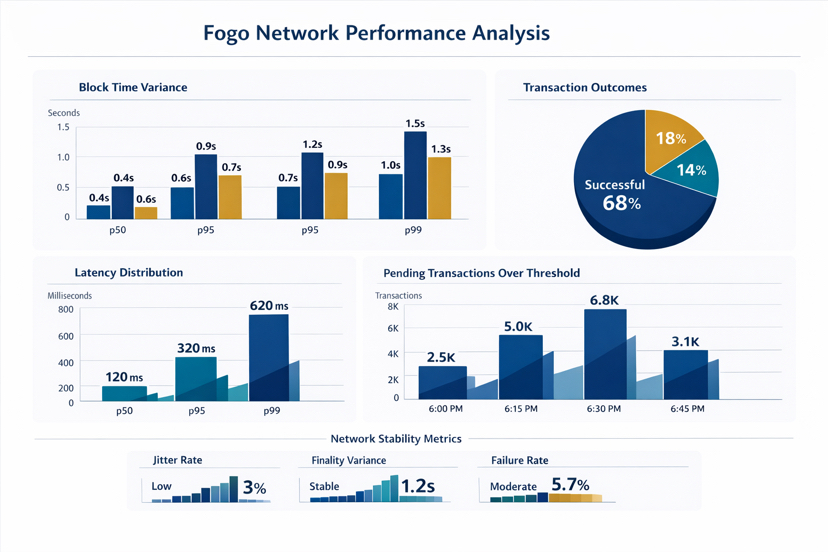
In practice, newcomers get pulled in by numbers, while people who have lived through multiple cycles only watch experience and operations. Does the network self stabilize when load spikes, or does the build team have to rush in and intervene manually. Does every upgrade shake the system. Fogo is trying to buy back peace of mind through boring technical decisions and a disciplined operational rhythm, while Solana already paid tuition through periods where real load bent the cadence out of shape.
I do not expect miracles. I set a cold standard. When load multiplies, can $FOGO self stabilize, can it hold cadence, can it save users and builders time. Because what remains after every wave of hype is durability, and durability does not come from promises. It comes from Fogo holding cadence when the crowd arrives, again and again.