
The blockchain industry has long assumed that more validators automatically mean more security. But this assumption hides a flaw.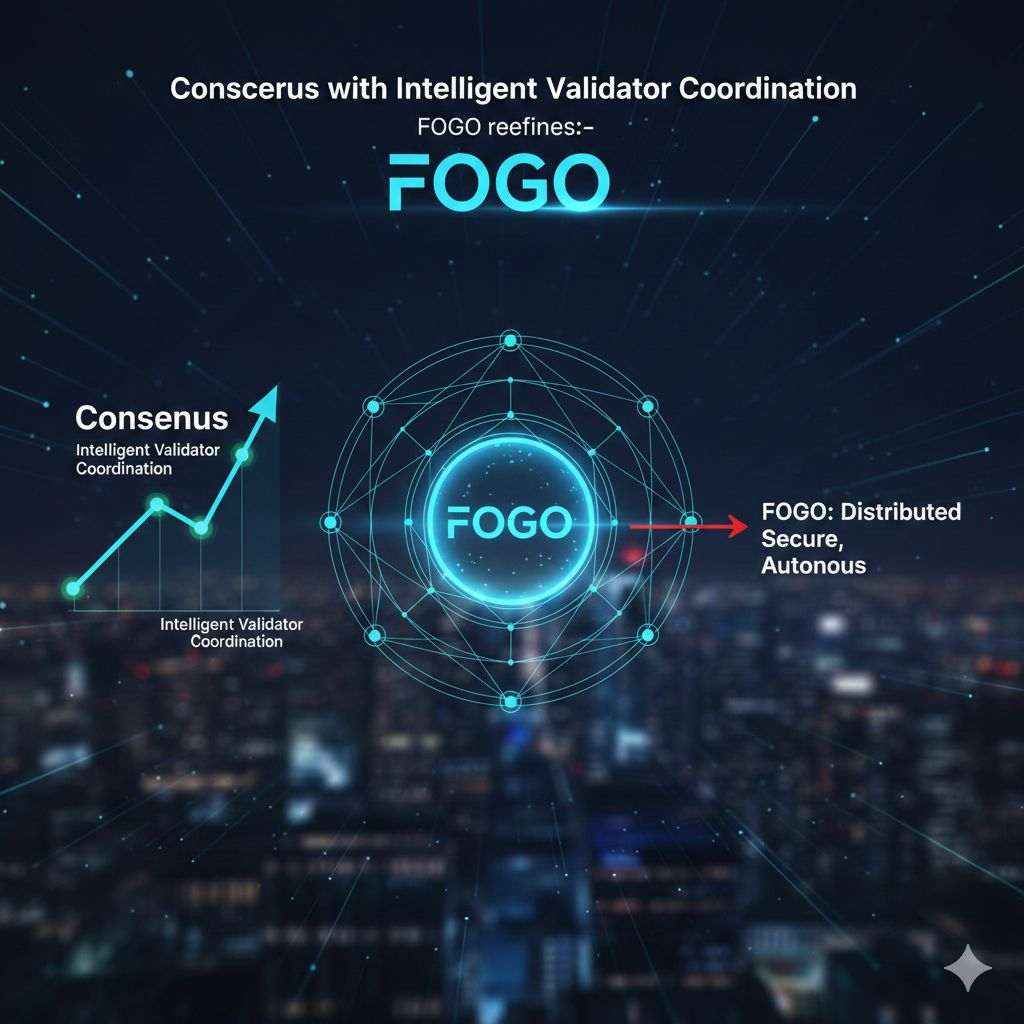
Forcing every validator to participate in consensus regardless of its geographic position, latency conditions, or performance quality does not strengthen a network. In many cases, it weakens it.
Traditional blockchain systems struggle with what can be called a client diversity bottleneck. While client diversity improves fault tolerance, it also introduces performance drag. Networks are limited by the slowest client, the least optimized configuration, or the validator operating under poor network conditions.
A validator running consensus from New York during peak congestion while the rest of the active set is optimized in Asia does not improve resilience. It introduces delay. It increases coordination friction. It slows finality.
The industry inherited the belief that “more participation equals more safety.”
But performance-sensitive distributed systems don’t work that way.
Fogo Takes a Different Approach:
Fogo operates with a curated validator model designed for performance alignment rather than chaotic participation.
Instead of encouraging constant uniform presence, Fogo focuses on:
The right validators
At the right time
In the right environment
This produces faster block times, cleaner finality, and reduced coordination overhead.
This is not a compromise on decentralization.
It is a refinement of its purpose.
Decentralization is not about maximizing simultaneous participation.
It is about preserving integrity, continuity, and outcome reliability.
The Strategic Design: Performance Windows & Coordinated Rotation
Fogo’s mainnet launched with validators operating inside a high-performance Asian data center, strategically positioned near major exchange infrastructure. This reduces physical data travel distance and minimizes latency — a principle long adopted in traditional finance.
Consider how stock exchanges operate:
They design trading sessions.
They implement maintenance windows.
They structure participation tiers.
They manage risk through controlled coordination.
They do not require every participant to operate at peak capacity 24/7.
Fogo applies similar logic to consensus architecture.
Validators rotate intelligently.
Performance windows are optimized.
Transitions are structured — not improvised.
The result is a network that behaves less like a crowd and more like a trained team.
The Deeper Implication: Resilience Through Coordination
The blockchain space has often equated constant availability with security. But these are not the same.
A system where every node is always online — regardless of performance quality — is not necessarily secure. It can become noisy, fragmented, and inefficient.
True resilience in distributed systems has never meant every component operating at all times. It has meant the whole continuing to function when parts cannot.
Fogo challenges the mythology of perpetual participation.
It suggests:
Let nodes rest.
Let zones rotate.
Let silence be structured.
Let coordination replace randomness.
This philosophy may feel uncomfortable to an industry raised on maximal decentralization narratives.
But from a systems engineering perspective, it is difficult to dismiss.
Distributed resilience was never about everyone being awake.
It was about ensuring the system performs when it matters most.
Conclusion:-
Fogo is not rejecting decentralization.
It is redefining what decentralization should achieve.
Not participation for its own sake.
But performance with integrity.
As blockchain evolves toward institutional-scale infrastructure, coordinated consensus may become the dividing line between next-generation chains and legacy design assumptions.