

Founded in 2018, Dusk is a blockchain platform specifically designed to reconcile the stringent demands of regulated financial institutions with the opportunities offered by modern blockchain technology. Unlike general-purpose networks, Dusk focuses on the operational realities of entities that must comply with legal oversight while safeguarding sensitive financial data. Privacy and auditability are embedded as foundational design principles rather than optional add-ons. Transactions are private by default, leveraging zero-knowledge proofs to maintain confidentiality while enabling selective disclosure to regulators or auditors. This ensures that institutions can issue, trade, and manage tokenized real-world assets without compromising compliance or transparency.
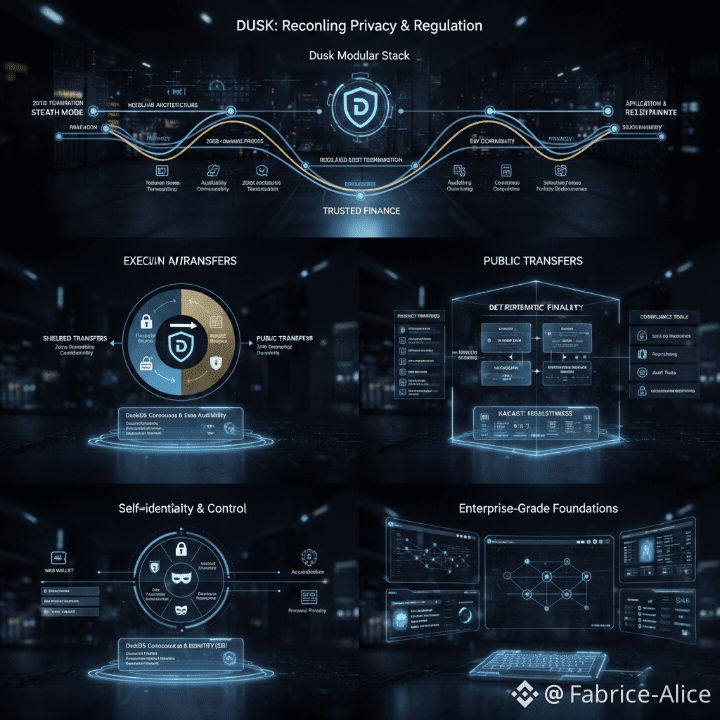
Dusk’s architecture is modular, distinctly separating the consensus and data-availability layers from execution environments. The foundational layer, DuskDS, utilizes a committee-based proof-of-stake consensus mechanism known as Succinct Attestation. This protocol delivers deterministic finality, meaning confirmed blocks are highly resistant to reorganization. Such predictability is vital in regulated financial settings, allowing institutions to rely on precise settlement times and mitigating the operational risks associated with block reorganizations. The network layer, implemented via Kadcast, optimizes message routing for efficiency and resilience. Kadcast dynamically adjusts to node churn and isolates misbehaving peers, ensuring stability in environments where unexpected downtime is unacceptable. Validators, or provisioners, adhere to strict operational guidelines, including dedicated hardware, segmented key management, and fortified network topologies, ensuring infrastructure robustness against both technical failures and targeted attacks.
Above the settlement layer, Dusk supports multiple execution environments. A native WASM-based virtual machine allows specialized contracts to access the blockchain’s privacy and compliance features directly. In parallel, an EVM-compatible layer enables developers to use familiar Ethereum tools and libraries while settling transactions on DuskDS. Native bridges allow seamless asset and message transfer between layers, giving contracts the flexibility to operate with either standard transparency or selective privacy. This modularity allows developers to match execution models to regulatory or operational requirements without sacrificing interoperability or reliability.
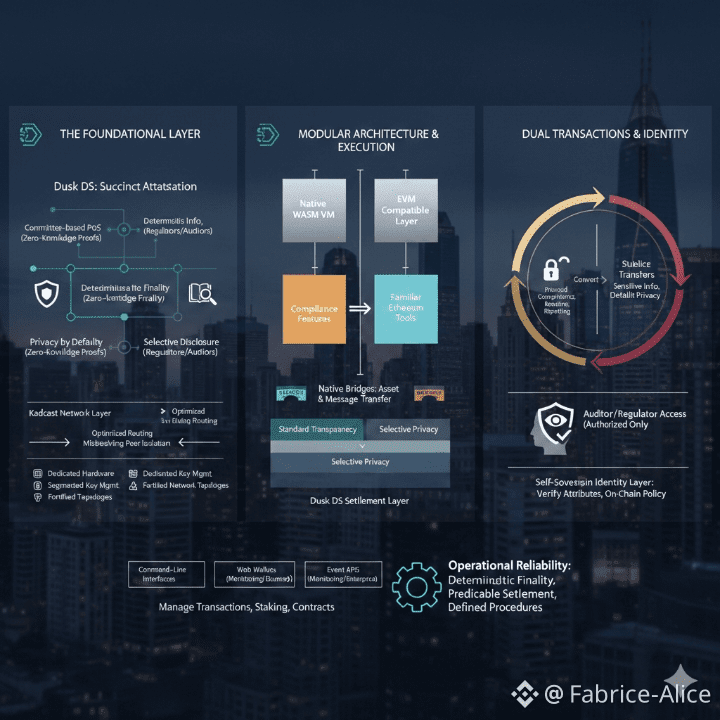
Dusk employs a dual transaction system reflecting the balance required in regulated finance. Public transfers provide full transparency, suitable for standard reporting or routine oversight, while shielded transfers protect sensitive information by default. Users can convert between these modes as necessary, and auditors or regulators gain access to shielded data only when authorized. By embedding these capabilities at the protocol level, Dusk resolves the typical tension between confidentiality and compliance. Additionally, a self-sovereign identity layer allows users to verify attributes like accreditation or eligibility without revealing full identity details. This enables on-chain policy enforcement, ensuring compliance while maintaining individual privacy.
The platform also emphasizes operational reliability through developer and operator tools. Command-line interfaces and web wallets allow both everyday users and professional operators to manage transactions, staking, and contract interactions while adhering to privacy defaults. Event APIs provide integration with monitoring and enterprise systems, offering insight into network state without compromising the confidentiality of shielded transactions. While less glamorous, these operational features are critical for institutional adoption. Deterministic finality, predictable settlement, and clearly defined operational procedures create the practical reliability necessary for regulated deployments.
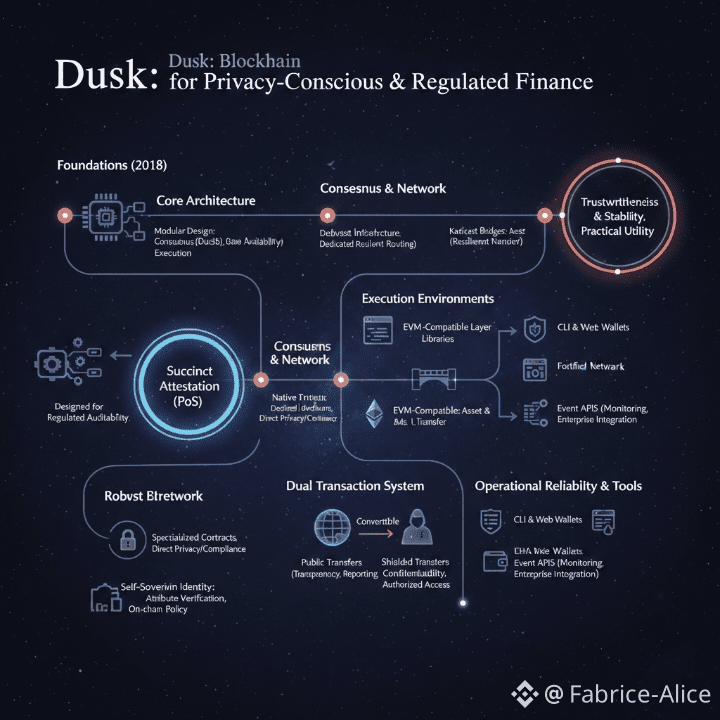
Ultimately, Dusk embodies a design philosophy focused on practical utility over novelty. The platform embraces the complexity of dual transaction modes, privacy primitives, and layered execution environments because these features meet the concrete needs of regulated participants. Every aspect—from the consensus protocol to wallet interfaces—is guided by considerations of compliance, auditability, and infrastructure resilience. Dusk is therefore not a blockchain designed to generate speculative attention; it is a carefully engineered system meant to operate in contexts where predictability, transparency, and privacy must coexist. Its architecture and operational guidance reflect the principle that in regulated finance, trustworthiness and stability are just as essential as any user-facing feature.
