

Established in 2018, Dusk positions itself as a layer-1 blockchain purpose-built for a specific and demanding use case: regulated financial infrastructure that requires strong privacy guarantees. This positioning is significant. It indicates that the platform is not aimed at open-ended experimentation, retail-driven speculation, or ideological decentralization for its own sake. Instead, it targets environments where systems must endure audits, comply with legal frameworks, and perform reliably under operational pressure. Viewed through this lens, Dusk’s design choices become clearer. The project emphasizes control, predictability, and the reconciliation of privacy with institutional accountability rather than unrestricted flexibility or expressiveness.
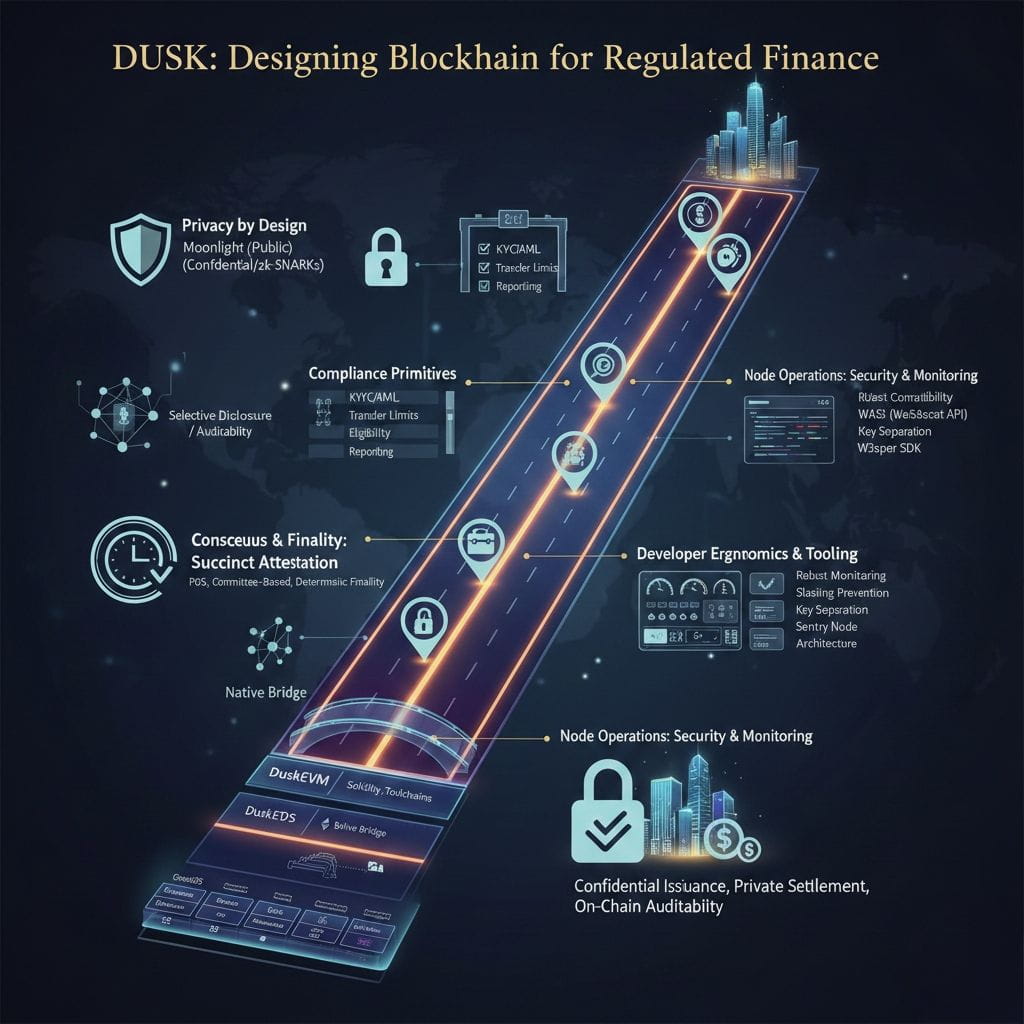
A foundational assumption behind Dusk is that financial infrastructure is inseparable from real-world constraints. Regulation, auditability, uptime expectations, deterministic settlement, and failure transparency are not peripheral concerns—they are central requirements. Dusk’s architecture reflects an effort to incorporate these realities directly into the protocol rather than pushing them off-chain. The blockchain is framed not as a substitute for institutional safeguards, but as a base layer where such safeguards can be formalized, enforced, and examined with greater rigor.
This mindset is evident in the system’s modular architecture. By clearly separating consensus and settlement from execution environments, Dusk contains complexity and limits its potential impact. The core layer handles finality, data availability, and cryptographic validation, while execution layers can evolve independently to meet varying application needs. While this does not eliminate complexity, it renders it more transparent. For operators, auditors, and infrastructure teams, such clarity makes it easier to identify responsibilities, understand guarantees, and locate potential points of failure or misconfiguration.
Dusk’s approach to finality further underscores its institutional orientation. Rather than relying on probabilistic settlement, the protocol prioritizes deterministic finality: once a transaction is confirmed, it is not expected to be undone. This choice has meaningful implications for regulated finance. Chain reorganizations complicate accounting, reconciliation, and legal ownership. By constraining this behavior at the protocol level, Dusk reduces uncertainty and downstream operational burden. The trade-off is stricter expectations for consensus participants, who must maintain reliable uptime and robust key management. Responsibility is thus concentrated among infrastructure operators, but the result is a system whose behavior is easier to predict and reason about.
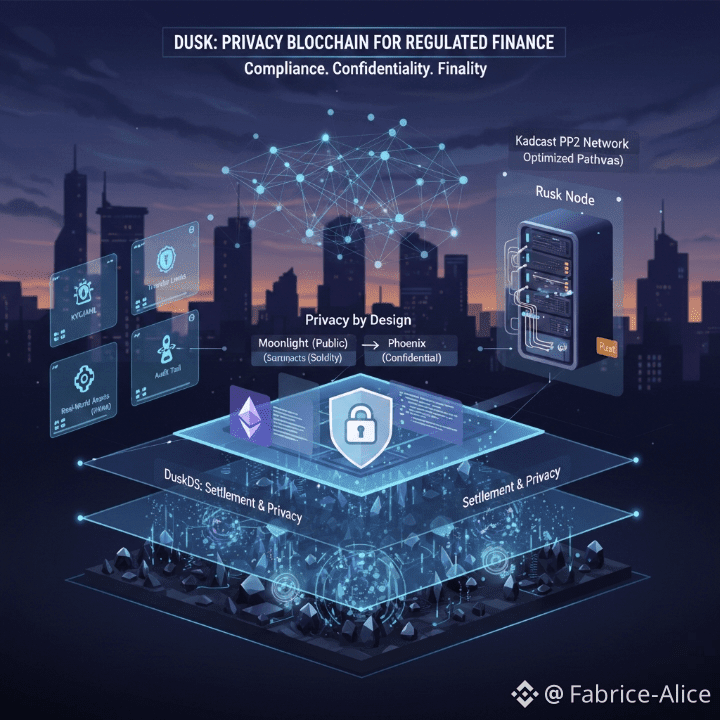
Privacy is treated as a core feature rather than an add-on. Confidentiality is embedded directly into the transaction model, alongside mechanisms that allow selective disclosure when required. This balance is critical. Transactions can remain private by default, yet still generate verifiable proofs for audits, investigations, or regulatory compliance. Instead of presenting privacy and transparency as mutually exclusive, Dusk treats them as adjustable parameters. In regulated settings, this flexibility is often more practical than either complete opacity or total public visibility, allowing sensitive activity to remain protected without undermining accountability.
From a compliance standpoint, Dusk’s emphasis on on-chain rule enforcement stands out. Constraints such as eligibility requirements, permissioning, and transactional limits can be encoded directly into asset logic. This reduces dependence on off-chain controls and manual processes. While governance and legal interpretation remain necessary, enforcement shifts closer to the protocol itself. For compliance teams, this reframes audits: the question becomes less about whether rules were followed and more about whether they were correctly implemented. Though still challenging, this approach offers determinism, inspectability, and testability.
Operational considerations, while less prominent, are equally important. Decisions around a structured peer-to-peer network, along with explicit guidance on monitoring, alerting, and node security, reflect an understanding of how systems fail in practice. Issues like bandwidth limitations, node downtime, firewall misconfigurations, and delayed alerts are common in real-world deployments. By addressing these concerns directly in both design and documentation, Dusk acknowledges that reliability depends as much on disciplined operations as on cryptographic soundness or consensus mechanisms. This operational realism aligns well with institutional expectations around service levels and incident response.
Developer experience is approached pragmatically rather than idealistically. Support for familiar execution environments and standard tooling lowers adoption friction, while native privacy and verification primitives reduce the need for complex off-chain coordination. This balance suggests awareness of institutional constraints such as limited engineering resources, risk sensitivity, and time pressures. Even theoretically superior systems struggle to gain traction if they require entirely new mental models or highly specialized tooling.
Taken together, these choices do not point toward maximal decentralization or radical transparency. Instead, they outline a system tuned for environments where trust is procedural and accountability is non-negotiable. Dusk does not attempt to eliminate intermediaries outright; rather, it reorganizes how trust, verification, and privacy are distributed across the infrastructure. Its attention to pragmatic details—deterministic behavior, operational monitoring, and clearly defined responsibilities—reflects an understanding that such factors often determine real-world viability.
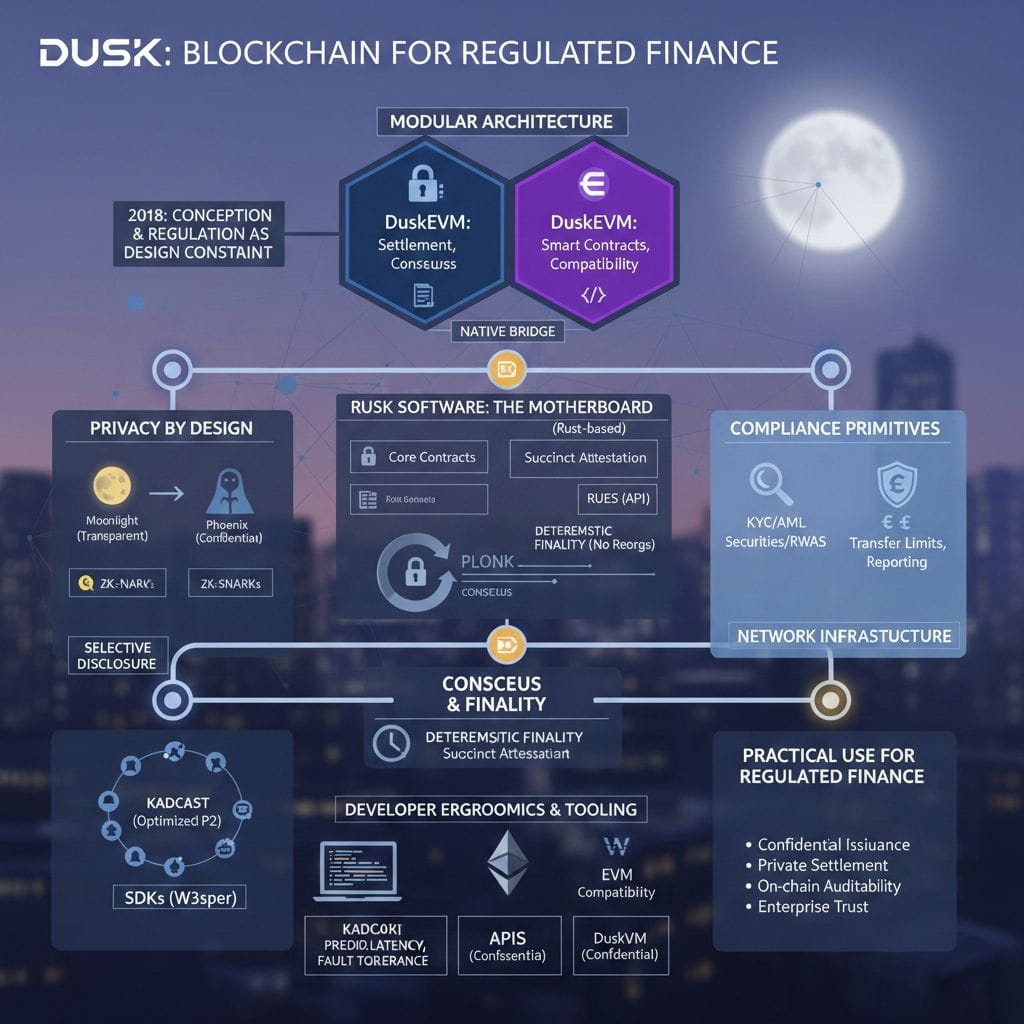
Viewed this way, Dusk reads less like a disruptive manifesto and more like a study in institutional pragmatism. Its architecture accepts the persistence of regulation, audits, and oversight, treating the blockchain not as an escape from these forces but as a mechanism to encode them more precisely and enforce them more consistently. Whether this strategy ultimately succeeds will depend on execution, governance, and long-term reliability. What is clear, however, is that Dusk is designed to meet finance as it exists in practice, not merely as it is imagined.
