In most Web3 systems today, data is treated like a background tool. Apps upload files, store them somewhere, and move on. The data itself doesn’t really matter after that. All the value is created at the app level, while the data just sits there doing nothing.
Walrus changes this way of thinking.
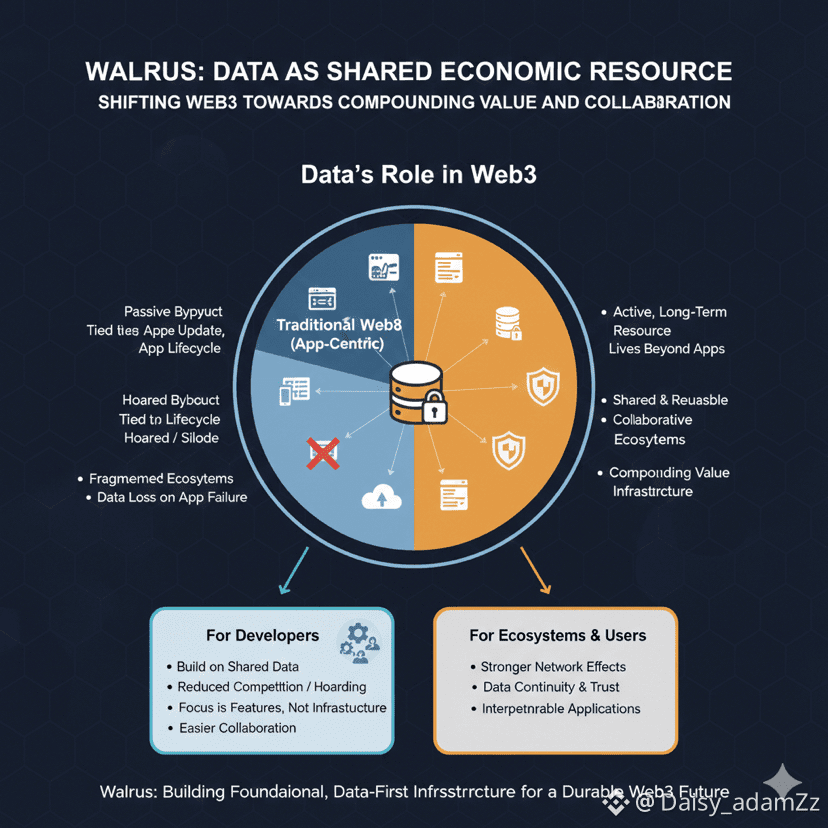
Instead of seeing data as something temporary or disposable, Walrus treats data as a long-term resource. On Walrus, data is meant to live beyond a single app, a single team, or a single use case. It can be referenced, reused, and built on by many applications over time.
This may sound simple, but it has big implications.
On Walrus, data is not just uploaded and forgotten. Once it exists, it can become part of a larger ecosystem. Different apps can point to the same data, use it in different ways, and even improve it. This means data can create value again and again, instead of being locked inside one product.
This approach encourages a healthier model for developers. Today, many apps compete by hoarding data. Whoever controls the data controls the value. Walrus flips that idea. Developers can still build unique products, but they don’t need to trap data inside their own system to do it.
With Walrus, data can exist independently, with clear rules about how it can be accessed or extended. This allows collaboration without chaos. Apps can share data without losing control, and users don’t lose their information just because one app shuts down.
For ecosystems, this creates strong network effects. When many apps rely on the same underlying data, improvements made by one app benefit others. If data quality improves in one place, the whole ecosystem becomes better. Instead of fragmentation, you get compounding value.
Another important part of Walrus is long-term data stewardship. In Web3 today, a lot of data disappears when projects fail or lose interest. That creates waste. The same data gets recreated again and again because there is no durable place for it to live.
Walrus solves this by separating data from applications. Even if an app changes direction or stops operating, the data can remain useful. Other developers can still reference it. This makes decentralized systems more efficient and less fragile.
From a bigger picture, Walrus turns data into a real digital asset. Not something you trade like a token, but something that holds long-term usefulness. Over time, ecosystems built on shared datasets can grow deeper and stronger than systems where every app starts from zero.
This is how real digital economies form. Not through isolated apps competing for attention, but through shared infrastructure that everyone can build on. Roads, electricity, and the internet worked this way. Walrus applies the same idea to data.
Walrus is not just a storage solution. It is a shift in how Web3 thinks about information. Data is no longer a passive byproduct. It becomes an active part of the ecosystem, contributing value over time.
If Web3 wants to move beyond short-lived apps and experiments, shared data infrastructure is necessary. Walrus is laying the groundwork for that future, where data compounds, collaboration is easier, and ecosystems grow stronger instead of more fragmented.
That’s what makes Walrus important. It’s not flashy, but it’s foundational.