

Artificial intelligence did not arrive quietly. It reshaped interfaces, workflows, and expectations almost overnight. Systems that once required human input began to act, decide, and adapt on their own. Yet when AI met blockchain infrastructure, something felt off. The tools that promised decentralization, trustlessness, and automation suddenly looked rigid, slow, and mismatched with how intelligent systems actually behave.
This gap is not accidental. Most blockchains were never designed with AI in mind. They were built for transactions, not cognition. They optimize for throughput, not memory. They assume humans at the edges, not autonomous agents operating continuously. As a result, AI has been bolted on as an add-on rather than woven in as a foundational element.
This is the core problem @Vanar sets out to address. To understand why VANAR’s approach matters, we first need to be honest about why so much of Web3 treats AI as an afterthought.
Blockchains Were Built for Humans, Not Autonomous Systems
The earliest blockchains were designed around a simple assumption: humans initiate actions, verify outcomes, and absorb complexity. Wallets required deliberate clicks. Transactions happened sporadically. State changes were discrete and intentional.
AI systems break that assumption completely.
An AI agent does not “log in.” It runs continuously. It does not tolerate ambiguous state. It depends on reliable memory, predictable execution, and clear settlement. It cannot pause every few seconds to calculate gas spikes or wait for human confirmation.
When AI is dropped into infrastructure designed for human pacing, friction appears immediately. Developers compensate with off-chain components, centralized controllers, or manual safeguards. Over time, the blockchain becomes a passive ledger while intelligence lives elsewhere.
That is what “AI-added” infrastructure looks like in practice.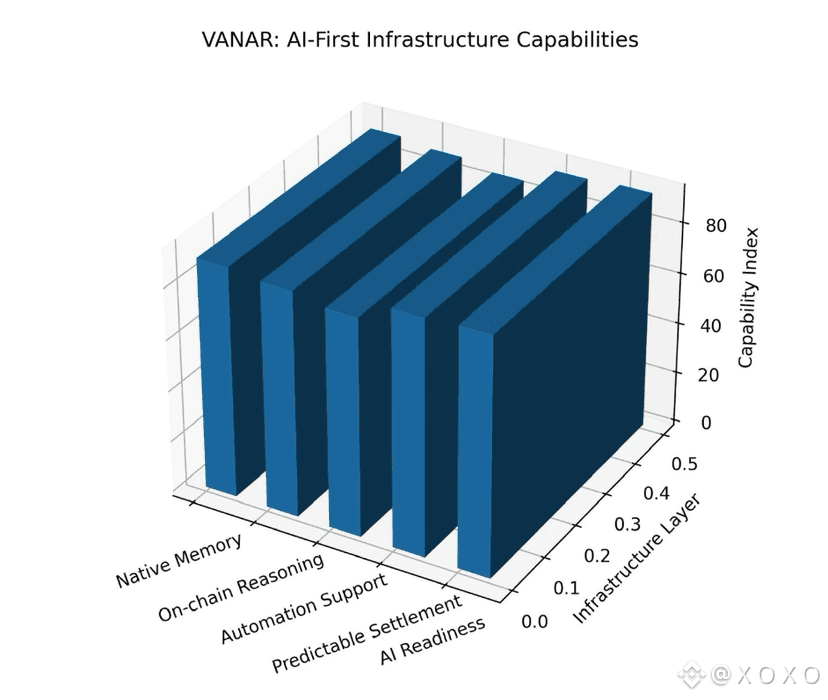
Why Retrofitting AI Rarely Works
Most chains respond to AI demand by adding features. New SDKs. AI-friendly marketing. Occasional partnerships. Yet the underlying architecture remains unchanged.
This creates several structural failures.
First, memory is externalized. AI systems require persistent, verifiable memory. When that memory lives off-chain, the blockchain loses relevance in decision-making. It becomes an execution endpoint rather than a source of truth.
Second, reasoning becomes opaque. If logic is executed off-chain, it cannot be audited, explained, or trusted at the infrastructure level. The chain records outcomes, not intent.
Third, automation becomes fragile. Autonomous systems interacting with volatile fee markets and unpredictable settlement layers are forced to throttle themselves or rely on centralized schedulers.
These are not surface-level issues. They stem from the fact that most blockchains were optimized for a different era.
The TPS Obsession Misses the Point
For years, blockchain performance discussions revolved around throughput. More TPS meant more adoption. Faster blocks meant better UX. This made sense when blockchains were competing with payment networks.
AI systems change the metric entirely.
An AI agent does not need thousands of transactions per second if it cannot rely on consistent execution. It needs determinism. It needs predictable cost. It needs state continuity.
High throughput without intelligence-aware design leads to brittle systems. AI agents either slow themselves down or move critical logic off-chain. The chain becomes fast, but irrelevant.
This is why raw speed is no longer the defining metric for next-generation infrastructure.
AI Needs Native Memory, Not External Databases
Memory is not optional for AI. It is foundational. Without memory, an AI system is stateless. It cannot learn from past actions. It cannot reason over history. It cannot explain itself.
Most blockchains treat storage as archival rather than operational. Data is stored, but not structured for reasoning. Retrieval is expensive. Context is fragmented.
As a result, AI developers default to traditional databases for memory and use blockchains only for settlement. This splits intelligence from trust.
VANAR challenges this separation by treating memory as a first-class primitive rather than a byproduct of transactions.
Why “AI-Ready” Is Often a Misleading Label
Many projects claim to be AI-ready. What they usually mean is that AI can interact with them. That is a low bar.
True AI readiness means infrastructure can support:
Continuous execution
Verifiable reasoning
Persistent memory
Automated settlement
Predictable cost structures
If any one of these is missing, AI systems must compensate externally. Over time, the blockchain fades into the background.
VANAR’s thesis is simple: AI readiness cannot be layered on. It must be designed in.
The Cost of Treating AI as a Feature
When AI is treated as a feature, it inherits the limitations of the system it sits on. It becomes a demo rather than infrastructure.
This is why many AI-crypto integrations feel shallow. Chatbots that sign transactions. Agents that trigger swaps. These are useful experiments, but they do not scale into autonomous economies.
Real AI systems operate without supervision. They interact with markets, users, and other agents continuously. They require rails that do not degrade under repetition.
Treating AI as an afterthought guarantees that it will remain peripheral.
VANAR’s AI-First Philosophy
VANAR starts from a different premise. Instead of asking how AI can use blockchain, it asks how blockchain must change to support AI.
This shift affects everything.
Execution is designed for automation, not human timing. Memory is structured for retrieval and reasoning, not just storage. Settlement is treated as a primitive, not a plugin.
AI is not an app on VANAR. It is a design constraint. 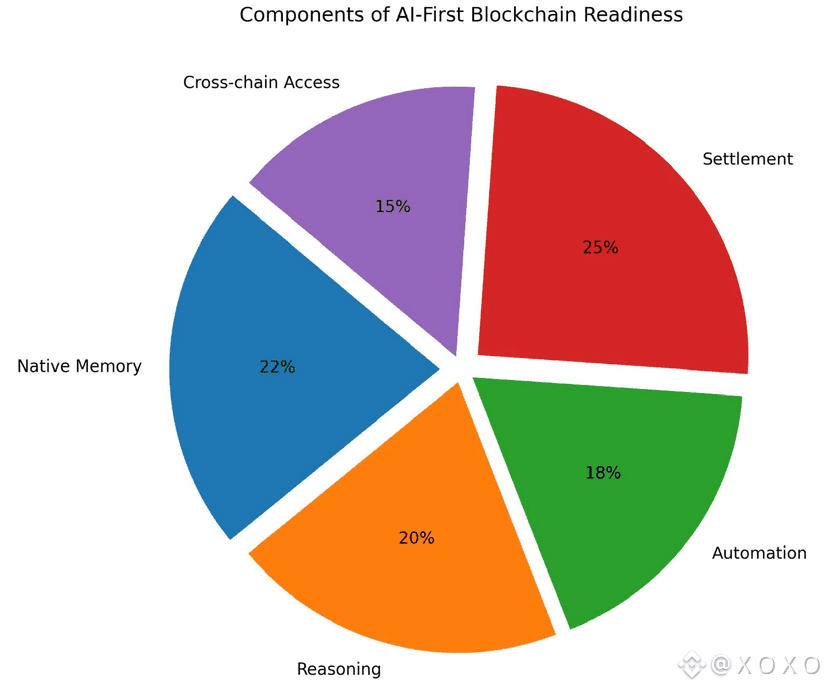
Why Payments Matter More Than Demos
One of the most overlooked aspects of AI infrastructure is payments. Autonomous systems cannot rely on traditional wallet UX. They need programmatic settlement, compliance-aware rails, and predictable execution.
Most chains treat payments as an application layer concern. VANAR treats them as infrastructure.
This matters because AI agents operate in real economies. They pay for services. They compensate other agents. They settle obligations without human oversight.
Without native payment support, AI systems remain theoretical.
The Problem With Isolated AI Chains
Some projects attempt to solve AI readiness by launching new, isolated chains. This introduces a different problem: distribution.
AI systems do not live in a vacuum. They interact with users, liquidity, and applications across ecosystems. Isolation limits adoption and relevance.
VANAR addresses this by designing for cross-chain availability from the outset. AI-first does not mean siloed. It means interoperable without sacrificing design principles.
From Narratives to Readiness
Crypto narratives move quickly. AI is the current headline. But narratives do not build infrastructure. Readiness does.
Infrastructure that survives hype cycles is infrastructure that works quietly. It handles edge cases. It supports real usage. It compounds value slowly.
VANAR positions itself around readiness rather than slogans. Its products exist to prove design choices, not to advertise them.
Why Most Blockchains Struggle to Catch Up
Could existing chains adapt? In theory, yes. In practice, architectural inertia is powerful.
Changing execution models, storage assumptions, and settlement logic is difficult once ecosystems are live. Backward compatibility becomes a constraint. Governance slows change. Incentives misalign.
This is why AI-first infrastructure is unlikely to emerge from retrofitting alone.
The Long-Term View
AI is not a feature cycle. It is a structural shift. Systems that cannot support autonomy, memory, and reasoning will become peripheral over time.
Blockchains that treat AI as an afterthought may remain useful for transactions, but they will not anchor intelligent economies.
VANAR’s approach recognizes this early. By designing for AI from the ground up, it aims to support systems that act, learn, and settle continuously.
Closing Perspective
The mismatch between AI and existing blockchains is not a failure of ambition. It is a consequence of history. Most chains were built for a different world.
As AI moves from tools to agents, infrastructure must evolve. That evolution cannot happen through marketing or marginal upgrades. It requires a shift in mindset.
VANAR represents that shift. Not by adding AI on top, but by rebuilding assumptions underneath.
In the long run, the blockchains that matter will not be the ones that talk about AI the loudest. They will be the ones that quietly make autonomy possible.