

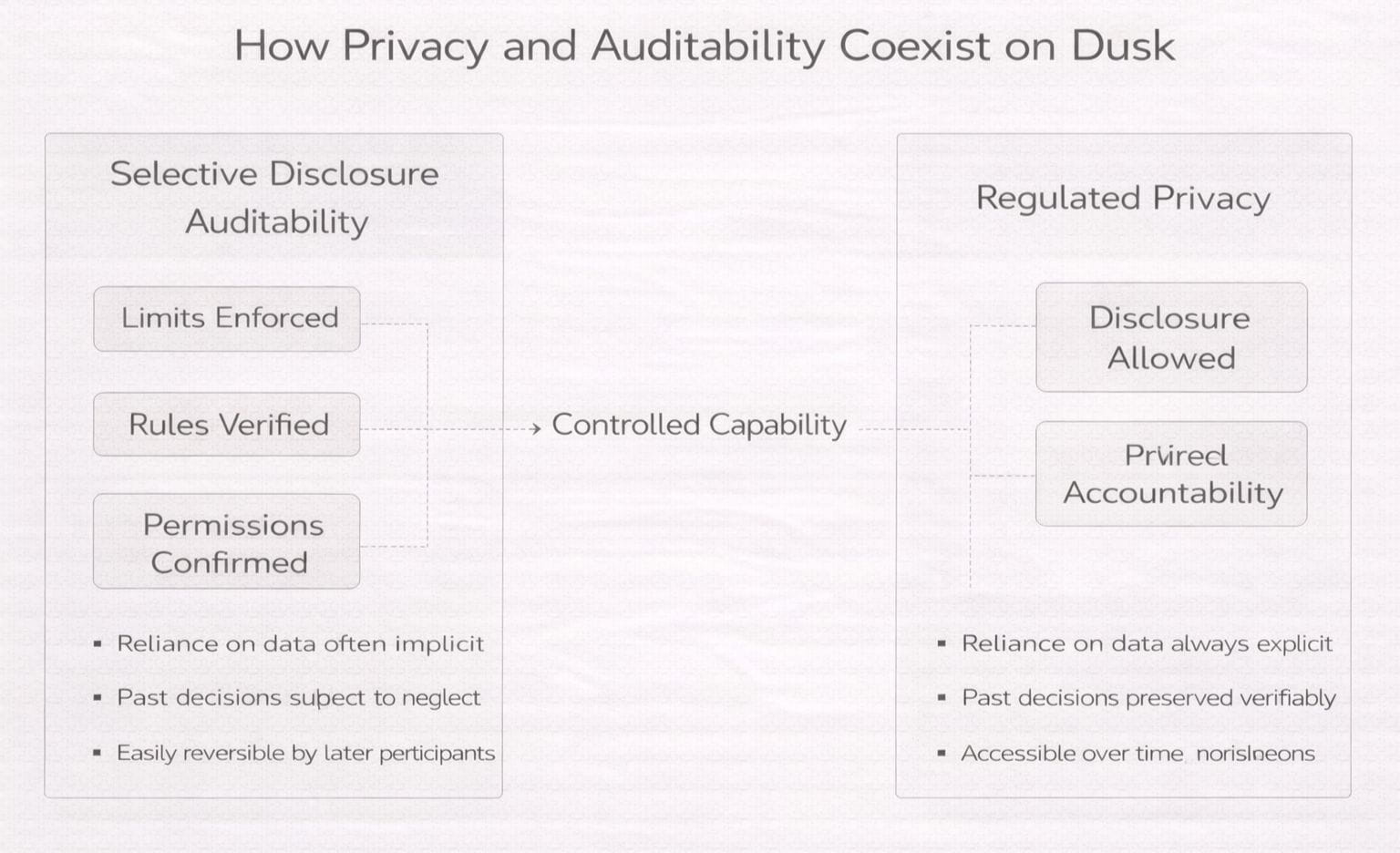
 Privacy and auditability are usually framed as opposites. One hides information. The other demands visibility. Most blockchains choose a side and accept the trade-off. Either everything is public and auditable by default, or everything is hidden and trusted off-chain. Dusk Network exists because this framing is wrong. In real financial systems, there has always been a coexistence of privacy and auditability just not through radical transparency.
Traditional markets also do not broadcast every transaction to the world. They keep sensitive data private but permit regulators, auditors, and courts to verify that they are in compliance. In essence, this means that the critical element is not transparency but selective verifiability. Dusk brings this principle on-chain by treating privacy as the default state and auditability as a controlled capability, rather than a global condition.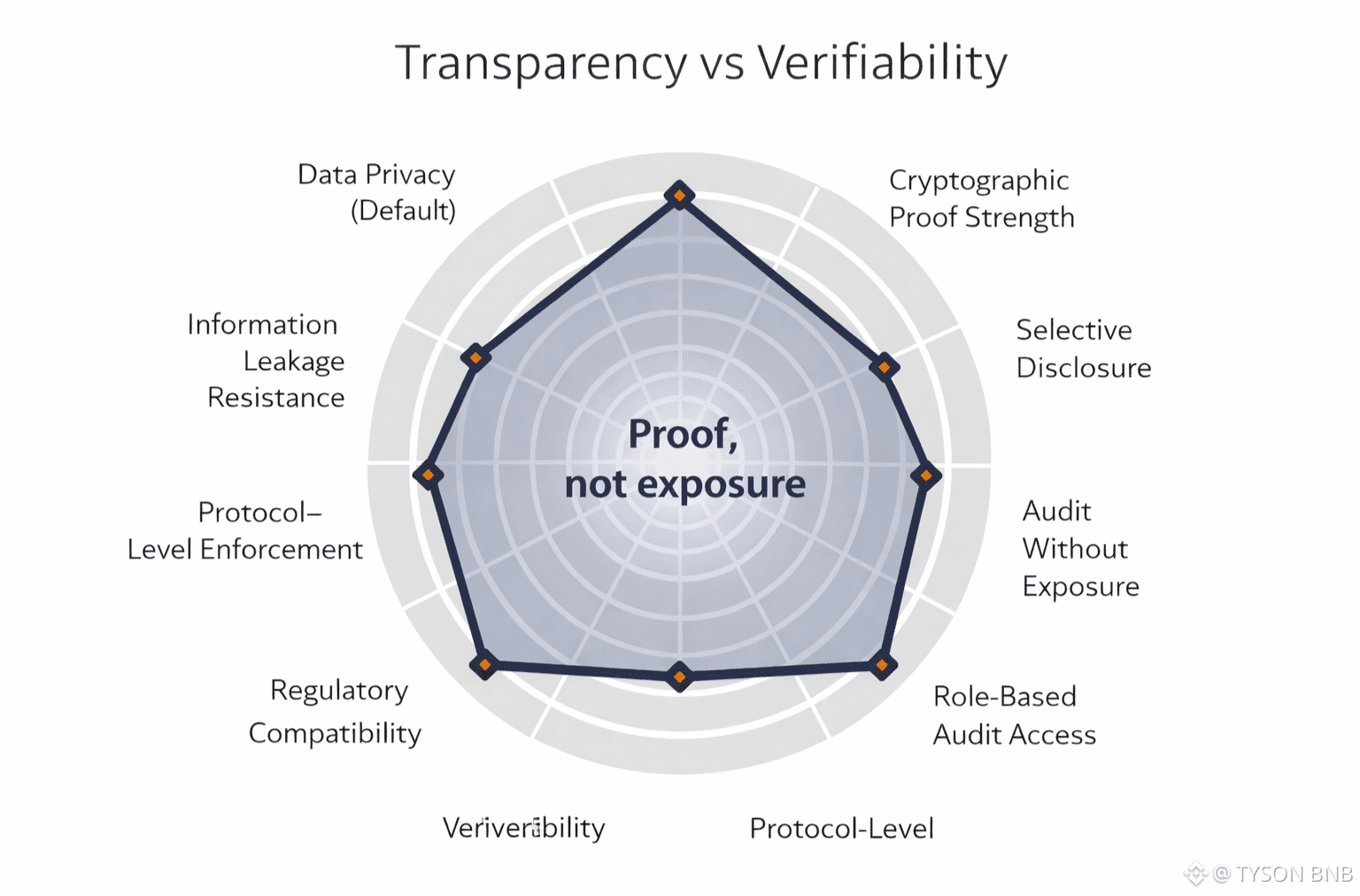
The mistake many blockchains make is assuming that auditability requires exposure. In practice, auditability requires proof. What matters is not who can see the data, but who can verify that rules were followed. Dusk separates these concerns at the protocol level. Transactions can remain confidential while still producing cryptographic evidence that constraints, limits, and permissions were respected.
This is where zero-knowledge systems stop being a privacy feature and become infrastructure. On Dusk, proofs are not cosmetic. They are how the system explains itself without revealing its internals. Compliance is demonstrated mathematically, not socially. Auditors do not need raw data; they need assurance that the system behaved correctly. Dusk is built to provide that assurance natively.
Another important distinction is who gets to audit. Public blockchains assume everyone is an auditor, all the time. Regulated systems do not work that way. Oversight is contextual, role-based, and legally scoped. Dusk reflects this reality by enabling disclosure without permanence. Access can be granted, exercised, and revoked without turning private data into public artifacts.
This design also reduces a quiet form of risk present on transparent chains: information leakage. Even when transactions are legal, exposing strategies, balances, or counterparties can create unfair advantages and systemic instability. Dusk treats this as a structural flaw, not a user mistake. Privacy protects markets from being gamed, while auditability protects them from being abused.
What makes this coexistence credible is that it is enforced at the base layer. Applications do not need to invent their own compliance logic or trust off-chain processes. The protocol itself defines how privacy is preserved and how verification is performed. This removes ambiguity and shifts responsibility away from individual developers.
Privacy and auditability coexist on Dusk because they are not implemented as competing features. They are implemented as complementary guarantees. One protects participants. The other protects the system. When financial infrastructure accepts that distinction, it no longer has to choose between secrecy and trust. It can support both without compromise.