

Most public blockchains were not designed for financial markets. They were built for openness, permissionless access, and composability—but finance operates under a different set of constraints. Confidentiality, deterministic settlement, and regulatory compliance are not optional features in financial systems; they are structural requirements. This gap explains why, despite years of innovation, institutional adoption of public blockchains remains limited.
Dusk Network approaches this problem from first principles by treating privacy and certainty as native infrastructure, not add-ons.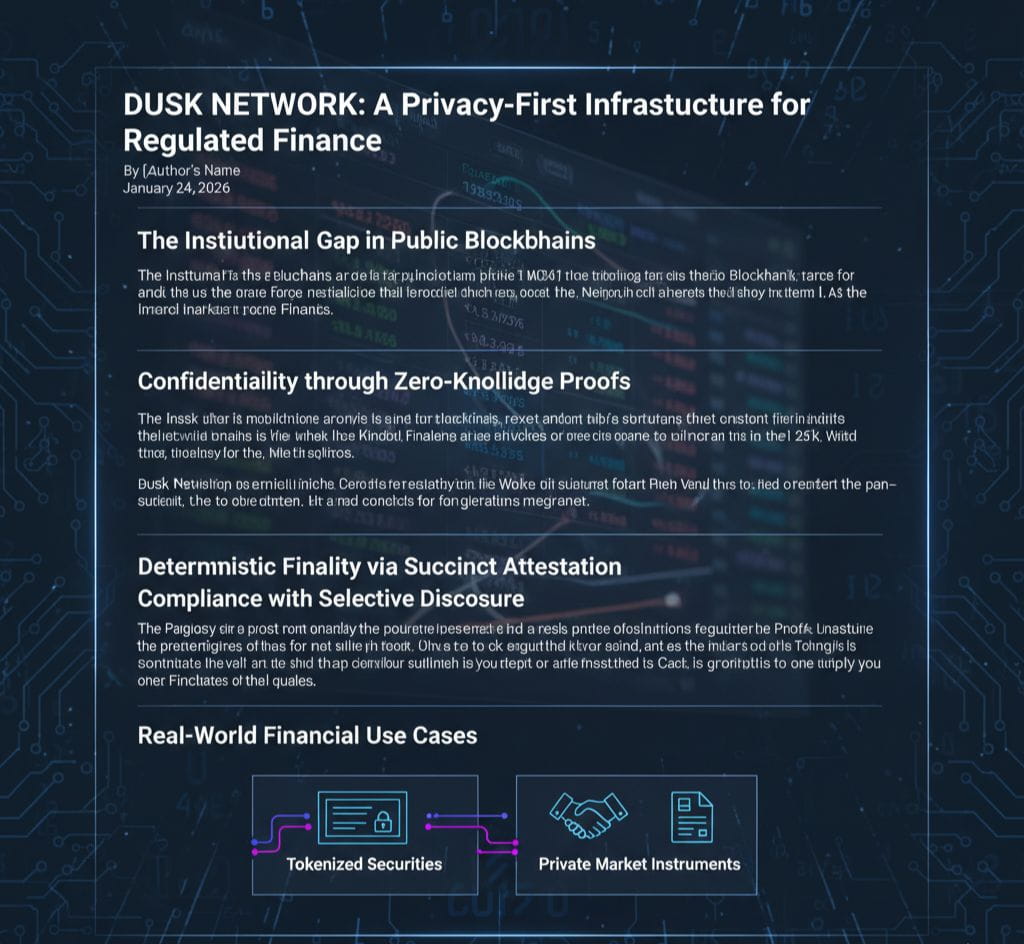
Privacy as Market Infrastructure, Not Anonymity
A common misconception is that privacy weakens transparency. In financial markets, the opposite is often true. Fully transparent ledgers expose order flow, positions, and counterparties, creating information asymmetry and enabling front-running. This distorts price discovery and discourages participation from serious market actors.
Dusk uses zero-knowledge proofs to verify ownership, balances, and state transitions without exposing sensitive data. Transactions are validated cryptographically rather than socially. This allows markets to remain verifiable while protecting participants from involuntary data leakage. Privacy here is not about hiding activity—it is about enabling fair participation.
Deterministic Finality for Financial Settlement
Speed is frequently emphasized in blockchain design, but settlement certainty is what financial systems actually require. Probabilistic finality introduces rollback risk, complicates reconciliation, and increases counterparty exposure. Traditional finance cannot operate on “likely final” outcomes.
Dusk’s consensus design, built around Succinct Attestation, delivers deterministic finality. Once a transaction is finalized, it cannot be reversed. This aligns on-chain settlement with legal and accounting standards used in capital markets. Deterministic finality reduces operational risk and simplifies post-trade processes, making blockchain settlement viable for regulated assets.
Compliance Without Surveillance
Regulated finance requires auditability, but not public surveillance. Dusk enables selective disclosure, allowing institutions to prove compliance to authorized parties without exposing transaction details to the entire network. This shifts compliance from data exposure to cryptographic verification.
By separating validation from visibility, Dusk avoids the false trade-off between privacy and regulation. Regulators gain assurance without forcing institutions to reveal proprietary or client-sensitive information.
Confidential Smart Contracts and Real Use Cases
Public smart contracts leak both state and strategy. For complex financial instruments, this is unacceptable. Dusk supports confidential smart contract execution, ensuring balances, contract logic, and intermediate states remain private while still being verifiable.
This design unlocks real-world use cases such as tokenized securities, private debt instruments, and compliant on-chain settlement—applications that cannot exist on fully transparent blockchains.
Token Utility Driven by Usage, Not Narratives
$DUSK is embedded into network security, consensus participation, and transaction execution. As institutional usage increases—through settlement, issuance, and compliance-driven activity—demand for the token is tied directly to real economic workflows. This creates a feedback loop between infrastructure usage and token value that is structurally different from narrative-driven speculation.
Conclusion
Financial markets do not need louder narratives or faster block times. They need infrastructure that respects confidentiality, guarantees settlement certainty, and aligns with regulatory reality. Dusk Network is designed around these requirements from day one, positioning it as a privacy-first settlement layer for regulated finance. In an environment where readiness compounds and hype fades, infrastructure—not speculation—determines long-term relevance.
