

@Plasma only really makes sense if you stop thinking about blockchains as places people go, and start thinking about them as places value passes through. Payment rails don’t get applause when they work. They get blamed when they don’t. That’s why Plasma’s obsession with stablecoin settlement feels less like a product pitch and more like a temperament: it keeps returning to the question of what happens when money needs to move and the people moving it don’t have the patience, the context, or the emotional bandwidth to “learn” anything first. The title says high-throughput, but the deeper promise is quieter than speed. It’s the promise that the system won’t demand attention at the exact moment a person has none to spare.
If you’ve lived close to real payments, you learn that most failures don’t look dramatic. They look like a screen that spins. A transfer that says “pending” long enough for someone to feel exposed. A fee that appears at the last second, turning a routine payment into a negotiation with the app. Plasma’s mainnet beta date was framed with unusual specificity—September 25, 2025 at 8:00 AM ET—because schedules matter when you’re trying to become infrastructure, not entertainment. The network paired that moment with the launch of its native token, XPL, and it didn’t talk about “growth” as an abstract idea. It talked about stablecoin liquidity as something that should be there immediately, like electricity when you flip a switch.
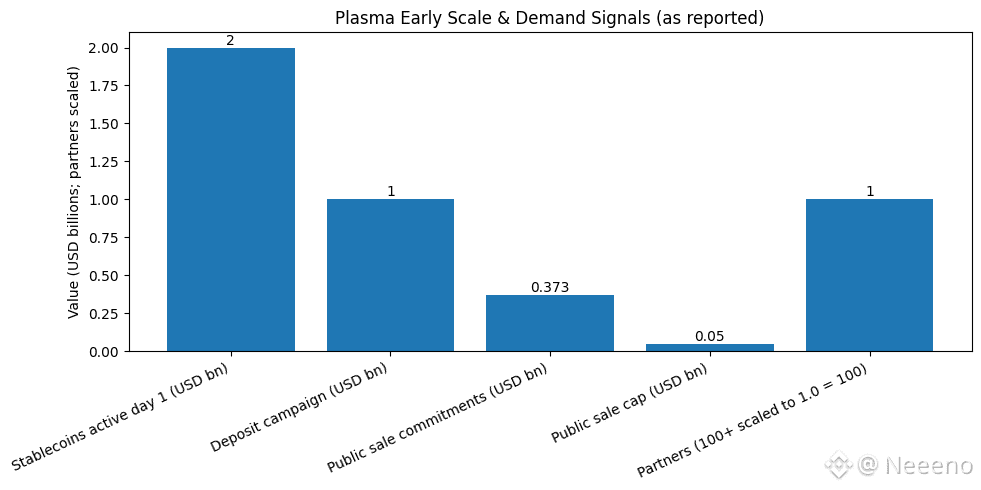
The early liquidity numbers weren’t subtle. Plasma said $2 billion in stablecoins would be active on day one, with capital deployed across more than 100 partners. But the number is less interesting than what it implies about intent. You don’t seed that kind of starting state if you’re optimizing for a nice demo. You do it if you’re trying to reduce the psychological cost of adoption. People trust what feels already in motion. They trust markets that don’t look empty. And they trust rails that don’t make them wonder whether they’ll be the first person to discover a hidden crack. Plasma’s own framing—that it would launch as a top stablecoin venue by liquidity—wasn’t just bravado. It was a recognition that payments are social: confidence spreads when the environment looks lived-in.
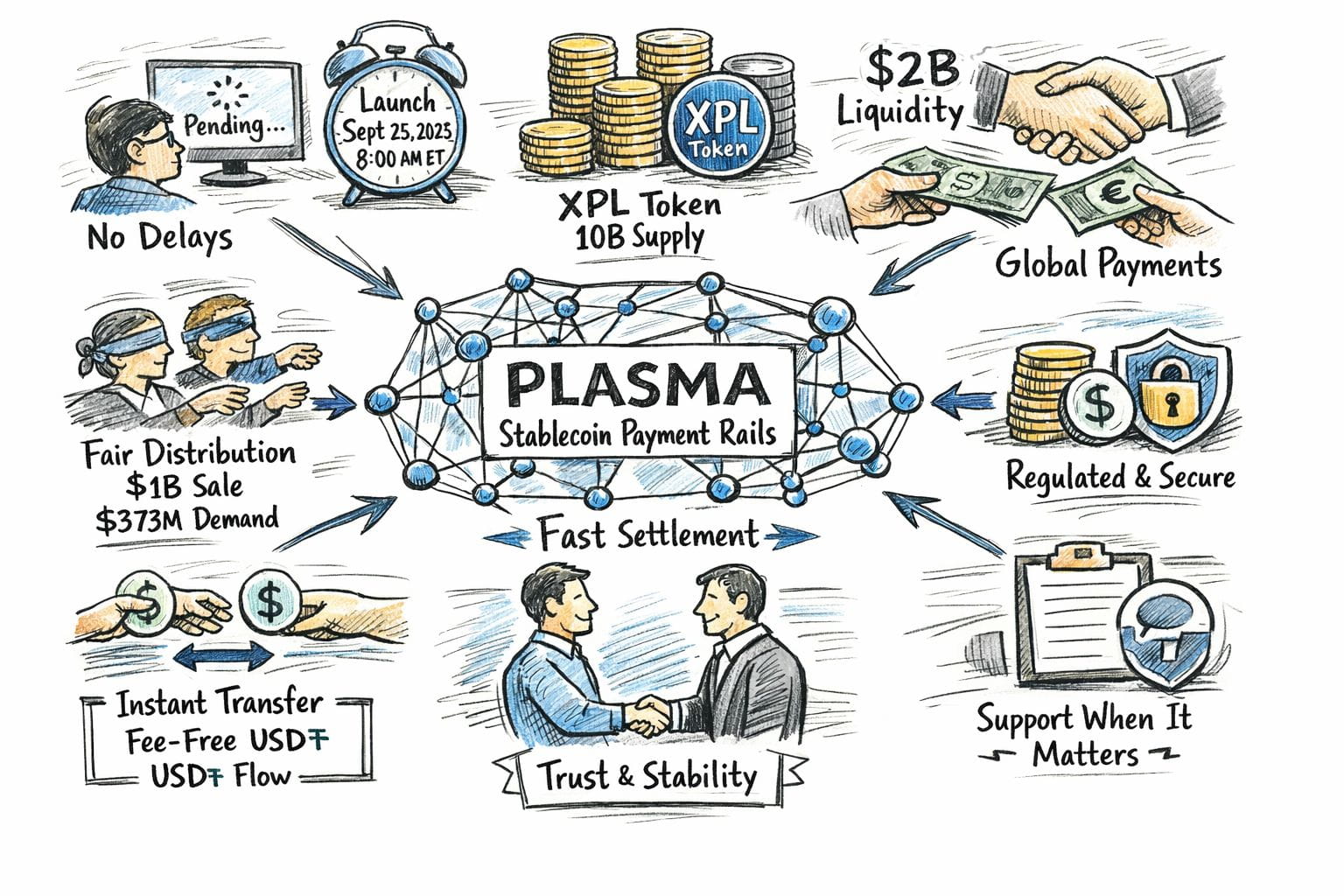
Where Plasma becomes emotionally legible is in how it treats the stablecoin itself as the main character. It’s built around USD₮ as a daily-use asset, not as an accessory you occasionally move between other priorities. That sounds obvious until you watch how often stablecoin users are asked to accept small frictions as normal: extra steps, extra balances, extra “just in case” behaviors that people develop to protect themselves from surprises. Plasma tries to remove those little protective rituals. The project openly described enabling fee-free USD₮ transfers through its own dashboard during rollout, then extending that experience outward over time. That’s a rollout strategy, yes, but it’s also a trust strategy: start in a controlled surface where failure is containable, then widen the promise only after it survives stress.
You can also see the same mindset in the way Plasma talked about its early access and sale mechanics. It described a deposit campaign where more than $1 billion was committed in just over 30 minutes, followed by a public sale that drew $373 million in commitments against a $50 million cap. Those aren’t just fundraising anecdotes. They’re signals about distribution and expectations. When a system is going to sit under people’s money movement, the first thing it inherits is suspicion: suspicion of insiders, suspicion of rigged access, suspicion that the “real” users show up later and pay the spread. Plasma’s public storytelling here was basically an argument that it wanted ownership to feel broad enough that the rail doesn’t psychologically belong to a single room.
And then there’s XPL, which is where incentives stop being philosophical and start becoming operational. Plasma’s docs anchor XPL’s initial supply at 10,000,000,000 tokens at mainnet beta launch, and the distribution is described in a way that reads like a plan for long-lived pressure rather than a short-lived celebration. Ten percent is allocated to the public sale, with an explicit difference in unlock treatment for U.S. purchasers—subject to a 12-month lockup with full unlock on July 28, 2026—versus non-U.S. purchasers who are fully unlocked at launch. That detail matters because it tells you Plasma expects to live in a world where legal categories and real user experiences collide, and it’s willing to encode that collision rather than pretend markets are frictionless.
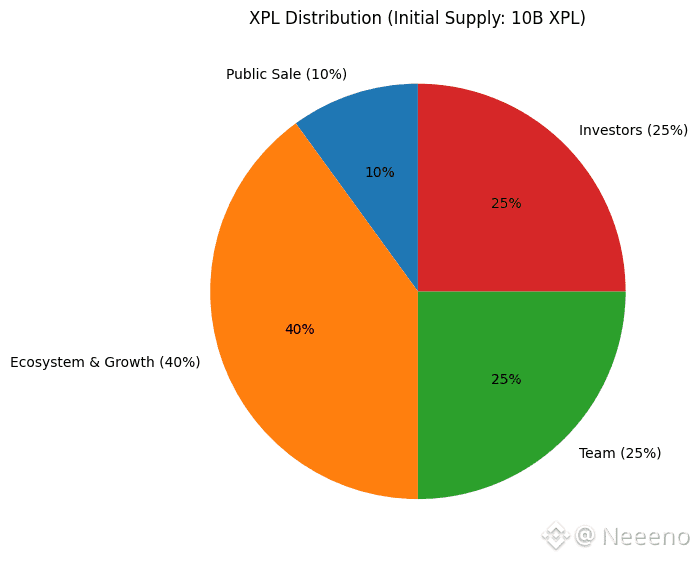
The rest of the allocation reads like the economics of a rail that wants to keep paying its own maintenance. Forty percent is set aside for ecosystem and growth, with 800,000,000 tokens immediately unlocked at mainnet beta for things like incentives, liquidity needs, and integrations, and the remainder unlocking monthly over three years. Another fifty percent is split between team and investors, with a one-year cliff and then monthly unlocks, reaching full unlock three years after launch. You can disagree with any one of these choices, but the shape of the story is clear: Plasma is trying to avoid a cliff-edge world where one dramatic unlock becomes the emotional weather for everyone using the chain. The steadier the release, the easier it is for a payment rail to feel like it has a future that won’t suddenly change its personality.
Of course, none of this matters if the rail can’t survive messy reality. Payments don’t fail only because of malicious actors. They fail because people mistype addresses, misunderstand interfaces, route funds to the wrong place, or act while distracted. They fail because different parties disagree about whether something “arrived,” especially across time zones, banking cutoffs, or customer support timelines. Plasma’s entire posture—fast settlement, predictable movement, and a user experience designed to feel closer to sending money than to “using a chain”—is basically a response to these human failure modes. When settlement becomes more predictable, conflicts become smaller. People spend less time arguing about what happened, and more time resolving what to do next.
What I find most revealing is that Plasma keeps tying itself back to regulated corridors and operational expansion, not just onchain activity. An example is the report that Plasma obtained a VASP license and opened an Amsterdam office as part of expanding stablecoin payments in the EU. Whether you see licensing as a moat, a constraint, or a risk, it’s a statement of intent: Plasma isn’t building for a world where the rail can stay socially anonymous. It’s building for a world where you’ll be asked, in plain language, what you are and how you operate. In payments, that question is never theoretical for long.
There’s also a subtle humility embedded in the way Plasma talked about limiting certain user experiences during stress testing and then widening them. That’s the opposite of the usual temptation to promise universality on day one. It’s closer to how serious infrastructure behaves: it scopes risk, watches reality, and expands only when the system has earned it. A lot of “blockchain reliability” talk collapses into performance claims. But reliability, as users feel it, is psychological. It’s the absence of dread when you hit send. It’s the sense that your money won’t become a support ticket. It’s the quiet confidence that you won’t have to explain to someone else why the system is asking for patience again.
Plasma’s story, in that light, is not really about throughput as a trophy. It’s about throughput as a way to reduce exposure. When settlement is slow, people become inventive in unhealthy ways: they split transfers, overpay fees, keep buffers everywhere, and build personal workarounds that eventually become systemic fragility. When settlement is fast and routine, behavior gets calmer. People stop trying to outsmart the rails. They just use them. That’s when a stablecoin starts to feel like money rather than a project.
And this is where I land on the responsibility part. Plasma launched its mainnet beta alongside XPL with a public, dated claim about starting scale and liquidity, and it backed that with explicit token allocation and unlock mechanics designed to fund growth while managing long-lived incentives. It’s also taken steps that point toward the regulated, operational world it says it wants to serve. None of that guarantees success. But it does place a kind of quiet burden on the system: if you choose to be payment rails, you’re choosing to be judged by your worst day, not your best demo.
In the end, the most honest compliment you can give infrastructure is that you stopped noticing it. The best payment rails don’t make users feel clever. They make users feel safe. Plasma’s direction—stablecoin-first settlement, a deliberately staged rollout of fee-free user flows, explicit liquidity seeding, and a token model that describes who gets what and when—reads like an attempt to earn that kind of invisibility. Quiet responsibility is a strange goal in a loud industry, but it’s the only goal that matters if you want people to trust the rails beneath their everyday life.
