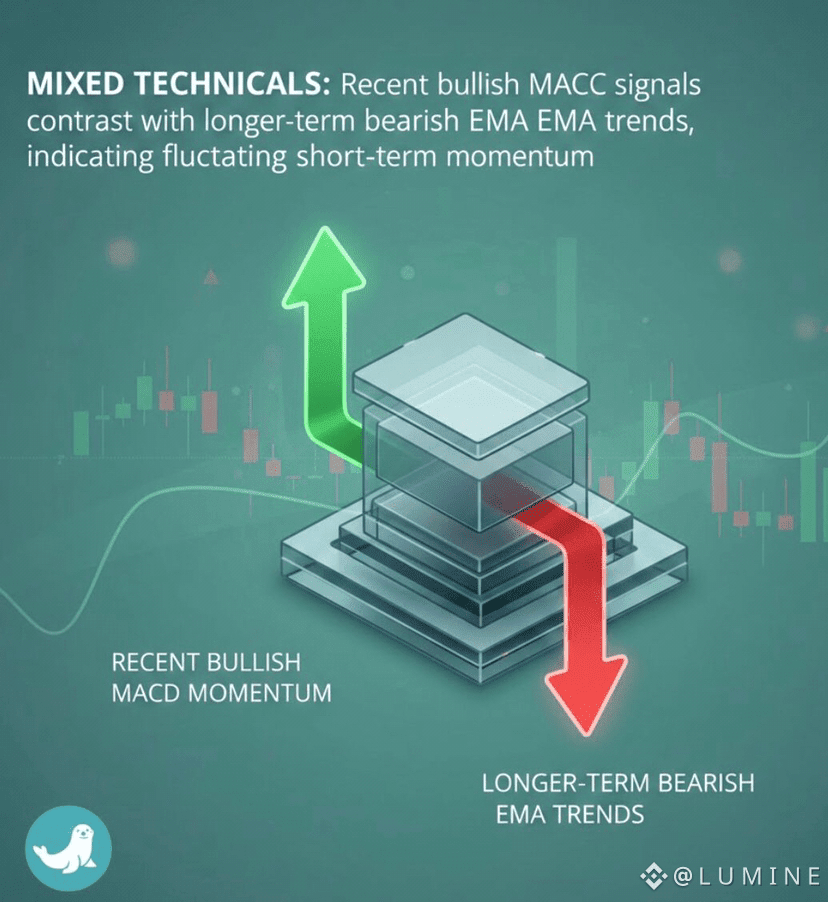
The Walrus market is currently sending traders a complex but fascinating message. Recent technical signals suggest a tug of war between short-term bullish momentum and longer-term bearish structure. This kind of mixed technical environment often precedes decisive moves, making Walrus a chart worth watching closely. Understanding how to interpret these conflicting indicators can be the difference between reacting emotionally and trading strategically.
In this analysis, we’ll break down what the bullish MACD signals really mean, why bearish EMA trends still matter, and how traders can position themselves intelligently during this phase of fluctuating momentum.
Understanding the Current Technical Landscape
Walrus is not moving in a clean, one-directional trend. Instead, price action reflects hesitation, recovery attempts, and underlying weakness all at once. This is a classic transition zone where markets reassess value after extended moves.
On one side, momentum indicators are flashing early signs of renewed buying interest. On the other, trend-following indicators continue to warn that the broader structure has not yet flipped bullish. Neither side should be ignored.
This environment favors disciplined traders who respect both momentum and trend context.
MACD Signals: Short-Term Momentum Turning Bullish
The Moving Average Convergence Divergence (MACD) is often one of the earliest indicators to reflect changes in momentum, and in Walrus’s case, it has recently turned constructive.
Bullish MACD Crossover
Walrus has printed a bullish MACD crossover, with the MACD line moving above the signal line. This typically suggests that bearish momentum is fading and buyers are starting to regain control, at least in the short term. These crossovers often precede relief rallies or short-term trend reversals.
Improving Histogram Strength
Adding further confidence, the MACD histogram has shifted into positive territory or is steadily rising toward it. This indicates increasing bullish momentum rather than a weak or false signal. When histogram bars expand upward, it reflects growing buying pressure behind price movement.
What This Means for Traders
Short-term traders often view this setup as an opportunity for tactical entries, especially if supported by volume or price reclaiming key intraday levels. However, MACD is a momentum tool, not a trend confirmation by itself. Its signals are strongest when aligned with broader structure, which is where caution becomes essential.
EMA Trends: The Bigger Picture Remains Bearish
While MACD suggests improving momentum, the Exponential Moving Averages (EMAs) paint a more conservative picture.
Price Below Key EMAs
Walrus price remains below its major EMAs, particularly medium- and long-term averages. This signals that the broader trend is still bearish or, at best, neutral. In technical analysis, EMAs act as dynamic resistance during downtrends, often rejecting price on attempted recoveries.
Bearish EMA Alignment
The EMA structure itself remains bearish, with shorter-term EMAs positioned below longer-term ones. This alignment indicates that downward pressure has dominated for an extended period, and the market has not yet done enough to reverse that structure.
Why EMAs Matter More for Trend Traders
EMA trends are slower to change than momentum indicators, but they are far more reliable for defining market regime. As long as Walrus trades below these averages, rallies should be treated as counter-trend moves rather than confirmed reversals.
The Meaning of This Divergence
When bullish MACD signals clash with bearish EMA trends, it usually means the market is in a consolidation or corrective phase rather than a full trend shift.
Short-Term Optimism vs Long-Term Caution
Short-term participants are stepping in, driving momentum higher, but long-term sellers have not yet been fully absorbed. This often results in choppy price action, sharp intraday swings, and false breakouts.
A Market Searching for Direction
Walrus is likely in a price discovery phase, where buyers and sellers are testing each other’s conviction. These periods are frustrating for impatient traders but extremely valuable for those who wait for confirmation.
Potential Scenarios Ahead for Walrus
Given the current technical setup, several scenarios are worth considering.
Bullish Continuation Scenario
If bullish MACD momentum persists and price manages to reclaim and hold above key EMAs, this would mark a meaningful shift in market structure. A successful EMA reclaim often turns former resistance into support, opening the door for trend continuation.
In this case, the current MACD signal would be remembered as the early warning of a larger reversal.
Range-Bound Consolidation Scenario
The more neutral outcome is sideways consolidation. Walrus could continue oscillating between support and EMA resistance, forming a base. This would allow EMAs to flatten and momentum indicators to reset, preparing the market for a more sustainable move later.
Bearish Rejection Scenario
If price fails to break above EMAs and MACD momentum weakens, Walrus could see another leg downward. In this case, the bullish MACD signal would be classified as a temporary relief bounce within a broader bearish trend.
How Smart Traders Approach This Setup
This is not a market for emotional decision-making. It rewards patience, structure, and adaptability.
For Short-Term Traders
Short-term traders may look to capitalize on MACD-driven momentum while keeping tight risk management. Quick reactions and clear invalidation levels are critical, as counter-trend trades can reverse quickly.
For Swing and Position Traders
Higher-timeframe traders are better served waiting for EMA confirmation. A clean break and hold above key EMAs, combined with sustained bullish momentum, would offer a higher-probability setup than trying to front-run a reversal.
Final Thoughts: Respect the Conflict, Trade the Confirmation
Walrus is currently at a technical crossroads. The bullish MACD signals show that buyers are waking up, but the bearish EMA trends remind us that the broader market structure has not yet changed. This conflict is not a weakness—it’s information.
Markets often give their best opportunities after periods of uncertainty, once momentum and trend finally align. Until then, Walrus demands discipline, patience, and respect for both sides of the chart.
In moments like this, the smartest move is not prediction, but preparation.